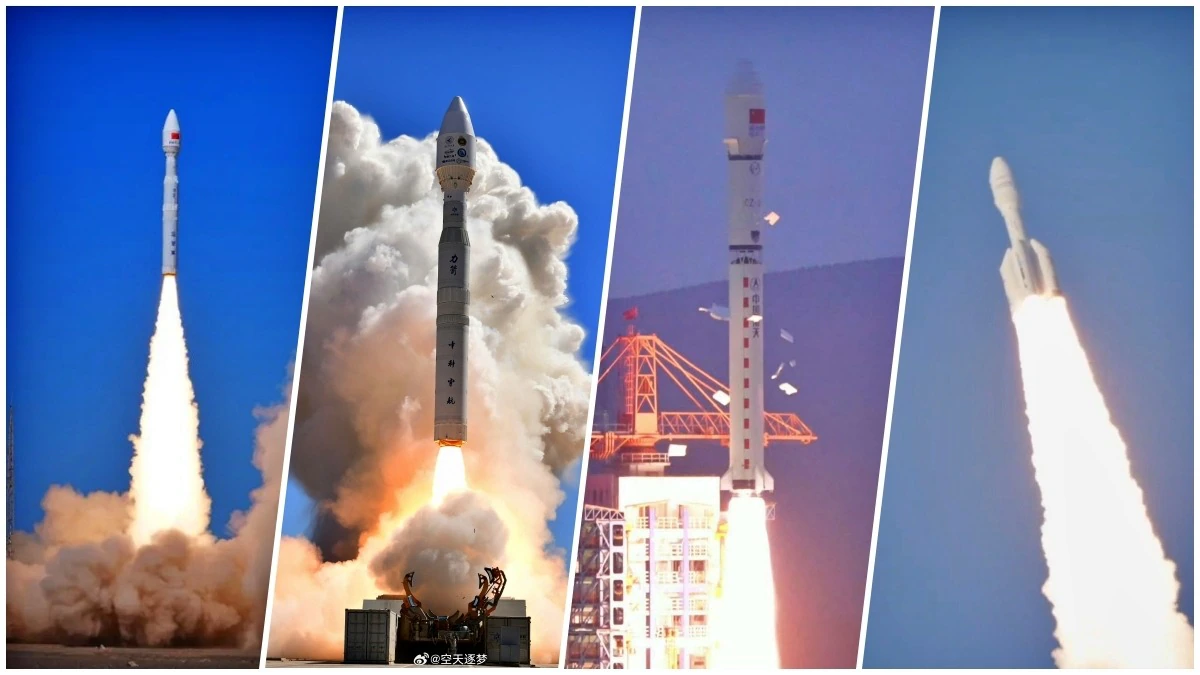
China has demonstrated a striking new capability in its space program by successfully launching four different orbital rockets within a roughly 45-hour window between September 15 and 16, 2026. This rapid-fire sequence, conducted from three separate launch sites, underscored the country’s accelerating efforts to deploy massive satellite constellations and highlighted the growing maturity of its commercial space sector alongside its established state-owned enterprises. The launches involved a diverse mix of vehicles from both private and state-backed organizations, with all four missions successfully delivering their payloads into orbit.
The launch marathon began on September 15 at the Jiuquan Satellite Launch Center in northwest China, where the private company LandSpace launched its Zhuque-2E rocket. This vehicle, notable for using liquid methane and liquid oxygen as propellants, carried 10 satellites for the Qianfan broadband megaconstellation. This mission was a landmark event, as it marked the first time a privately developed Chinese rocket had undertaken a large-scale deployment for a national satellite internet network, signaling a significant shift away from reliance solely on state-owned Long March vehicles. The Qianfan constellation, also known as “Thousand Sails,” is a massive project planned to eventually comprise approximately 15,000 satellites to provide global broadband connectivity.
Less than 16 hours later, the commercial firm Orienspace launched its Gravity-1 rocket from a mobile sea platform off the coast of Shanghai. This mission carried nine more Qianfan satellites into orbit. The Gravity-1 is a unique, solid-fuel rocket known for its almost comically squat and stubby profile, and it currently holds the title of the world’s most powerful solid-fuel rocket. Its sea-based launch demonstrated China’s growing proficiency in diverse launch methods, which offer greater flexibility and safety by allowing debris to fall into unpopulated waters. This flight set a Chinese record for payload mass and orbital altitude for a single sea launch.
The third launch occurred early on September 17, with the state-owned China Aerospace Science and Technology Corporation (CASC) launching a Long March 12 rocket from the Wenchang Space Launch Site on Hainan Island. This mission carried nine spacecraft for the SatNet program, another major state-backed broadband constellation that is planned to eventually include about 13,000 satellites. The Long March 12 is one of the newer additions to China’s launch vehicle fleet, and this flight represented the 667th launch involving a Long March rocket.
The rapid sequence concluded roughly two hours after the Long March 12, when a Kuaizhou-11 rocket lifted off from Jiuquan. Operated by a subsidiary of the state-owned China Aerospace Science and Industry Corporation (CASIC), this rocket carried two Earth-observing radar satellites for the Chinese company Spacety. This final mission added a commercial Earth observation component to the primarily constellation-building launch campaign.
The underlying reason for this intense launch cadence is the sheer scale of China’s planned low Earth orbit (LEO) broadband networks. Together, the Qianfan and SatNet constellations are envisioned to comprise nearly 28,000 satellites. Deploying such massive fleets requires an unprecedented launch tempo and a diverse array of vehicles. This campaign showcased that China is assembling a multi-faceted launch capacity, combining the resources of state-owned giants with the agility of private firms like LandSpace and Orienspace. The involvement of private companies in deploying satellites for national megaconstellations indicates they have moved beyond experimental flights to become integral operational partners.
While this 45-hour burst demonstrated impressive organizational and logistical capabilities, it also highlighted a key area where China’s launch sector is still evolving: reusability. None of the four rockets in this sequence attempted to land their first stages. This stands in contrast to the progress being made in the reusable rocket domain, where both LandSpace’s Zhuque-3 and CASC’s Long March 10B have successfully landed their first stages during orbital missions in recent months. However, no Chinese first stage has yet completed multiple orbital flights. Achieving operational reusability is seen as crucial for reducing launch costs by an estimated 40 to 60 percent, which will be essential for sustaining the high launch rates needed to build and maintain the planned satellite constellations.
The rapid launches also reflect a broader national strategy. In 2025, China conducted 92 space launch missions, a 35 percent increase compared with 2024, and it has planned an even more intensive schedule for 2026. This includes crewed missions, asteroid exploration with Tianwen-2, and flight verification tests of multiple reusable rockets. The construction of satellite internet systems is accelerating, with large-scale production lines for constellation deployment advancing rapidly. Furthermore, the launch infrastructure itself is expanding, with sea launch capabilities developing into a full industrial chain. China has completed 28 sea-based launches since 2019, sending 175 satellites into orbit with a 100 percent success rate.
In summary, China’s four rocket launches in 45 hours were not just a display of technical prowess but a calculated demonstration of its industrial capacity to build the infrastructure for a space-based internet. The successful combination of private innovation and state-backed resources, the use of diverse launch sites and vehicle types, and the focus on deploying massive satellite constellations all point to a strategic push to establish a dominant presence in low Earth orbit. While the sector continues to work toward the goal of fully reusable rockets, the sheer volume of launches planned and executed signals that China’s space program is entering a new phase of high-frequency, constellation-focused operations.