
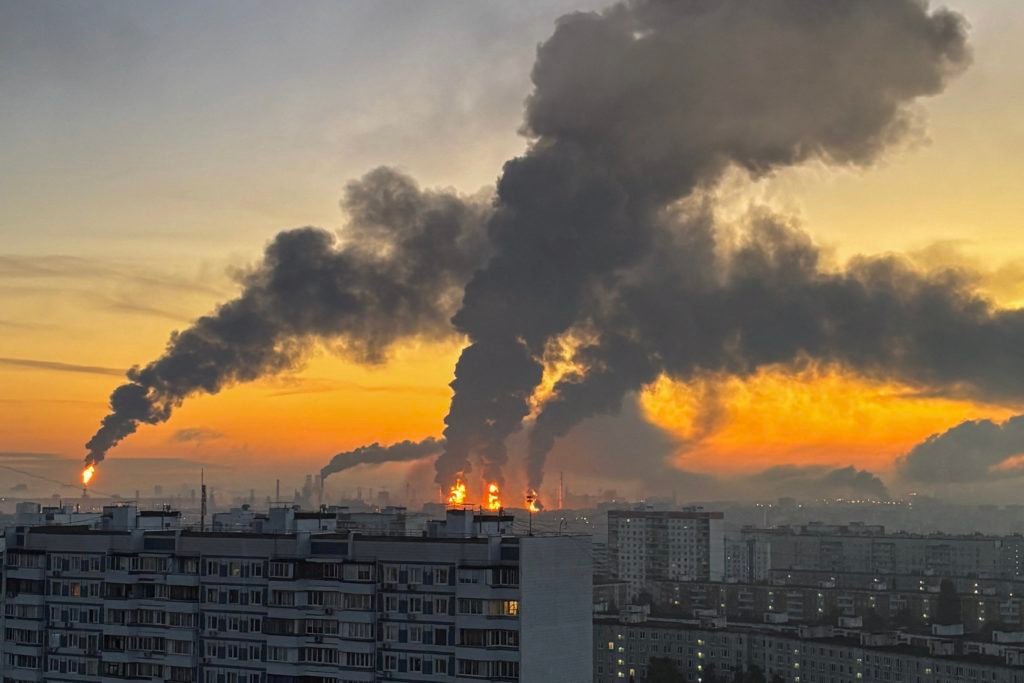
On the night of September 20, 2026, Ukraine launched one of the largest aerial assaults against Russia since the full-scale war began, firing more than 1,000 fixed-wing drones at targets across the country, with hundreds directed toward Moscow in what Russian officials described as the capital’s “largest ever” drone attack. The operation coincided with the final day of Russia’s parliamentary elections, a timing Ukrainian officials framed as a deliberate message that the war is reaching Russian soil.
The Russian Ministry of Defense reported that its air defenses intercepted and destroyed 1,110 Ukrainian drones overnight across at least 19 regions, including Belgorod, Bryansk, Kursk, Ryazan, Tula, Kaluga, Vladimir, Nizhny Novgorod, Tambov, Voronezh, Lipetsk, Smolensk, Oryol, Rostov, Volgograd, Saratov, Samara, and Krasnodar Krai, as well as over occupied Crimea and the Black Sea. Moscow Mayor Sergei Sobyanin stated that 450 drones were shot down as they approached the capital, while Moscow Region Governor Andrei Vorobyov reported that 249 drones were destroyed over 17 districts of the surrounding region between 3 a.m. and 5 a.m.. Sobyanin characterized the assault as “unprecedented” and accused Kyiv of attempting to disrupt the State Duma elections.
Despite the heavy interception rate, several drones penetrated Russian air defenses and struck significant targets. The Moscow Oil Refinery in Kapotnya, operated by Gazprom Neft, sustained damage to a facility within its grounds, and a warehouse complex in Sofrino caught fire. A residential building in the region was also hit. Governor Vorobyov confirmed that two people were killed and six others were injured in the Moscow region, while a high-rise residential building in Ramenskoye had its roof set ablaze, prompting the evacuation of 400 residents, and 20 cars were damaged. The airport chaos that followed was extensive: more than 150 flights were canceled or diverted at Moscow’s Vnukovo, Domodedovo, Zhukovsky, and Sheremetyevo airports, with Aeroflot forced to adjust its schedule.
Ukrainian President Volodymyr Zelensky claimed responsibility for the operation and celebrated its results in a social media statement, saying that “our long-range responses had a very significant impact in the Moscow region last night”. He confirmed that “one of Russia’s key oil industry facilities and the aggressor’s logistics facility were hit”, describing them as “billions of dollars that sustain the war machine”. Zelensky specified that Ukraine used a range of domestically produced weapons, including the Flamingo cruise missile, the Palianytsia drone missile, and the Pelican ballistic missile, alongside FP-1, RZ-100, and other long-range strike drones. He also indicated that a facility in the Voronezh region was successfully targeted.
The attack drew sharp reactions from Russian officials. Moscow Mayor Sobyanin framed the assault as evidence of Kyiv’s intent to destabilize the electoral process, while the Russian Defense Ministry reported that it had conducted retaliatory strikes against Ukrainian targets, including logistics centers, warehouses, ports, and vessels serving the Ukrainian military in Kyiv, Odesa, and other regions. The ministry claimed to have hit a data center and defense enterprise in Kyiv, a warehouse storing remote drone components in Kyiv Oblast, a logistics center in Odesa Oblast, and a dry cargo ship carrying military supplies in Odesa port. Ukrainian officials reported that a Russian drone struck a monastery in the Kherson region, killing a member of the clergy and wounding four others, and that Russian attacks on Kyiv killed two children and their mother, with another wounded child dying in the hospital on Sunday.
The scale of the assault reflects a dramatic escalation in Ukraine’s long-range strike campaign against Russian territory. In a warning issued earlier in September, Zelensky had declared that “the days of safe skies in Russia are over”, stating that Ukrainian drones would make Russian airspace dangerous for civil aviation as long as the war continues. The Kremlin responded at the time by accusing Kyiv of “state terrorism”, with President Vladimir Putin asserting that Russia would respond to any tragedies resulting from such strikes. The September 20 operation represented the largest single demonstration to date of Ukraine’s ability to project force deep into Russian territory, combining mass drone swarms with domestically produced cruise and ballistic missiles to overwhelm air defenses and strike high-value economic and logistical targets.
The attack also underscored the growing sophistication of Ukraine’s domestic defense industry. The Pelican ballistic missile, reportedly used for the first time against Moscow, represents a new capability that Ukrainian officials have touted as a significant upgrade in striking hardened targets at extended ranges. The Flamingo cruise missile, another domestically developed system, was also employed in the operation. These systems, combined with the Palianytsia drone missile and a diverse fleet of long-range strike drones, demonstrate that Ukraine is increasingly able to bypass Western restrictions on the use of donated weapons against Russian territory by relying on its own production.
The broader context of the strike includes a significant escalation in Russian aerial attacks on Ukraine in the preceding week. Zelensky reported that Russia launched more than 2,000 strike drones, 1,700 aerial bombs, and 19 missiles of various types at Ukrainian targets over the course of a single week. The September 20 operation was thus framed by Ukrainian officials as a proportional response to Russia’s continued bombardment of Ukrainian cities and infrastructure. The strike on the Moscow Oil Refinery, a facility that supplies fuel to the Russian capital and its military operations, was presented as a direct blow to the economic engine of the war. Zelensky emphasized that Moscow must “end its brutal war and choose peace instead of building multi-layered air defense rings at the expense of other regions”, and mentioned that de-escalation measures in energy and food security were on the table, requiring political will from the Kremlin.
The immediate practical impact of the attack extended beyond physical damage. The disruption to Moscow’s air traffic rippled through Russia’s aviation network, with over 150 flights canceled or delayed, stranding thousands of passengers. The psychological effect on the Russian public was also significant, as videos and images of fires at the refinery and the warehouse complex circulated widely on social media. Russian authorities attempted to downplay the damage, with Sobyanin initially stating that “there were no fatalities” at the refinery and that the residential building strike caused no deaths, but the regional governor later confirmed two deaths and six injuries in the broader Moscow region. The evacuation of 400 residents from a high-rise in Ramenskoye and the visible damage to multiple residential and commercial buildings contradicted official narratives of minimal impact.
As the sun rose on September 20, the Russian Defense Ministry issued a second statement claiming to have destroyed or suppressed 1,951 Ukrainian drones over the course of the day, suggesting that the assault may have continued into daylight hours or that additional waves were launched. The discrepancy between the ministry’s overnight figure of 1,110 and the later figure of 1,951 indicated that the operation was larger and more sustained than initially reported. Ukrainian officials did not provide a total number of drones launched, but Zelensky’s statement confirmed the use of multiple weapon systems and the successful engagement of oil and logistics targets. The Foreign Ministry of Ukraine issued a brief statement on the strikes, with Minister Andrii Sybiha saying that “this picture is certainly not the result Putin expected when he started his war of aggression against Ukraine” and urging the Russian president to “look out the Kremlin window, see the flames over Moscow – and end this war”.
The September 20 attack marked a new chapter in Ukraine’s deep-strike campaign, one defined by mass scale, domestic weapons systems, and a willingness to target the Russian capital directly. The combination of over 1,000 drones and advanced missiles overwhelmed Russian air defenses to the point where critical economic infrastructure was struck, civilian air traffic was paralyzed, and the psychological security of Moscow’s residents was shaken. For Kyiv, the operation served multiple purposes: demonstrating its growing military-industrial capacity, imposing economic costs on Russia’s war machine, and sending a message that the war’s consequences are not confined to Ukrainian territory. As Zelensky stated, the strikes represented “billions of dollars” in pressure on the Russian economy, and the flames over the Moscow Oil Refinery became a visible symbol that the conflict had reached the heart of Russia.