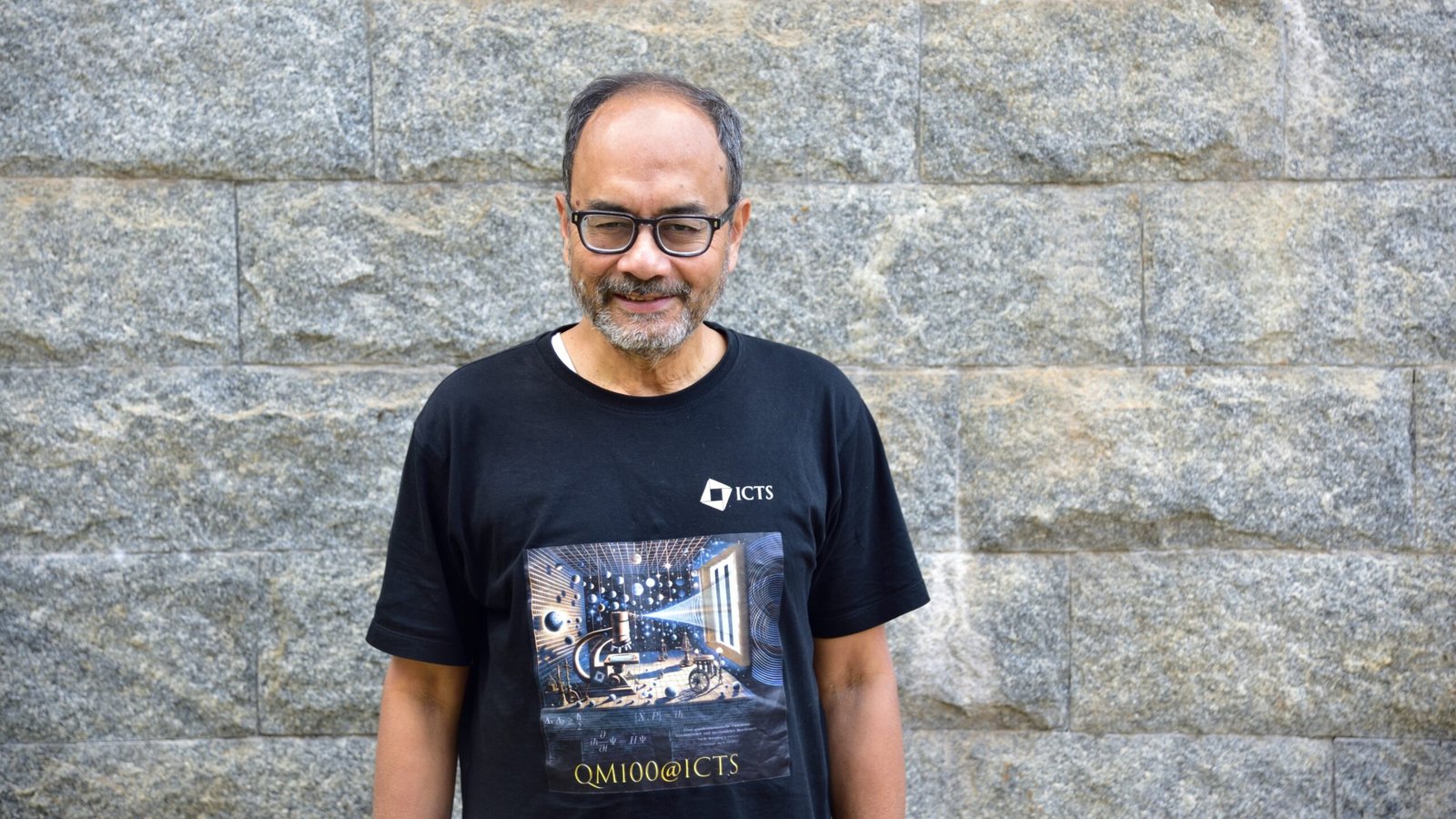
The triumph of Professor Ashoke Sen, one of the world’s foremost theoretical physicists and a pioneer of string theory, offers a profound lesson on how modern science must operate. In an era increasingly dominated by short-term metrics, immediate technological applications, and empiricism that demands instant experimental validation, Sen’s career stands as a monumental vindication of pure theoretical inquiry. His scientific journey demonstrates why human knowledge requires structural space, institutional support, and intellectual freedom to pursue untested ideas long before they can be verified by physical experiments.
Throughout the history of science, the most transformative breakthroughs have frequently originated from abstract theoretical frameworks that lacked immediate observational proof. Albert Einstein’s general relativity, Paul Dirac’s prediction of antimatter, and Peter Higgs’s mechanism for mass were all proposed years or decades before experimental instruments were sophisticated enough to test them. In the contemporary era, string theory—which replaces zero-dimensional point-like particles with one-dimensional vibrating strings to bridge quantum mechanics and general relativity—occupies a similar frontier. Because the energy scales required to directly probe strings lie far beyond current particle accelerators, skeptics often critique the field as overly speculative. Yet, it is precisely within this mathematical architecture that Ashoke Sen uncovered deep, revolutionary truths about the structure of reality.
Ashoke Sen’s landmark contribution came in the early 1990s through his pioneering work on S-duality and strong-weak coupling symmetry. At the time, theoretical physics was stalled by the existence of five distinct, seemingly competing superstring theories, alongside the difficulty of performing calculations when physical forces became strongly interacting. Sen demonstrated that a system operating under strong interactions in one formulation could be mathematically equivalent to a weakly interacting system in another. By proving the existence of specific bound states (dyons) predicted by S-duality, Sen provided rigorous mathematical evidence that these distinct string models were not isolated theories, but rather different limits of a single unified framework. This breakthrough helped trigger the Second Superstring Revolution, fundamentally changing how physicists view space, time, and fundamental forces.
Sen’s later achievements—including the famous Sen Conjecture on tachyon condensation in string field theory and his precision counting of black hole microstates—further proved that mathematical consistency within an untested theory can yield profound physical insights. His work resolved long-standing paradoxes surrounding black hole entropy and information loss, demonstrating that theoretical frameworks, when developed with mathematical rigor, serve as an essential laboratory for exploring extreme regimes of nature where physical instruments cannot yet go.
The environment that enabled Ashoke Sen’s success highlights the critical role of institutional philosophy in fostering fundamental research. Performing his ground-breaking work at premier Indian research institutions—such as the Tata Institute of Fundamental Research (TIFR), the Harish-Chandra Research Institute (HRI), and the International Centre for Theoretical Sciences (ICTS)—Sen benefited from an academic culture rooted in long-term vision. Established under the foundational philosophy of pioneers like Homi Bhabha, these institutions provided researchers with the freedom to think deeply, explore open-ended questions, and work without the pressure of producing immediate commercial or empirical outputs. Recognizing Sen’s brilliance with major global honors, including the inaugural Breakthrough Prize in Fundamental Physics and the Dirac Medal, the global scientific community acknowledged that advancing theoretical frontiers is as vital to human knowledge as experimental discovery.
Ultimately, Ashoke Sen’s legacy serves as a compelling reminder that science cannot thrive if it restricts itself strictly to the verifiable present. If scientific funding and public enthusiasm prioritize only short-term applied technology or immediately testable hypotheses, humanity risks forfeiting the deep theoretical foundations that make future revolutions possible. Unproven theories are not empty speculations; they are the scaffolding of future understanding. By preserving institutional spaces where visionary thinkers can explore mathematical truths unburdened by immediate experimental constraints, science ensures that its greatest leaps forward remain within reach.