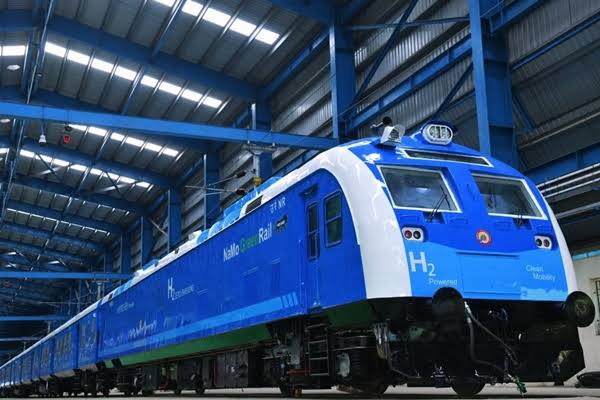
For decades, railway propulsion worldwide has relied on two primary methods: burning diesel inside heavy internal combustion engines or drawing electricity directly from overhead catenary wires connected to an external power grid. India’s hydrogen-powered train represents a major technological leap by eliminating both requirements entirely. Instead of relying on external grid infrastructure or polluting fossil fuels, the train functions as a self-contained, rolling power plant that generates its own clean electricity on the go. By combining advanced hydrogen fuel cell chemistry with high-capacity battery buffering systems, Indian Railways has engineered a zero-emission passenger train set that produces no toxic exhaust and requires zero overhead electrification.
At the heart of this innovation is an onboard electrochemical energy conversion system, rather than an internal combustion engine. The train carries compressed hydrogen gas stored at high pressures—typically around 350 bar—in lightweight, carbon-fiber-reinforced Type 4 tanks mounted safely on the roof. This stored gas is fed through precision pressure regulators into onboard Proton Exchange Membrane (PEM) fuel cells. Simultaneously, compressors draw in ambient atmospheric oxygen from the surrounding air and push it into the fuel cell stack. Inside the stack, hydrogen molecules are split into protons and electrons at a platinum-coated anode. While the membrane allows the positive protons to pass through, it forces the negative electrons through an external circuit, generating a direct electrical current (DC). When the electrons, protons, and atmospheric oxygen recombine at the cathode, the only operational by-products released into the environment are clean water vapor and heat.
Because a train’s power demands fluctuate wildly depending on whether it is idling, accelerating, or climbing steep gradients, relying solely on fuel cells would be inefficient and place excessive stress on the chemical stacks. To solve this, India’s hydrogen train uses a hybrid powertrain architecture combining fuel cells with a robust Lithium Iron Phosphate (LiFePO4) battery buffer. The fuel cells supply a steady baseline of electrical power, while the LiFePO4 battery pack acts as a dynamic energy reserve. When the train starts from a standstill or accelerates rapidly out of a station, the battery discharges instant power to assist the fuel cells. Conversely, when the train travels at constant cruising speeds or coasts, excess electricity generated by the fuel cells tops up the battery storage.
This hybrid system is further enhanced by advanced regenerative braking technology. When the train operator applies the brakes to slow down, the onboard electric traction motors reverse their function, acting as electrical generators. Instead of wasting kinetic energy as friction and brake heat, the train converts its forward momentum back into electricity, routing it straight into the battery bank for later use. Tying the entire setup together are sophisticated power electronics—including DC-to-DC converters and variable-frequency AC inverters—which regulate voltage fluctuations and convert the direct current from the fuel cells and batteries into three-phase alternating current (AC). This AC power drives heavy-duty electric traction motors mounted on the bogies underneath the coaches, turning the axles and propelling the train forward.
To make this technology viable for practical deployment, Indian Railways opted to retrofit existing Diesel Electric Multiple Unit (DEMU) trainsets rather than manufacturing entirely new rolling stock from scratch. In this configuration, the diesel engines and fuel tanks are completely removed and replaced with dual driving power cars at both ends of the train, housing a collective propulsion rating of 2,400 kW of output power. Approved to operate at service speeds up to 75 km/h (with a maximum design capability of 110 km/h), the trainset delivers smooth, whisper-quiet acceleration with significantly reduced noise and vibration compared to traditional diesel engines.
The success of a hydrogen train depends as much on ground infrastructure as it does on the rolling stock itself. Because hydrogen gas has extremely low volumetric energy density in its natural state, dedicated refuel facilities are required. At key hubs, such as the initial operational facility in Jind (Haryana), green hydrogen is produced on-site using water electrolysis powered by renewable solar or wind energy. Water molecules ($\text{H}_2\text{O}$) are split into pure oxygen and hydrogen gas, which is then compressed to ultra-high pressures (up to 500 bar) and stored in ground storage banks before being safely dispensed into the train’s roof cylinders. Because green hydrogen is used, the entire lifecycle—from fuel production to train exhaust—remains 100% carbon-free.
Safety remains an integral component of the design given hydrogen’s high flammability. The onboard storage tanks feature multi-layer carbon composite construction, integrated leak detectors, automated emergency shut-off valves, and thermal relief devices. Because hydrogen is much lighter than air, any accidental release vents vertically upward into the atmosphere through specialized roof ducts rather than pooling near the passengers or traction gear.
Ultimately, India’s hydrogen train technology unlocks a third avenue for modern rail transport—offering all the environmental and operational advantages of electric trains on non-electrified routes, scenic heritage lines, and remote branch networks where installing high-voltage overhead catenary wires would be geographically difficult or economically unfeasible. By eliminating diesel exhaust, particulate matter, and greenhouse gases at the source, the system serves as a vital technological bridge toward Indian Railways’ broader strategic goal of achieving Net-Zero carbon emissions by 2030.