On late afternoon of November 13, 2026 local time in South Texas—SpaceX conducted the 15th test flight of its flagship Starship rocket system, a landmark mission designed to push the boundaries of full and rapid orbital reusability. Lifting off from Orbital Launch Pad 2 at SpaceX’s Starbase facility near Boca Chica, Texas, the towering two-stage launch vehicle paired Super Heavy Booster 22 with Ship 42, representing the fourth pair of SpaceX’s upgraded Block 3 (Version 3) vehicles to take flight. While the mission successfully propelled the upper-stage spacecraft into orbit on an ambitious 22-hour orbital test campaign, SpaceX’s primary objective for the first phase of the flight was thwarted when the Super Heavy booster suffered an anomaly and failed to return to the launch site for recovery.
The stakes for Starship Flight 15 were exceptionally high because SpaceX was attempting an unprecedented “double catch”—a feat never before achieved in the history of aerospace engineering. Having received regulatory approval from the Federal Aviation Administration (FAA) on the day of the launch, SpaceX aimed to recover both the Super Heavy first-stage booster minutes after liftoff and the orbital Ship 42 upper stage roughly 22 hours later using the mechanical “chopstick” arms mounted on the Starbase launch tower. Achieving back-to-back tower catches of both stages is central to Elon Musk’s vision of making Starship operate like a commercial airliner, eliminating the need for slow ocean recovery operations and enabling the rapid launch cadence required for deep-space exploration, lunar base construction, and eventual missions to Mars.
The opening moments of Flight 15 proceeded smoothly as the colossal rocket thundered off the South Texas coast. During the initial ascent phase, the upgraded Version 3 Super Heavy booster performed nominally, lifting the massive stack through the lower atmosphere. Approximately two and a half minutes into the flight, the vehicle executed a clean main engine cutoff followed immediately by hot-staging, a maneuver in which Ship 42 ignited its own Raptor engines while still attached to the booster to push away cleanly. Following stage separation, Ship 42 continued accelerating eastward toward low Earth orbit, while Booster 22 flipped around and initiated its boostback burn to orient itself for the high-speed return trip toward the Starbase launch tower.
However, as the booster descended back toward the Texas coastline, the recovery plan unraveled. Telemetry and automated safety checks detected a malfunction during the return sequence, prompting flight computers to trigger an automatic abort. Under SpaceX’s strict range-safety protocols, every system on both the returning rocket and the ground-based catching tower must verify healthy operating parameters before the booster is permitted to steer toward the populated launch complex. Because those stringent criteria were not met, SpaceX abandoned the tower catch attempt, and Booster 22 automatically diverted away from the coastline toward a designated offshore contingency zone in the Gulf of Mexico.
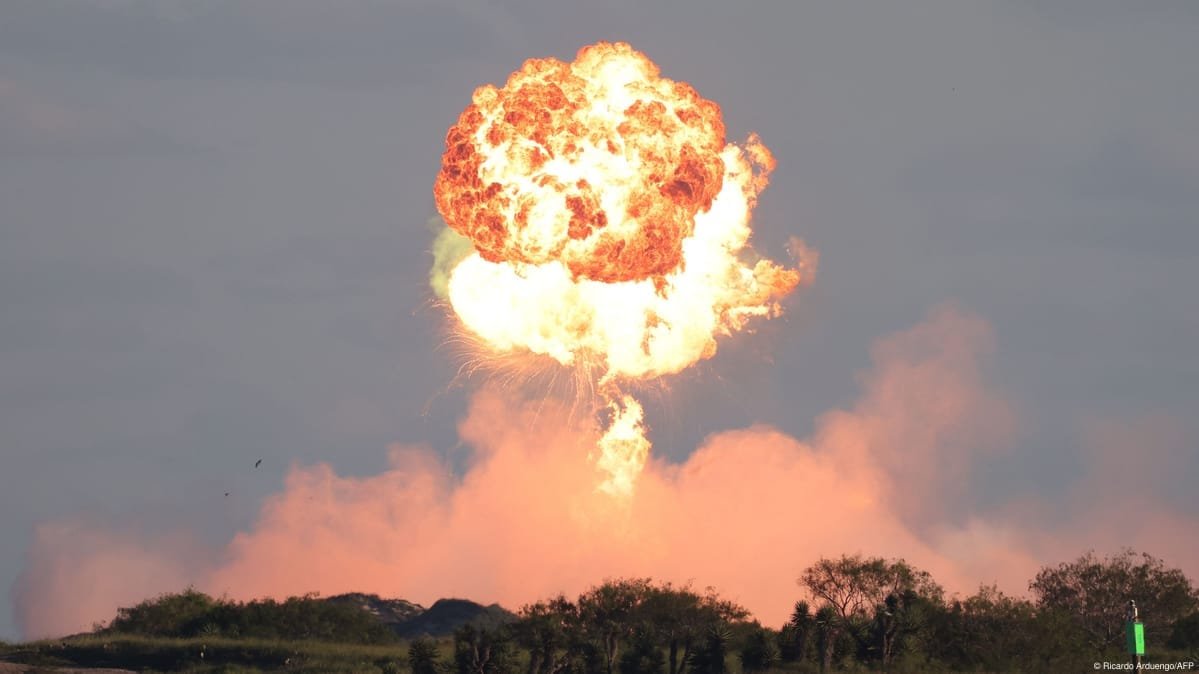
Roughly six and a half minutes after liftoff, the wayward booster executed a controlled descent and offshore splashdown in the Gulf of Mexico. Although the first stage successfully navigated through its landing burn sequence over open water rather than losing control mid-air, it could not be recovered intact. Immediately following engine shutdown on the water’s surface, the booster’s Flight Termination System (FTS) was activated, triggering a controlled detonation that broke the vehicle apart to ensure the massive stainless-steel structure sank safely without posing a navigational hazard to maritime traffic.
The loss of Booster 22 marked a notable setback for SpaceX’s newer hardware generation. While SpaceX had previously demonstrated the viability of tower catches by successfully recovering three of its earlier Version 1 Super Heavy boosters—and even reusing two of them on subsequent missions—Flight 15 was intended to be the very first successful tower recovery of a Version 3 Super Heavy booster. In the days leading up to the launch, Booster 22 had undergone extensive ground verification, including static fire tests and a “squeeze test” at the launch pad on November 10 in which the tower’s chopstick arms physically held the booster at catch height to validate the mechanical interface. The failure to bring the V3 hardware back to the pad underscores the ongoing engineering challenges of refining upgraded Raptor engines, structural modifications, and autonomous guidance systems under real flight stresses.
Despite the disappointment of the aborted booster catch, the broader Flight 15 mission remained far from over. Because the stage separation and upper-stage ignition had occurred without issue, Ship 42 successfully reached its intended trajectory into low Earth orbit. Independent of the booster’s fate in the Gulf of Mexico, SpaceX’s flight controllers pressed forward with the second half of the 22-hour orbital mission. Over the course of roughly 14 orbits around Earth, Ship 42 was tasked with testing orbital maneuvering systems, thermal protection tiles, and reentry guidance before attempting its own historic return from orbit to be caught by the very same launch tower arms at Starbase.
Ultimately, the events of November 14, 2026, highlighted both the rapid progress and the unforgiving complexity of SpaceX’s iterative aerospace development model. By safely diverting a malfunctioning 23-story booster into the ocean without endangering ground infrastructure, SpaceX preserved its orbital launch pad and kept the rest of Flight 15 alive. At the same time, the failure to recover Booster 22 denied SpaceX its coveted simultaneous double catch and provided engineers with critical flight telemetry that will be scrutinized to diagnose the malfunction before the next Version 3 Super Heavy attempts to return home.