The historic exploration of the asteroid belt by NASA’s Dawn spacecraft revolutionized our understanding of the early solar system by uncovering extraordinary geological features on two distinct worlds: the protoplanet Vesta and the dwarf planet Ceres. Among the most astonishing discoveries delivered by the mission were a colossal mountain towering over Vesta’s southern hemisphere and a series of enigmatic, highly reflective white deposits gleaming across the cratered landscape of Ceres. These monumental findings provided planetary scientists with rare windows into the dynamic internal processes, violent impact histories, and thermal evolutions of bodies residing between Mars and Jupiter.
Orbiting the massive protoplanet Vesta, the Dawn mission mapped a world scarred by ancient cosmic cataclysms, chief among them being the colossal Rheasilvia impact basin. Spanning roughly 505 kilometers in diameter, this gigantic depression covers nearly the entire southern hemisphere of the asteroid. Rising dramatically from the center of this colossal basin is an awe-inspiring central peak that reaches heights of 19 to 22 kilometers (approximately 12 to 14 miles) above its base. This gargantuan geological formation stands roughly three times as tall as Mount Everest, making it one of the absolute tallest mountains known in the solar system. The formation of this towering peak is a direct consequence of the immense kinetic energy released during the cataclysmic impact, which caused Vesta’s crust to rebound violently, thrusting mantle and deep crustal material upward into a towering monument of rock.
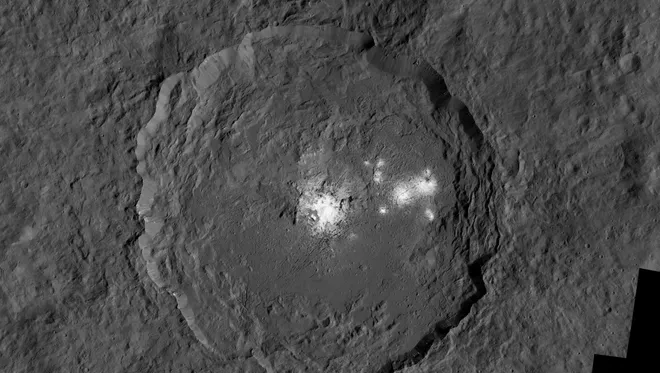
Years later, when the Dawn spacecraft arrived at its second destination—the dwarf planet Ceres—it encountered an entirely different set of geological mysteries, most notably the mysterious white deposits gleaming within the Occator Crater. Initially sparking widespread public curiosity and playful speculation about extraterrestrial origins, these intensely bright patches feature an albedo roughly four times brighter than the surrounding terrain. High-resolution spectral analysis later revealed that these luminous features are composed primarily of sodium carbonate and ammonium chloride, which are chemical evaporite residues left behind when mineral-rich fluids reached the surface and rapidly sublimated.
The presence of these young, reflective salt deposits provided definitive proof of cryovolcanism and subsurface aqueous activity on a world previously thought to be geologically dead. Scientists determined that a deep brine reservoir situated beneath Ceres’ crust was tapped by energetic impact events, allowing water-rich salty liquids to ooze upward through fractures and deposit brilliant salt crusts as the water evaporated into the vacuum of space. The exceptional brightness of these patches indicated that the geological activity was geologically recent, transforming our scientific perspective of dwarf planets and confirming that icy bodies can harbor active interior plumbing systems driven by residual heat and impact melting.
Together, these two extraordinary discoveries highlight the incredible diversity of planetary evolution in the asteroid belt. While Vesta showcased the brutal, structural reshaping of a dry protoplanet via high-energy impacts that raised a 16-mile-high mountain, Ceres unveiled the subtle, volatile-rich dynamics of an icy ocean-class dwarf planet venting salty underground brines. The data captured by NASA’s Dawn mission ultimately bridged the gap between small asteroids and major terrestrial planets, offering profound clues about how water, heat, and impacts shape worlds across our solar system.