
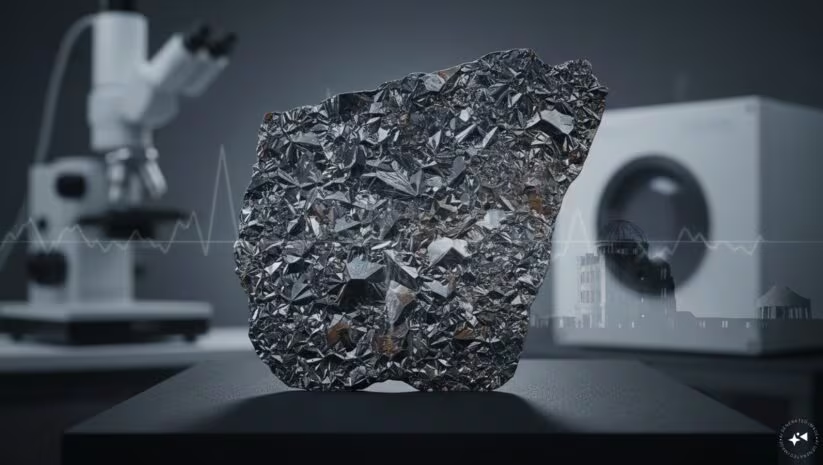
Nearly 81 years after the atomic bombing of Hiroshima, scientific examination of debris from that fateful day has led to a remarkable discovery: a previously unknown metal alloy forged in the extreme heat of the nuclear blast. This finding, published in the journal Science Advances, offers a unique glimpse into how matter behaves under conditions that are nearly impossible to replicate on Earth and underscores how nuclear explosions can serve as inadvertent and extreme scientific laboratories.
The discovery was made by an international research team led by mineralogist Luca Bindi of the University of Florence while analyzing tiny fragments preserved in the beach sands of Hiroshima Bay. These microscopic particles, known as “hiroshimaites,” are glass-like fallout debris created when the intense heat of the 6 August 1945 blast vaporized and melted buildings, soil, glass, and metal, which then solidified into small droplets as they cooled and fell back to Earth. Of the 34 Hiroshimaite samples examined, most contained familiar iron-chromium alloys, but one microscopic grain stood out due to its unusual composition and structure. This single grain, measuring only a few thousandths of a millimeter across, held a complex mix of iron, chromium, nickel, manganese, molybdenum, silicon, and aluminum arranged in a crystal structure never before observed in conventional natural or industrial alloys.
The researchers determined that this unique alloy was not a piece of debris that survived the blast but was created by the explosion itself. The atomic bomb, codenamed “Little Boy,” detonated approximately 1,900 feet above the city, generating a fireball with temperatures exceeding 7,000°C (over 12,000°F) . This unimaginable heat vaporized the diverse materials of the city—structural steel, aluminum, concrete, and more—into a swirling, mixed metallic vapor. As the fireball rapidly expanded and cooled almost instantly, the different elements condensed and solidified together, locking their atoms into a metastable configuration that was frozen in time. This process of ultrafast quenching, or rapid cooling, is the critical factor, as it prevented the atoms from separating into the more common, simple structures seen in normal metallurgy. The alloy is characterized by a fully ordered cubic crystal structure known as the AlAu4-type, which is notably different from the body-centered or face-centered cubic structures typically found in stainless steel and other common alloys.
The discovery of this alloy holds significance beyond being a mere historical curiosity. While the specific composition of the Hiroshima alloy is not expected to become a new engineering material, it provides a real-world example that can broaden the understanding of complex multicomponent alloys, which are of great interest for their potential strength, thermal stability, and corrosion resistance. The research suggests that extreme environments can stabilize unusual crystal structures that could inspire future laboratory research and alloy design.
This finding follows a similar discovery of an unusual quasicrystal formed in the debris of the Trinity nuclear test, indicating that nuclear detonations can generate a spectrum of unconventional atomic arrangements. Consequently, these blast-derived particles act as an unintended record of extreme physical processes, preserving microscopic materials that could never have formed otherwise and potentially aiding in the development of lighter and more heat-resistant materials in the future. The study emphasizes that continued scientific examination of these particles can contribute to nuclear forensics and offer new insight into one of the most significant events of the 20th century.