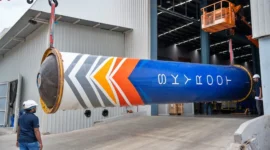
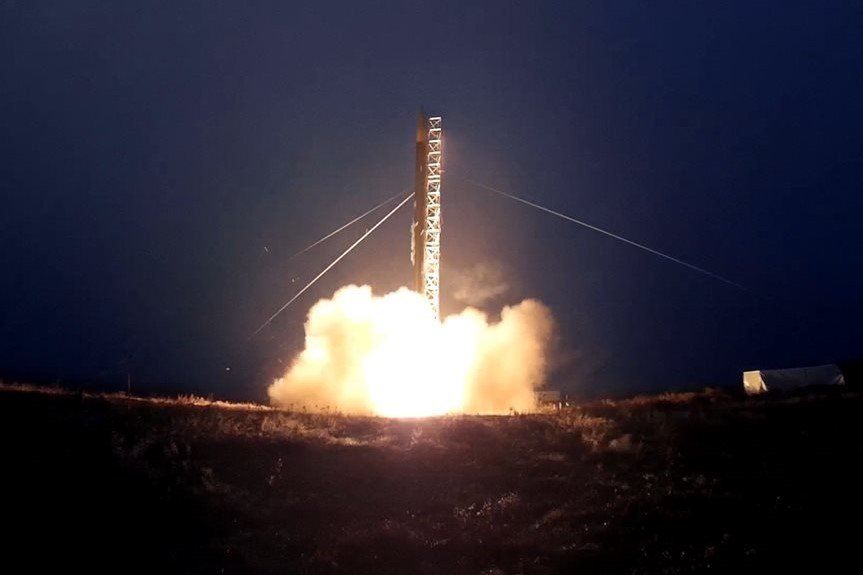
SpaceForest, a Polish aerospace company based in Gdynia, has successfully completed the fourth flight of its suborbital PERUN rocket, marking another significant milestone in Europe’s emerging private space sector. The test flight, conducted from the Central Air Force Training Area in Ustka, Poland, on the Baltic coast, represents a major step forward in the company’s efforts to develop a commercially viable suborbital launch system capable of carrying scientific payloads to the edge of space.
The PERUN rocket reached an altitude of approximately 50 kilometers during the flight, which took place under favorable weather conditions. While this falls short of the Kármán line—the internationally recognized boundary of space at 100 kilometers altitude—the mission successfully tested critical systems including the rocket’s propulsion, guidance, recovery, and payload integration capabilities. The flight lasted several minutes from launch to splashdown in the Baltic Sea, where recovery teams retrieved the rocket’s components for post-flight analysis.
This fourth flight follows a series of incremental test campaigns that SpaceForest has conducted over the past several years. Each successive launch has allowed engineers to validate different aspects of the rocket’s design and performance. The earlier flights focused on proving basic propulsion and structural integrity, while more recent missions have emphasized guidance precision, payload handling, and reusable component recovery—all essential for establishing a reliable commercial suborbital service.
The PERUN rocket is designed to serve as a suborbital launch platform for scientific research, technology demonstration, and educational missions. It can carry payloads of up to 50 kilograms to altitudes ranging between 50 and 100 kilometers, providing several minutes of microgravity conditions for experiments. This capability makes it attractive to universities, research institutions, and private companies seeking affordable and frequent access to near-space environments for testing instruments, materials, and biological samples.
One of the key features of the PERUN system is its emphasis on reusability and cost-effectiveness. SpaceForest has designed the rocket to be recovered after each flight, with components refurbished and reused in subsequent missions. This approach mirrors the broader trend in the global launch industry toward reusable launch vehicles, which reduce costs and increase flight frequency. The company aims to offer regular commercial flights at competitive prices, positioning PERUN as a viable alternative to larger, more expensive sounding rockets operated by government agencies.
The successful fourth flight also highlights Poland’s growing role in the European space economy. While Poland has traditionally been a contributor to European Space Agency (ESA) programs and has a robust academic space science community, the emergence of private companies like SpaceForest signals a new phase of commercial space activity in the country. SpaceForest has received support from the European Space Agency and Polish national research and development funds, reflecting broader European Union efforts to nurture a competitive private space industry alongside established players like Arianespace and new entrants such as Isar Aerospace and Rocket Factory Augsburg in Germany.
The PERUN program has attracted attention from international research groups interested in using suborbital flights for experiments that cannot be conducted on the International Space Station or on orbital satellites. Suborbital platforms offer unique advantages, including rapid turnaround times, lower costs, and the ability to launch from multiple locations. For experiments requiring only a few minutes of microgravity or exposure to near-vacuum conditions, PERUN provides an accessible and flexible option.
SpaceForest has outlined ambitious plans for the future of the PERUN rocket. Following this fourth successful flight, the company intends to conduct additional test launches to refine the vehicle’s performance and reliability. The goal is to achieve consistent altitudes approaching or exceeding 100 kilometers, which would allow the rocket to officially cross the Kármán line and conduct true space missions. Once operational, PERUN could support a wide range of applications, from atmospheric research and astrophysics to materials science and biology.
The commercial suborbital market is becoming increasingly competitive, with companies in the United States, Europe, and Asia developing small launch vehicles for research and tourism. Blue Origin’s New Shepard and Virgin Galactic’s SpaceShipTwo have focused primarily on human spaceflight, while others like Exos Aerospace and UP Aerospace target unmanned scientific payloads. SpaceForest’s PERUN distinguishes itself through its European base, modular payload capacity, and focus on frequent, affordable flights for the research community.
The fourth flight also provided valuable data for SpaceForest’s engineering team. Telemetry from the rocket’s onboard sensors will inform future design iterations, particularly in areas such as aerodynamic stability, thermal protection, and recovery system reliability. The company has emphasized a philosophy of iterative testing, where each flight builds on the lessons of the previous one. This approach has allowed SpaceForest to make steady progress without the massive budgets available to larger aerospace corporations or government agencies.
From a strategic perspective, the success of PERUN contributes to Europe’s broader goals of achieving “strategic autonomy” in space access. The continent currently relies heavily on foreign launch providers for many of its space missions, and the development of indigenous suborbital and orbital launch capabilities is seen as a priority. Poland, in particular, has been increasing its space budget and encouraging private sector involvement, with SpaceForest serving as a flagship example of what domestic industry can achieve.
Looking ahead, SpaceForest plans to transition from test flights to commercial operations. The company has already signed preliminary agreements with several research institutions and is in discussions with potential customers for future missions. The next flight is expected to push closer to the 100-kilometer threshold, and if successful, could pave the way for regular commercial service within the next two to three years. Additionally, SpaceForest is exploring options for mobile launch capabilities, which would allow PERUN to operate from different sites depending on mission requirements and customer preferences.