
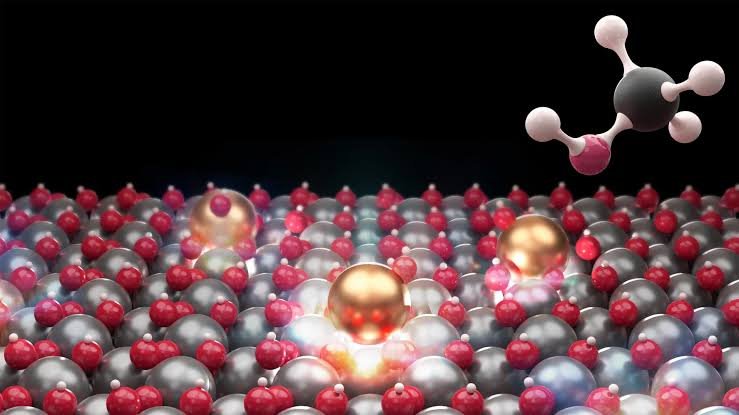
Researchers at the Indian Institute of Science (IISc) in Bengaluru have achieved a major scientific breakthrough in the field of carbon capture and clean energy conversion. The team has developed an advanced, data-driven computational framework capable of deciphering and mapping the complex atomic-scale reactions necessary to convert waste carbon dioxide CO2 into valuable fuels such as methanol and carbon monoxide. This innovation marks a significant leap forward in carbon dioxide hydrogenation—a catalytic chemical process where greenhouse gas emissions are reacted with hydrogen over a catalyst to generate liquid fuels and high-value chemical products. By drastically accelerating the understanding of how these chemical transformations occur on metal surfaces, the research bridges a long-standing gap between theoretical modeling and real-world industrial experiments.
Traditionally, turning atmospheric or industrial carbon dioxide into usable liquid fuel has presented an overwhelming chemical puzzle. Converting CO2 involves thousands of minute, elementary chemical reactions occurring simultaneously on the surface of a catalyst, typically copper-based catalysts. Due to the sheer complexity and computational expense of simulating these processes using traditional quantum-mechanical calculations, scientists historically had to limit their models to a small handful of assumed reaction pathways. Conventional frameworks typically analyzed around 152 elementary reactions, which led to severe inaccuracies, often wrongly predicting formic acid as the primary product rather than liquid fuels like methanol. By ignoring thousands of secondary and intermediate pathways, older computational models failed to reflect what actually took place inside physical reactors.
To solve this challenge, the IISc research team integrated quantum-mechanical simulations, automated reaction discovery algorithms, machine learning models, and microkinetic modeling into a single cohesive framework. By training machine learning models on a curated foundational dataset of quantum calculations, the algorithm autonomously mapped out an expansive network of 9,389 elementary chemical reactions. This vast reaction network captured virtually every conceivable atomic interaction taking place during CO2 conversion on copper surfaces. The unprecedented depth of this computational map allowed the scientists to track the precise movement, bonding, and rearrangement of molecules across the catalyst at a level of detail that was previously impossible.
The results of incorporating this massive 9,389-reaction network into microkinetic models were striking. The new IISc framework predicted an approximately 40-fold increase in CO2 conversion efficiency compared to legacy models, while accurately identifying methanol and carbon monoxide as the dominant reaction products. This output aligns perfectly with empirical data observed in laboratory experiments, confirming that the new model successfully solves the discrepancy that plagued chemical engineering models for decades. Methanol is particularly crucial in this context because it serves both as a directly usable, high-energy liquid fuel and as a versatile chemical feedstock capable of replacing fossil fuels in existing combustion engines and industrial processes.
Beyond predicting reaction outcomes with high accuracy, the computational framework uncovered previously hidden chemical pathways. Notably, the researchers identified a novel direct hydrogen-transfer mechanism. In traditional models, molecular hydrogen (H2) was assumed to dissociate into single hydrogen atoms on the catalyst surface before interacting with CO2 intermediates. The IISc model revealed that intact molecular hydrogen can, in certain circumstances, directly transfer hydrogen atoms to reaction intermediates. Uncovering this alternative pathway provides scientists with brand-new chemical levers to manipulate, paving the way for the intelligent design of next-generation, highly active catalysts tailored for maximum fuel yields.
The broader implications of this development reach far beyond copper catalysts and methanol synthesis. Because the framework relies on generalized machine learning and automated reaction search tools, IISc researchers confirmed that the same computational methodology can be adapted to evaluate other critical clean energy technologies. The system can be deployed to optimize catalysts for nitrogen reduction to produce green ammonia, as well as catalytic water splitting for green hydrogen production. By dramatically reducing the need for expensive, time-consuming trial-and-error physical experiments, the technology provides a scalable digital blueprint to convert carbon emissions from environmental hazards into sustainable chemical energy.