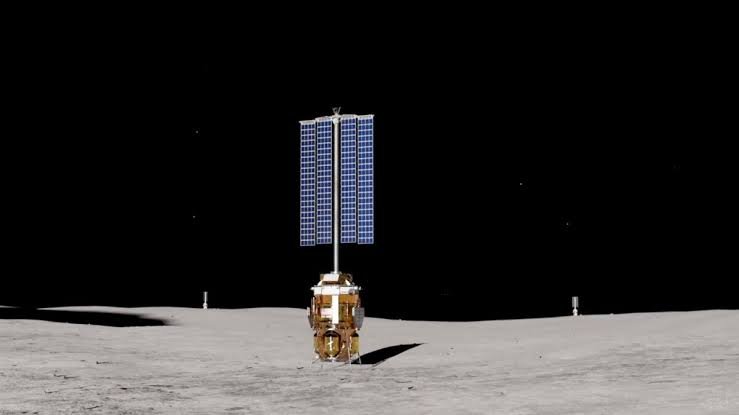
Blue Origin has unveiled a towering lunar power system designed to harvest sunlight at the Moon’s south pole and convert it into continuous electricity for future settlements. The concept, which the company calls the “Power Tower,” was presented as a solution to one of the most stubborn problems facing lunar exploration: the fact that the Moon’s poles are a patchwork of extreme light and shadow. Because the Moon’s axis is tilted only about 1.5 degrees relative to the Sun, the polar regions do not experience normal day-night cycles. Instead, some crater rims and ridges near the south pole are bathed in near-constant sunlight, while the floors of adjacent craters have been in darkness for billions of years. That makes the poles scientifically priceless — the permanently shadowed craters are thought to hold water ice — but it also makes them extraordinarily difficult to power with conventional solar arrays.
Blue Origin’s answer is a tall, vertical structure that lifts solar panels high above the lunar surface. By mounting the panels on a tower, the system can reach above the local terrain and stay in sunlight for a much larger fraction of the lunar day, even when the ground around it is in shadow. The tower is designed to capture sunlight that would otherwise be blocked by hills, crater rims, and the low angle of the Sun near the poles. In effect, the Power Tower turns altitude into a substitute for the missing lunar day-night cycle, allowing a single installation to generate electricity for a much longer stretch than a flat solar farm could manage. Blue Origin has not yet released a full engineering specification, but the company has described the concept as scalable and modular, suggesting that multiple towers could be deployed to power a growing base.
The announcement is significant because power is the limiting factor for nearly every ambitious lunar plan. NASA’s Artemis program aims to establish a sustained human presence at the south pole, and the agency has been soliciting proposals for a lunar surface power system capable of delivering at least 40 kilowatts of continuous power through the lunar night. Blue Origin’s Power Tower is aimed squarely at that requirement. If the concept works, it could provide the electricity needed to run life support, communications, scientific instruments, ISRU (in-situ resource utilization) experiments, and the machinery that would extract and process water ice into oxygen, hydrogen, and drinking water. Without a reliable power source, a permanent lunar base is essentially impossible.
The tower concept also addresses a key vulnerability of traditional solar power on the Moon: the two-week-long lunar night. At lower latitudes, a solar farm must either store enormous amounts of energy in batteries or rely on nuclear fission reactors to keep running through the darkness. Near the south pole, however, the geometry is different. Some ridges receive sunlight for more than 90 percent of the year, and a sufficiently tall tower could, in principle, stay illuminated almost continuously. That would allow Blue Origin to reduce — though probably not eliminate — the need for massive battery banks or nuclear backup. The company has framed the Power Tower as a complement to other power sources rather than a complete replacement, acknowledging that some level of storage or alternative generation will still be necessary for safety and redundancy.
Blue Origin has a growing stake in lunar infrastructure. The company is already developing a lunar lander, Blue Moon, which is intended to deliver cargo and eventually crew to the surface. Blue Moon is one of the vehicles competing to carry NASA payloads to the Moon under the agency’s Commercial Lunar Payload Services program. A power system like the Power Tower would fit naturally into that ecosystem: Blue Origin could deliver the tower on a Blue Moon lander, deploy it robotically, and then use it to support subsequent missions. The company has also been working on solar cells and power conversion technology, and the Power Tower appears to be an extension of that internal research. By unveiling the concept publicly, Blue Origin is signaling that it intends to be a full-service lunar infrastructure provider, not just a transportation company.
The technical challenges, however, are formidable. Building a tall structure on the Moon is not like building one on Earth. The tower must be lightweight enough to launch, strong enough to survive the trip, and stable enough to stand in lunar gravity, which is about one-sixth of Earth’s. It must also endure extreme temperature swings — from roughly 120 degrees Celsius (250 degrees Fahrenheit) in sunlight to minus 170 degrees Celsius (minus 280 degrees Fahrenheit) in shadow — as well as micrometeorite impacts and abrasive lunar dust. Deploying the tower robotically is another hurdle. Astronauts will not be able to assemble it by hand in the early phases, so the system must be designed to unfurl or telescope into place autonomously. Blue Origin has not yet said how the tower would be deployed, how tall it would be, or how much power a single unit would produce, but the company has indicated that it is working on those questions.