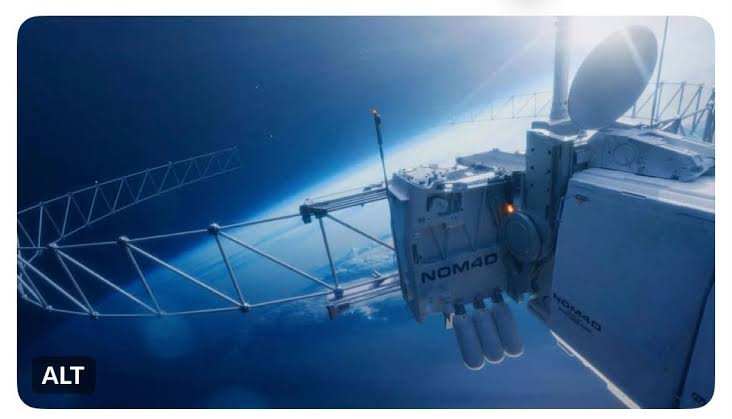
November 2026, researchers at the California Institute of Technology (Caltech) announced a landmark milestone in space engineering: their ASTRA robotic system successfully assembled part of a structure in orbit without astronauts performing the construction. Funded under the Defense Advanced Research Projects Agency (DARPA) Novel Orbital and Moon Manufacturing, Materials and Mass-efficient Design (NOM4D) program, the orbital demonstration shows how spacecraft can carry compact raw components and build larger architectures directly in the space environment. Rather than launching an entire finished frame inside a rocket fairing, future missions could transport lightweight struts, joints, and membranes and join them together where they are needed.
For decades, space hardware has been constrained by rocket fairing volume and launch mass limits. Large antennas, wide-aperture mirrors, and expansive solar collectors either had to be packed into intricate unfolding mechanisms that carried mechanical risk or kept small enough to fit inside existing payload bays. Even when robotic arms operated in orbit previously, they largely focused on inspection, servicing, or manipulation rather than building a structural bay from individual elements in free space. Caltech’s demonstration—led in Sergio Pellegrino’s laboratory with team members including Jaden Suh, George Popov, Charles Sommer, and Alan Truong—tested automated truss assembly directly in orbit.
The ASTRA payload launched on March 30, 2026, aboard Momentus’s Vigoride 7 spacecraft, which provided power, communications, and imaging support during the orbital campaign. Designed to construct a segmented reflector structure, ASTRA arrived with two pre-built bays and moved along three axes to join lightweight composite fiber tubes with metal joints while deploying a netlike reflective mesh, successfully constructing a third bay of the truss structure in orbit. Eleven onboard cameras captured images of the assembly so engineers on Earth could verify progress and diagnose anomalies. Although time constraints and orbital realities prevented finishing all 11 planned bays before the mission’s scheduled December 2026 end, completing the additional bay proved that modular, automated truss assembly works in space.
Operating in orbit introduced unforeseen environmental and mechanical challenges that do not appear on a laboratory bench. Thermal swings, microgravity dynamics, alignment tolerances, and limited communication windows—roughly seven or eight contact windows per day lasting about 15 minutes each—shaped how the team ran experiments. To troubleshoot issues remotely, researchers relied on a duplicate ASTRA system on Earth at Caltech to test commands and fixes before sending instructions back to the spacecraft. Repeating operations to overcome surprises highlighted why proof-of-concept flight testing is indispensable before scaling robotic builders to larger missions.
Looking ahead, in-space robotic assembly opens transformative possibilities across astrophysics, communications, and orbital energy. According to NOM4D program manager Andrew Detor, enabling scalable construction in space aims toward structures spanning hundreds of meters or even kilometers—far beyond what conventional single-launch spacecraft can achieve today. Giant space telescopes with huge reflective apertures could gather fainter light from distant cosmic objects, while large radio-frequency antennas could boost high-bandwidth links and deep-space relays. Expansive solar arrays for space-based solar power also represent a major potential application, alongside alternative approaches such as folded deployable modules that researchers continue to evaluate for cost and practicality.
More broadly, Caltech’s orbital milestone points toward a shift from pre-assembled spacecraft to on-orbit manufacturing and construction ecosystems. As agencies and commercial partners pursue ambitious orbital platforms and lunar or cislunar infrastructure, pairing modular structural components with capable autonomous and ground-supervised robots offers a flexible path to larger, more adaptable space systems. While scaling from a three-bay demonstration to kilometer-class structures will demand advances in reliability, autonomy, power, and servicing, the ASTRA flight provides concrete evidence that robots can actively build structures in space.