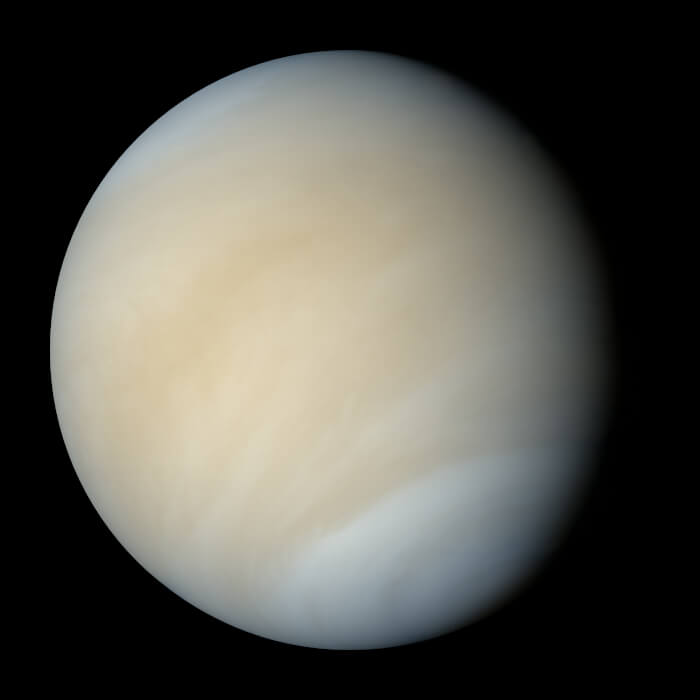
For decades, astronomers have wondered why Venus has no moon, despite closely resembling Earth in size, mass, and rocky composition. While Mercury also lacks a natural satellite, Venus sits much closer to Earth in bulk properties, making its moonlessness one of the Solar System’s enduring puzzles. Research published in The Astrophysical Journal in September 2026 by Stephen R. Kane at the University of California, Riverside and his colleagues offers a compelling physical explanation: Venus’s exceptionally slow rotation may have caused any ancient moon to spiral inward and crash into the planet rather than remain in a stable orbit.
To see why tidal dynamics behave so differently around Venus and Earth, compare how each world spins. Earth completes a full rotation roughly every 24 hours, which is faster than the Moon orbits Earth. That faster spin transfers rotational energy and angular momentum to the Moon through tidal bulges, pushing the Moon gradually outward—away from Earth at about four centimeters per year. Venus experiences the opposite regime: it takes 243 Earth days to complete a single rotation, and its spin is retrograde (backward relative to most planets). Because the planet turns so slowly, tidal interactions pull an orbiting satellite inward instead of pushing it away, causing its orbit to decay until it collides with Venus.
Earlier hypotheses for Venus’s missing moon generally relied on dramatic external events. One idea proposed that Venus once had a moon that was later shattered or obliterated by a massive impact. Another suggested that Venus simply never underwent the kind of giant collision needed to eject enough debris to form a large satellite in the first place. Kane’s team argues that no outside catastrophe was required to strip Venus of a moon; gravitational and tidal physics operating on a slowly rotating planet could naturally doom a satellite over time.
To test this mechanism, the researchers built computer simulations grounded in gravitational and tidal physics. They first verified their model by reproducing the known evolution of the Earth–Moon system, then varied Venus’s rotation rate and tested hypothetical moons ranging from 0.5 to 10 times the mass of Earth’s Moon. Across most simulated scenarios, the outcome converged on the same result: the moon spiraled inward and crashed into Venus, with more massive moons falling even faster—in some runs within 30 million years, and in others after as long as 1.7 billion years. As an inward-spiraling moon approaches the planet, tidal forces can also tear material apart inside the Roche limit—calculated for a Venusian moon at roughly 2.85 Venus radii (about 17,000 kilometers from the planet’s center), similar to the physics behind planetary rings.
Crucially, the study does not prove that Venus definitely formed a moon early in its history; whether a Venusian moon ever existed remains an open question. Instead, the findings show that if Venus once had a moon, it could not survive indefinitely under those rotational conditions. Detecting direct surface evidence of such an ancient impact is difficult because roughly 80% of Venus’s surface has a similar age, pointing to a major resurfacing event around a billion years ago that erased much of its earlier geological record.
If a moon did crash into Venus, the impact would have delivered immense energy and angular momentum, potentially altering the planet’s spin rate, internal dynamics, geology, and climate. Scientists studying whether Venus once had oceans or temperate conditions—and whether a large moon helps stabilize a planet’s axial tilt and long-term climate—see important implications here. Future spacecraft missions to Venus, such as NASA’s DAVINCI+ and VERITAS, along with seismic and interior probes, could help uncover deeper clues about Venus’s past. The work also shapes how astronomers evaluate exoplanets: finding an Earth-sized rocky world around another star does not guarantee a lasting moon if the planet rotates too slowly.