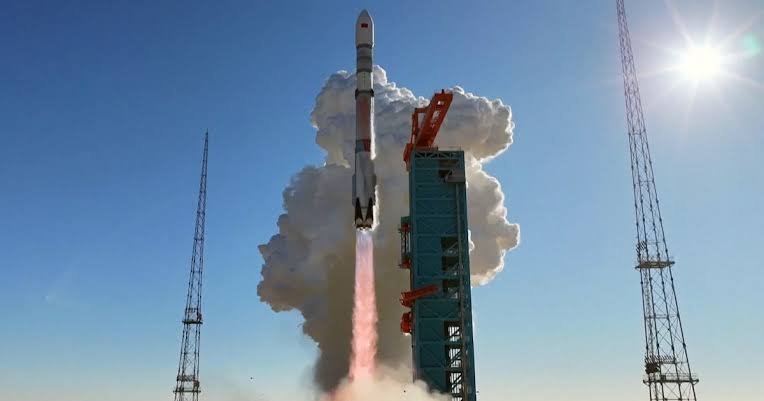
In a landmark achievement for China’s space program, the private company LandSpace successfully landed the first-stage booster of its Zhuque-3 rocket on solid ground for the first time on August 19, 2026 . The mission, which lifted off at 7:35 AM local time from the Dongfeng Commercial Space Innovation Pilot Zone in northwestern China, saw the 66.1-meter-tall stainless steel rocket complete its primary objective of sending the Honghu-03 satellite into orbit . Approximately six minutes after launch, the rocket’s nine-engine first stage separated and executed a controlled return, descending smoothly to a predesignated concrete landing pad in Minqin county, Gansu province, about 390 kilometers from the launch site . In the final phase of its descent, the booster deployed four landing legs to firmly support the massive structure, successfully completing the nation’s first-ever land-based recovery of an orbital-class rocket using this method .
This successful landing is a monumental step for China’s commercial space sector, making it the second country in the world, after the United States, to successfully recover a rocket booster both on land and at sea . The land recovery follows a July 2026 achievement in which the state-owned China Aerospace Science and Technology Corporation (CASC) captured a Long March 10B booster at sea using a cable-and-net system on a floating platform . By mastering two distinct recovery methods, China has demonstrated a versatile and robust approach to reusable rocket technology, pulling off what analysts have termed a “dual-track strategy” . For LandSpace, the success is particularly sweet, as it comes on the heels of a failed attempt in December 2025 when the first Zhuque-3 booster, although reaching orbit, exploded over the landing site during its final descent . This makes the company the second Chinese entity to recapture a booster, but the first private firm to do so, placing it in the elite company of SpaceX and Blue Origin as one of the only private companies globally to achieve this feat .
The Zhuque-3 rocket is designed by LandSpace to be China’s answer to SpaceX’s workhorse Falcon 9 . While both are reusable, the Chinese rocket has several distinct features. It is constructed primarily from stainless steel, a material its developers claim offers greater heat resistance during reentry and lower manufacturing costs compared to the aluminum-lithium alloy used in the Falcon 9 . Additionally, the Zhuque-3 is powered by a liquid oxygen-methane engine, which LandSpace says burns more cleanly than the kerosene-based fuel used by its American counterpart . However, the current iteration of the Zhuque-3 has a lower payload capacity, able to lift 14.2 metric tons into low Earth orbit on a one-way trip, compared to the Falcon 9’s 22.8 tons . LandSpace envisions the booster being reused as many as 20 times, a target that, while ambitious, is still below the record of the most reused Falcon 9 booster .
The successful recovery is more than just a technical marvel; it is a critical economic milestone that underlines the core promise of reusable rocketry: significantly reducing the cost of accessing space. In traditional expendable rockets, the first-stage booster accounts for about 70% of the total rocket cost, while the fuel itself is a negligible 1-3% . By proving that this most expensive component can be recovered, refurbished, and flown again, the path is paved toward lower-cost, higher-frequency launches, which are essential for building satellite constellations and making spaceflight commercially viable . The achievement is expected to boost investor confidence in LandSpace, which is currently seeking a listing on Shanghai’s tech-focused STAR Market with an aim for profitability by 2029 . This is especially significant as it shows that China’s private space industry is maturing and can compete on the global stage for commercial satellite launch contracts .
The gap between China’s capabilities and the industry leader, SpaceX, remains significant. SpaceX has made booster reuse a routine part of its operations, launching Falcon 9 rockets roughly three times a week and reusing boosters dozens of times . They have been recovering and re-flying their boosters since 2017, building a near-monopoly in heavy-lift launches and deploying their Starlink internet network . By contrast, while China has now achieved successful land and sea recoveries, LandSpace has yet to refly a recovered booster. The company’s next major challenge will be to make this process a repeatable commercial operation. They have announced a plan to fly a recovered first-stage booster again within six months . If successful, this test will prove that China can move beyond demonstrator flights to operational reality. In the larger context of the new space race, this milestone has geopolitical implications. The United States aims to return humans to the moon by 2028, while China has set its sights on a crewed lunar landing by 2030 . The advancements in reusable launch technology, particularly through the Long March 10B, are directly applicable to those lunar ambitions, with China planning to use the rocket for its crewed missions . As experts note, while the U.S. may still lead, China’s progress has been rapid, and they may have a better chance at establishing a permanent crewed station first .