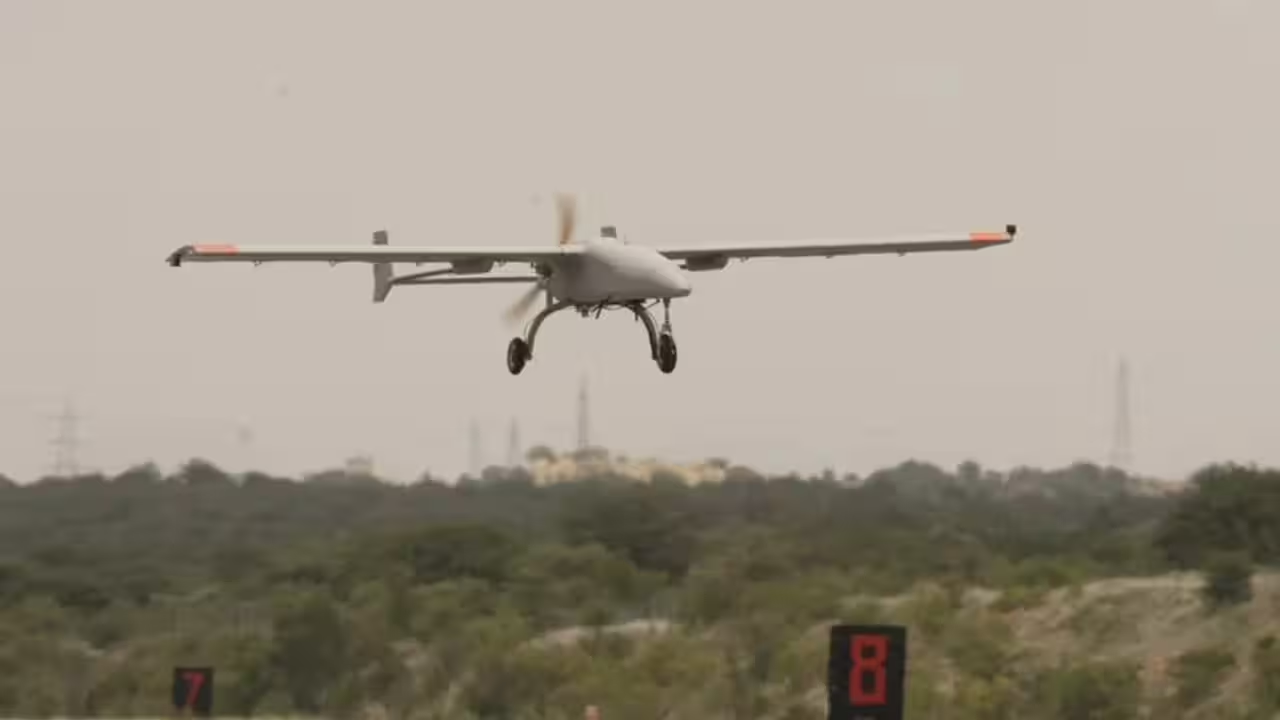
India’s indigenous defence technology sector has reached a significant milestone with the completion of 100 cumulative hours of flight testing for the FWD Kaal Bhairava Lite, an AI-powered autonomous combat aircraft developed by Bengaluru-based Flying Wedge Defence & Aerospace (FWDA) . The achievement comes as the Indian Navy evaluates long-range ship- and shore-launched loitering munitions, positioning the platform as a potential contender for emerging maritime and tactical requirements .
Designed and manufactured entirely in India with an 80% indigenisation rate, the Kaal Bhairava Lite has undergone rigorous testing in demanding operational environments . The platform was flown in 25 to 30 knot wind gusts over the Bay of Bengal, generating critical data on aircraft behaviour and control in challenging wind conditions . Additionally, the aircraft completed demonstration flights in Jammu and Kashmir, supporting its development for multi-terrain defence operations and high-altitude environments .
According to FWDA, the Kaal Bhairava Lite configuration is built around a 1,200-km-class range with 8 to 10 hours of endurance . During testing, the aircraft demonstrated climb rates of 7 to 8 metres per second, cruise speeds of 100 to 120 kilometres per hour, and take-off and landing distances of less than 120 metres, confirming its short-field capability . The platform follows a dual-role design, capable of conducting long-endurance intelligence, surveillance, and reconnaissance missions or serving as a long-range precision-strike loitering munition .
Suhas Tejaskanda, Founder and CEO of FWDA, stated that the 100-hour milestone provides the company with an extensively tested indigenous aircraft architecture . He noted that Kaal Bhairava has demonstrated short-field capability, strong climb performance, and operation in demanding wind conditions, adding that with its 1,200-km-class design and 8 to 10 hours of endurance, the platform holds significant potential for both Indian Navy requirements and international markets .
The development is particularly timely as the Indian Navy examines long-range ship- and shore-launched loitering munitions, with its current Request for Information seeking a system with a range exceeding 1,000 km and more than nine hours of endurance . FWDA is also developing a pneumatic-assisted launch configuration for the Kaal Bhairava Lite, aimed at enabling deployment from ships and austere locations without dependence on conventional runway infrastructure .
A key strategic advantage of the platform is its zero foreign dependency, which ensures complete data sovereignty and eliminates external kill-switch risks . FWDA has positioned the aircraft at a fraction of the cost of comparable Predator-class UAV systems, offering a cost-effective alternative for fleet deployment . The company has previously secured a $25 million export order from a South Asian nation and established its first international manufacturing node in Portugal, marking a significant step in India’s global defence expansion strategy and providing a strategic entry point into the European and NATO defence ecosystem .
The Kaal Bhairava programme is part of a broader indigenous defence ecosystem that includes FWDA’s more ambitious FWD Supreme, India’s first AI-piloted fighter jet concept . Unveiled in June 2026, the FWD Supreme programme introduces a Mobbing Doctrine envisioning coordinated swarms of AI-piloted combat aircraft operating against higher-value enemy manned platforms . The programme is led by a distinguished team of scientists involved in the development of the Tejas MK1, including figures such as V. Subba Rao, former Project Director of the LCA Tejas programme . The FWD Supreme family is envisioned in two variants: the FWD Supreme Lite at approximately 250 kg class as a technology demonstrator, and the FWD Supreme Heavy at approximately 1-tonne class for extended-range autonomous combat operations .
With the flight-test programme maturing and international interest emerging, FWDA is positioning the FWD Kaal Bhairava Lite as an Indian-developed long-range autonomous aircraft platform for both domestic and global defence requirements . The 100-hour milestone represents a tangible step forward in India’s efforts to build sovereign capabilities in AI-driven autonomous warfare systems, reducing reliance on foreign platforms while offering competitive alternatives in the global defence market.