July 18, 2026
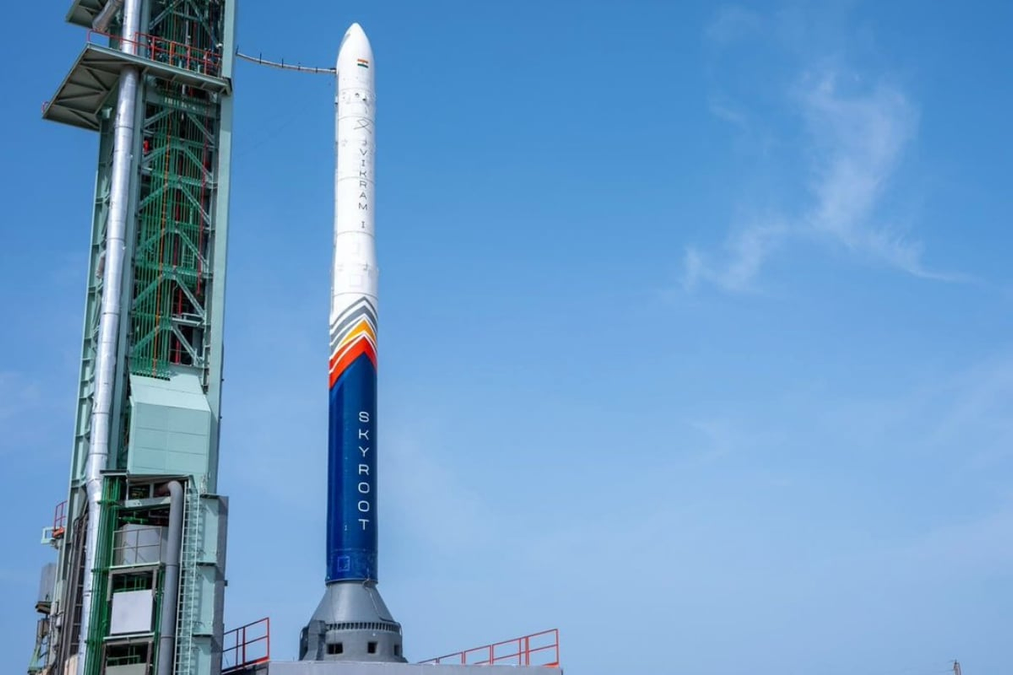
India’s private space sector soared to a historic milestone. At 12:05 PM, the Vikram-1 rocket, developed by the Hyderabad-based startup Skyroot Aerospace, lifted off from the Satish Dhawan Space Centre in Sriharikota . This inaugural flight, aptly named “Mission Aagaman” (Sanskrit for “arrival”), marked the first successful orbital launch by an Indian private company . The mission, initially scheduled for 11:30 AM, faced a brief, tense hold five minutes before liftoff due to a technical glitch identified by the Automated Launch Sequence . However, the issue was resolved, and the seven-storey-tall, 22-meter rocket roared to life, successfully completing its 14-phase flight sequence in approximately 15 minutes to inject its payloads into a 450-km low-Earth orbit . This flawless execution made India only the third country in the world—after the United States and China—to have a private company achieve independent orbital launch capability .
The true story of Vikram-1 is not just one of a successful launch, but of the cutting-edge engineering that makes it a game-changer. At the heart of this achievement is an all-carbon composite structure that forms the rocket’s airframe . This material, which is five times lighter than the strongest steel, provides an exceptional strength-to-weight ratio. This strategic choice drastically reduces the rocket’s overall mass, allowing it to carry a heavier payload of up to 350 kilograms while simultaneously improving its fuel efficiency . This design philosophy is central to Skyroot’s goal of creating a launch vehicle that is not only powerful but also cost-effective and rapid to manufacture .
Complementing the lightweight body is the rocket’s advanced propulsion system. Vikram-1 is a four-stage launch vehicle, a configuration designed for precision . The first three stages are powered by solid-fuel motors from Skyroot’s indigenously developed “Kalam” series, providing the immense thrust needed to punch through the atmosphere . The mission’s true technological showpiece, however, is the final stage: a liquid-fueled orbital adjustment module known as the “Raman” engine. This engine is distinguished by its 3D-printed combustion chamber, a technology flown for the first time in India . By using additive manufacturing, Skyroot engineers were able to compress hundreds of components into a single printed part, dramatically reducing production time, lowering manufacturing costs, and allowing for complex designs that are impossible with traditional methods . This restartable liquid engine provides the precision required to accurately place satellites into their specific orbital paths, a critical requirement for commercial customers .
The success of this private sector mission has been widely hailed by India’s space establishment, with ISRO Chairman Dr. V. Narayanan praising it as a reflection of the “growing maturity of India’s private space sector” and IN-SPACe Chairman Dr. Pawan Goenka calling it “an India moment” . Following the launch, the mission carried more than just satellites; it hosted technology demonstrators from companies like Grahaa Space and DCubed, a robotic arm experiment called “Embrace” for future space debris removal, and even symbolic payloads like a handwritten postcard from Prime Minister Narendra Modi . The engineers, whose months of tireless work culminated in this success, have already turned their focus from celebration to analyzing flight data, looking ahead to future commercial missions . With this achievement, Skyroot has not only launched a rocket; it has launched a new era for India’s space ambitions, positioning the nation as a formidable contender in the global commercial launch market .