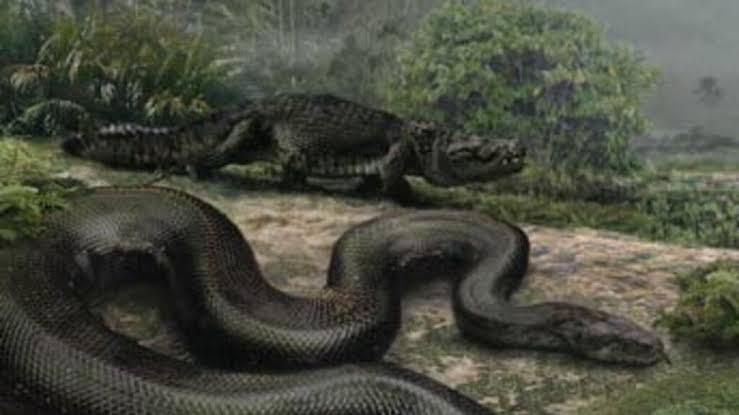
Discovered in the coal mines of Cerrejón, Colombia, the fossils of Titanoboa cerrejonensis have unveiled a creature that stretches the imagination and reshapes our understanding of prehistoric life. This colossal serpent, which slithered the Earth roughly 58 to 60 million years ago during the Paleocene Epoch, is the undisputed largest snake ever known to science, surpassing any living relative by a substantial margin. The sheer scale of Titanoboa is almost incomprehensible; based on the size of its fossilized vertebrae, paleontologists estimate that the average adult measured approximately 13 meters (42.7 feet) from nose to tail tip and weighed as much as 1,140 kilograms (2,500 pounds). To put this into perspective, this ancient predator was longer than a city bus and as heavy as a car, a size that dwarfs the largest modern anacondas and reticulated pythons, which rarely exceed 9 meters (29.5 feet) in length. The vertebrae, which are the primary remains found, suggest that at its greatest width, the snake would have reached about the height of a human’s hips, and it might have had to squeeze through a standard office door.
The discovery of Titanoboa is not just a story of a gigantic reptile; it is a profound window into a past world far different from our own. The fossilized remains of roughly 30 individuals, many of them adults, were unearthed in the Cerrejón coal mine in northern Colombia, a site that was once a lush, hot tropical rainforest. This ancient ecosystem, teeming with life, existed just a few million years after the extinction of the non-avian dinosaurs, making Titanoboa one of the largest, if not the largest, terrestrial apex predators of its time. It was a member of the boine snake family, a type of non-venomous constrictor related to modern boas and anacondas, and its sheer size made it a formidable hunter. Researchers believe that it was a semi-aquatic ambush predator, spending much of its time in the water and preying on the denizens of its ancient swampy habitat, which included giant turtles and primitive crocodile-like reptiles such as the Cerrejonisuchus improcerus.
Beyond its immense size, the most significant aspect of the Titanoboa discovery is its profound implications for understanding Earth’s ancient climate. The enormous size of this cold-blooded reptile is directly linked to the ambient temperature of its environment, as the metabolic processes of ectothermic animals, or poikilotherms, are dictated by external heat sources. By studying the relationship between the maximum body size of modern snakes and the climate they inhabit, scientists were able to work backward to calculate the temperature required to support a creature of Titanoboa‘s magnitude. Their findings were striking: the average annual temperature in the tropical forests of ancient Colombia must have been between 30°C and 34°C (86°F to 93°F) for a snake of this size to survive. This is significantly hotter—by as much as 3°C to 5°C (5°F to 10°F)—than the average temperatures found in modern tropical rainforests.
This research, published in the journal Nature in 2009 by an international team led by scientists including Jason Head, Jonathan Bloch, and Carlos Jaramillo, provides crucial data for ongoing debates about climate change and ecosystem resilience. The estimate that tropical rainforests could have thrived at such high temperatures in the past challenges the view that current tropical vegetation lives near its climatic optimum, suggesting that these ecosystems might be more resilient to future global warming than previously feared. However, it also serves as a powerful benchmark, highlighting the dramatic environmental shifts that have occurred over tens of millions of years. The rediscovery of Titanoboa is more than a paleontological triumph; it is a testament to how a collection of fossilized bones can bring a lost world back to life, revealing not just the form of an ancient monster, but the very climate that allowed it to rule.