July 16, 2026
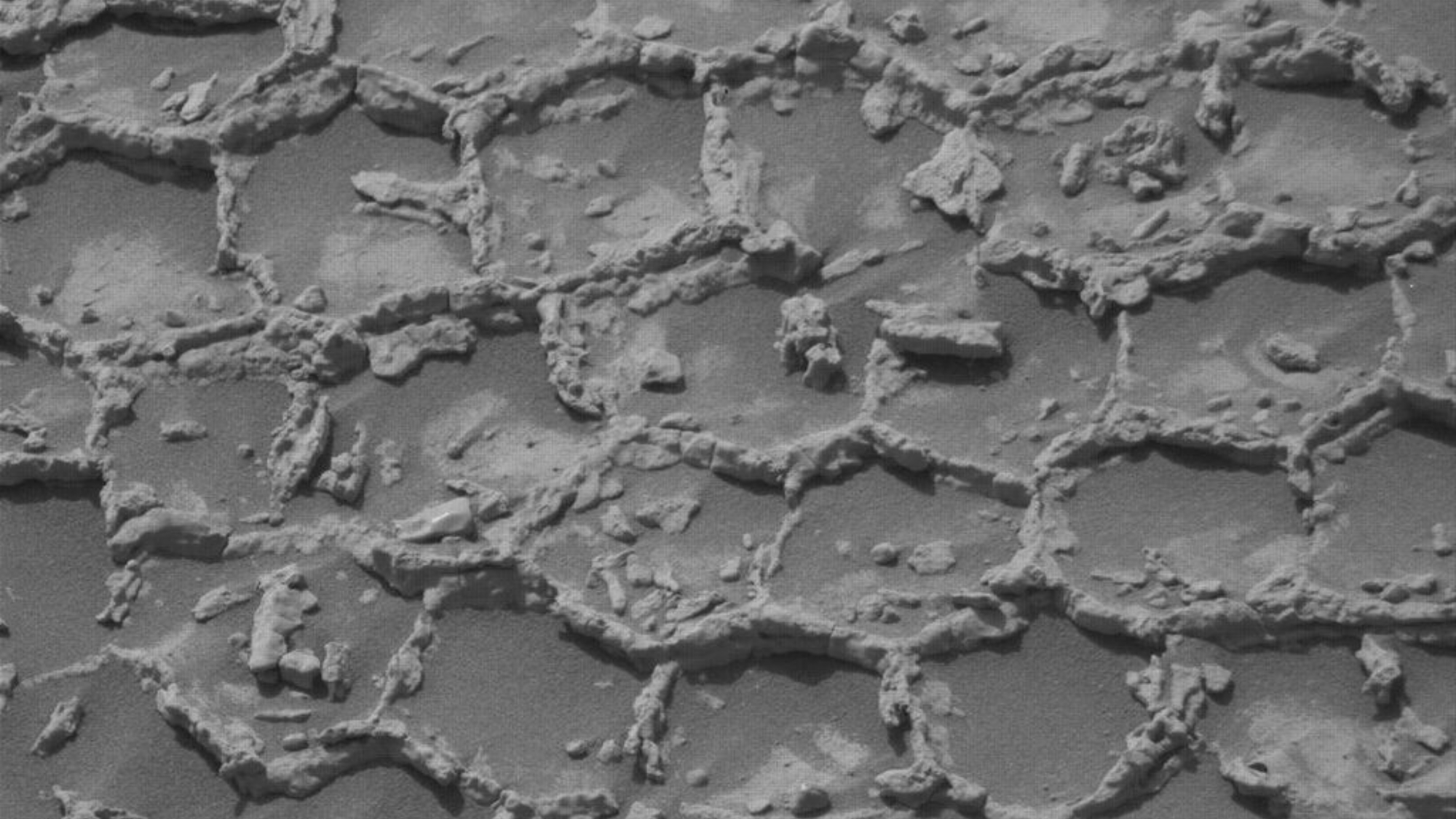
In a development that has astonished the scientific community, NASA’s Curiosity rover has transmitted images of a mysterious honeycomb-like pattern etched into the Martian surface, a discovery that has left researchers grappling for a definitive explanation. Nearly fourteen years after its historic landing on the Red Planet, the veteran rover made the finding during its latest traverse of the Gale Crater, a vast impact basin that has been its home since 2012. What was anticipated to be a routine survey of a light-toned area, which appeared relatively uniform in orbital imagery, instead revealed a stunning and unexpected landscape covered in a network of polygon-shaped ridges that closely resemble a giant honeycomb or a patchwork of dragon scales.
The sheer scale, clarity, and extensive coverage of these formations, stretching across the terrain for meters, have set them apart from any similar structures previously observed on Mars. Adding to the intrigue, the rover team noted that the polygonal ridges appeared increasingly eroded as Curiosity drove deeper into the unit, a sign that this landscape has endured significant weathering over eons.
The discovery was initially met with surprise when the rover team first laid eyes on the site. According to a NASA blog, the team was shocked to find the unit, which was expected to be smooth, “covered with polygonal structures like the top of a giant Martian honeycomb,” a striking contrast to the data gathered from orbit. The formations are crisscrossed by a grid-like surface of raised rocky ridges, with darker sand and debris filling the depressions between them. The scientific community is now engaged in a fervent debate to understand the origin of this peculiar geology.
While polygonal patterns have been observed on Mars before, they are typically linked to processes like the drying and cracking of mud, the freezing and thawing of ground ice, or the thermal contraction of rock. However, the unique characteristics of this new find have made it a far more complex puzzle. “A still-to-be-resolved question is whether these are bits of Mars that ‘floated’ down from higher in the stratigraphy, were ejected from distant impacts outside of Gale crater, or are meteorites from beyond Mars altogether,” a NASA blog post noted, referring to the small, dark-toned rocks that litter the entire honeycomb surface, adding another layer of mystery to the site.
The scientific team is actively exploring several hypotheses to explain the formation of this enigmatic terrain. On Earth, similar geometric patterns are known to form through the desiccation of clay-rich sediments or the repeated freezing and thawing of the ground, a phenomenon known as cryoturbation. One compelling theory posits that the Martian honeycombs are the result of ancient, repeated wet-dry cycles, a process that would have seen the ground periodically saturated with water and then baked dry over millions of years. This cyclical environmental stress would have caused the surface to fracture in a consistent pattern, and the subsequent evaporation of mineral-rich groundwater could have cemented the cracks, forming the raised ridges we see today.
This hypothesis is particularly tantalizing because it suggests a much more dynamic and watery past for Mars than its current arid state implies. “The origin of these cracks is not clear – could they have formed as desiccation cracks as Mars began to get drier, billions of years ago? Or during later periods when groundwater moved through the bedrock?” pondered Dr. Catherine O’Connell-Cooper, a planetary geologist, highlighting the central questions surrounding the formation.
Complicating the analysis is the presence of the dark-toned cobbles, one of which has been named “Cortadera,” scattered across the honeycomb area. Scientists are considering several possible sources for these rocks: they could have broken away from higher geological strata and rolled downhill, been ejected from the distant impacts that shaped the crater, or, perhaps most intriguingly, they could be meteorites from beyond Mars.
Preliminary analysis of similar dark fragments found on previous missions has revealed the presence of nickel, a chemical element common in meteorites but relatively rare in Martian rocks, lending credence to a potential extraterrestrial origin for these stones. To unravel these mysteries, Curiosity has deployed its full suite of scientific instruments. Over several sols, the rover used its Alpha Particle X-ray Spectrometer (APXS) and its Mars Hand Lens Imager (MAHLI) to conduct contact science on the polygon ridges and the dark cobbles. Simultaneously, the ChemCam laser spectrometer fired laser pulses to analyze their chemical composition, while the Mastcam captured detailed mosaics of the nearby “Cordillera” mesa and the “Valle Grande” channel.
As scientists pore over the wealth of data returned by Curiosity, the honeycomb-like landscape of Gale Crater stands as one of Mars’ newest and most compelling unsolved puzzles. Understanding whether these polygonal structures were forged by the drying of ancient lakes or the relentless cycles of frost and thaw will be crucial for piecing together the planet’s environmental history. This discovery is a powerful reminder that even after years of exploration, Mars continues to hold profound secrets. For now, the rover continues its ascent of Mount Sharp, leaving behind this bewildering patch of ground as it ventures into a zone of darker rocks, a testament to the ongoing, remarkable journey of discovery on the Red Planet.