
July 15, 2026
A groundbreaking proposal from an MIT physicist could revolutionize the enforcement of the 1967 Outer Space Treaty by offering the first practical method to detect covert nuclear weapons hidden aboard satellites. For nearly sixty years, the treaty has banned the placement of nuclear arms in orbit, with 118 nations including the U.S., Russia, and China as signatories, yet it has lacked any robust mechanism for verification. This loophole has become a critical concern amidst escalating geopolitical tensions in space, particularly following the 2022 launch of the Russian satellite Cosmos 2553. The U.S. has issued warnings that this satellite, placed in a highly unusual and harsh radiation orbit, might be a testbed for components of a nuclear anti-satellite weapon.
The innovative detection method, proposed by MIT Professor Areg Danagoulian in the journal Nature, exploits the unique physical interaction between nuclear materials and the space environment. The concept relies on the inner Van Allen radiation belt, a zone of intense radiation where Earth’s magnetic field traps highly energetic protons. As a satellite orbits, it is constantly bombarded by these protons. Professor Danagoulian’s calculations demonstrate that when these high-energy protons collide with dense nuclear materials like uranium or plutonium, they induce a process called spallation, which knocks loose a significantly large number of neutrons—potentially up to 40 million per second from a thermonuclear weapon. In contrast, a standard satellite made of aluminum and plastic emits a vastly smaller neutron signature, creating a clear and distinctive signal.
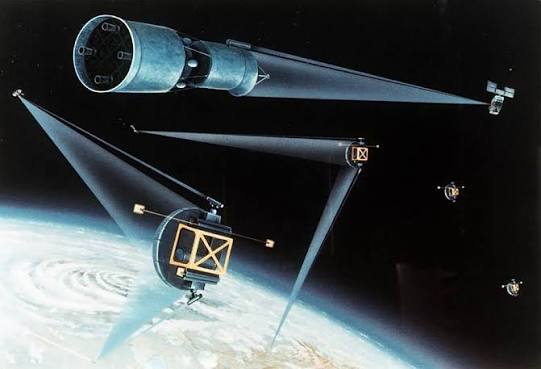
The heart of the proposal is a shoebox-sized satellite equipped with an advanced sensor system that could be deployed to inspect suspect spacecraft. This inspector satellite would fly in close proximity to the target, using a detector composed of scintillator panels and synthetic diamond crystals to capture and analyze the neutrons emanating from it. A key technological challenge is differentiating the target’s neutron signature from the natural background radiation emanating from Earth. The design overcomes this by using a directional detection system that can pinpoint the source of the neutrons, distinguishing those from the satellite from the planet’s atmospheric background. Professor Danagoulian’s modeling suggests that the sensor, approximately the size of a large encyclopedia, could detect a hidden nuclear weapon with 99% accuracy from a distance of roughly 4 kilometers after about a week of observation. This detection time could be drastically reduced to just an hour during a single flyby if the inspector satellite could maneuver to within one kilometer.
The proposal arrives at a time when the world is acutely aware of the fragility of space-based infrastructure. A nuclear detonation in low-Earth orbit would not only destroy the weapon’s intended target but would also release a pulse of highly energetic electrons that could cripple or destroy hundreds of operational satellites, disrupting global communications, GPS navigation, and military systems. This threat, alongside the absence of on-site verification measures in the New START treaty, has spurred research into remote verification technologies. “You can fake intelligence, but you can’t fake physics,” Professor Danagoulian stated, emphasizing the fundamental scientific basis of his approach, which he hopes will stimulate further research and policy discussions to develop this concept into a tangible verification tool. While the work is currently a feasibility study, it represents a pivotal step toward closing a dangerous verification gap and fostering a more stable and transparent environment in space.