China’s ambitious infrastructure projects have redefined what is possible in modern engineering, with the construction of gigantic “boat elevators” standing as a prime example. These monumental structures, designed to carry ships over towering dams and through mountainous terrain, are not isolated marvels but part of a broader strategy to revolutionize the nation’s inland waterways. The most famous of these is the ship lift at the Three Gorges Dam on the Yangtze River, the world’s largest hydropower project. Officially opened for trial operation in September 2016, this colossal elevator was the final piece of the puzzle for a project that had been in planning since its inception, having been put on hold for over a decade due to technical and safety concerns.
The core purpose of this “boat elevator” is to provide a rapid transit solution for vessels navigating the massive 113-meter height difference created by the dam, a journey that would otherwise take three to four hours through the adjacent five-tier ship lock system. The engineering challenges were immense, requiring a synergy of international expertise and local adaptation. The design was a collaboration between Chinese and German teams, utilizing a gear-and-rack system and a safety mechanism based on a nut-and-screw principle from Germany, but the design was heavily adapted to suit the unique conditions of the Three Gorges project. For instance, the design team had to account for the temperature differential between the two towers that flank the lift, which could alter the distance between them and distort the ship-carrying chamber itself—a problem less pronounced in the German model, which had a much shorter lifting distance of only about 30 meters.
The sheer scale and engineering prowess of the Three Gorges ship lift are staggering. The lift’s ship chamber is a massive structure, measuring 120 meters long, 18 meters wide, and 3.5 meters deep, holding a body of water that, combined with the chamber and its mechanical systems, weighs in at a colossal 15,500 tons. To lift this weight, the system employs a sophisticated counterweight system, where the weight of the counterweight is equivalent to a fully loaded chamber, ensuring balance regardless of the chamber’s position. This counterweight is divided into 16 sets connected to the chamber by 256 ropes via 128 pulleys at the top of the towers. The chamber is driven up and down by four pinions that engage with toothed racks installed in the towers; thanks to the counterweight system, these pinions only need to carry about 400 tons of the total weight, making the lift exceptionally efficient and energy-saving.
Safety is paramount for such a critical piece of passenger infrastructure, and the lift is equipped with a backup safety mechanism. In the event of an unbalanced force, the driving units stop, and the caisson is locked vertically using a nut-post and short screw section system, preventing any catastrophic failure. The lift can make 18 trips in a 22-hour operational window, and is designed to be operational 335 days a year, with the remaining month set aside for maintenance, handling ships of up to 3,000 tons and reducing the crossing time to just 40 minutes. This new system was not designed to replace the locks but to complement them, diverting passenger vessels for increased safety and speed, as fires on the locks are more difficult to extinguish than they would be on the ship-lift.
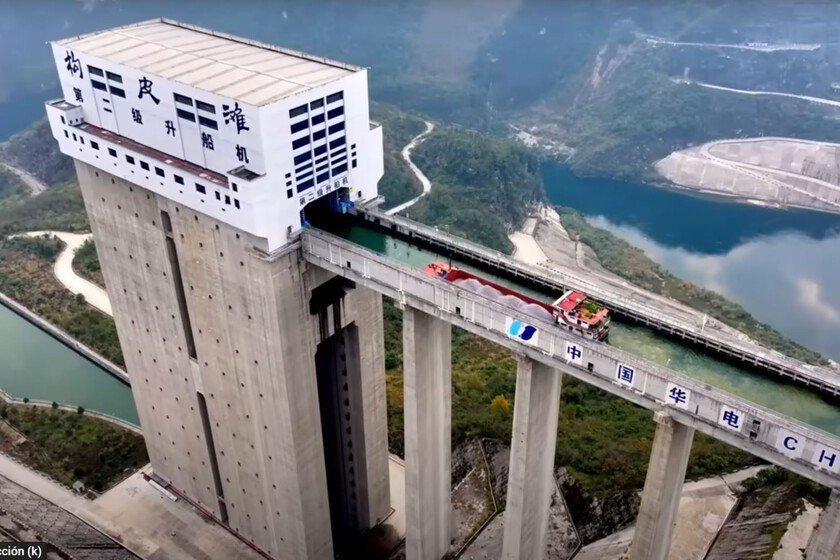
While the Three Gorges lift captures global headlines, it represents just one of many such innovative “boat elevators” China is building to conquer its challenging geography. One of the most remarkable is the Goupitan Hydropower Station’s “super elevator” system in Guizhou Province, which has created a spectacle of “water flowing upwards and ships sailing in the sky”. This project is not a single lift but a “three-stage” system of vertical lifts connected by canals and tunnels, used to overcome a jaw-dropping 199-meter height difference—the highest navigable water head in the world, which is comparable to a 65-story building.
The project was a decade-long endeavor to bypass a 232.5-meter-high dam and is a record-breaker in its own right, setting six world records including the highest single-stage lifting height (127 meters), the largest and most powerful immersion-type ship lift, the largest scale navigable aqueduct, and being the first to use a tunnel to connect two lifts in a deep mountain gorge. While the Three Gorges lift is designed for 3,000-tonne vessels, the Goupitan system is for a 500-tonne ship class but is notable for its efficiency, completing the passage in about 45 minutes to one hour—up to three times faster than the Three Gorges’s lock system. The Goupitan system and a massive new “boat elevator” in Guangxi, the Baise Water Conservancy Hub, are part of a grander plan to connect the inland provinces of Guizhou and Yunnan to the sea via the new Pinglu Canal.
The Baise project, with a total investment of 5.017 billion yuan, is a key “chokepoint” project that will end nearly 20 years of interrupted navigation on the Youjiang River. It features a lift with a maximum lifting height of 88.8 meters and a lifting weight of 10,700 tons—equivalent to lifting over 300 cars 30 stories high—making it the world’s largest fully balanced wire rope hoist ship lift. It will also be the first navigation hub in the world to include both a water-saving ship lock and a ship lift. The massive economic implications are clear; once complete, it will create a direct route from the Youjiang River to the Beibu Gulf via the Pinglu Canal, reducing the shipping distance for goods from the Southwest to the coast by 560 kilometers and saving an estimated 5.2 billion yuan annually in logistics costs for the region.
In a separate but equally human-focused project, even a 288-meter-high cliffside elevator in Yunnan’s Nizhu River Grand Canyon serves a similar purpose, significantly reducing a grueling commute for local children from nearly three hours to just thirty minutes, demonstrating China’s ability to apply vertical lifting technology for civic and commercial benefit alike. Through these immense projects, China is not just moving boats; it is moving mountains, transforming its rivers into superhighways and reshaping its economic and logistical landscape.