
June 19, 2026
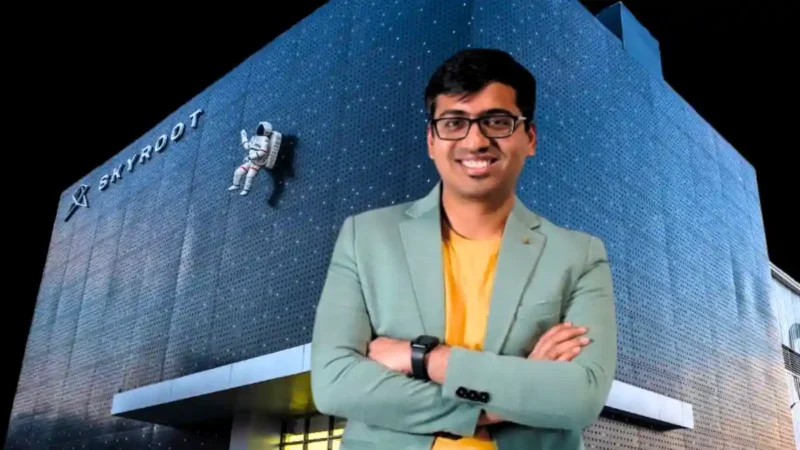
Pawan Kumar Chandana, the co-founder and CEO of Skyroot Aerospace, stands at the helm of a historic moment for India as his company prepares to launch Vikram-I, the nation’s first privately developed orbital rocket . This event marks the culmination of a remarkable journey for the 35-year-old, who has traversed an extraordinary path from a middle-class background in Hyderabad to becoming a central figure in India’s burgeoning private space industry . Chandana’s story is one of audacious ambition, resilience, and a steadfast belief in the power of private enterprise to democratise access to space. His trajectory, from a student who once struggled with mathematics to the leader of India’s first space-tech unicorn, serves as a powerful testament to the transformative potential of India’s new space age .
Chandana’s early life gave little indication of the monumental success that lay ahead. Born in 1991 in Hyderabad, he grew up in a middle-class family and, at one point, scored only 51 marks in mathematics . However, this academic setback proved to be a turning point; his father’s encouragement and enrolment in IIT-JEE coaching helped him rediscover his passion for science and technology . This preparation paid off handsomely when he secured admission to the prestigious IIT Kharagpur in 2007, where he completed a dual BTech-MTech degree in Mechanical Engineering . While many of his peers sought careers in the corporate world, Chandana’s fascination with rocketry and space exploration remained unwavering. This passion led him to join the Indian Space Research Organisation (ISRO) in 2012 as a scientist at the Vikram Sarabhai Space Centre .
During his nearly six-year tenure at ISRO, Chandana was involved in some of the nation’s most critical space projects. He contributed significantly to the development of the GSLV Mk-III heavy-lift launch vehicle, the S-200 solid rocket booster, and served as deputy project manager for the Small Satellite Launch Vehicle (SSLV) . His technical acumen and dedication were recognised with an internal innovation award in 2016 . Yet, despite a promising and stable career at the country’s premier space agency, Chandana began to envision a future where private companies could play a more prominent role in the space sector. The idea of becoming an entrepreneur was a daring one, as the Indian private space ecosystem was still in its infancy, lacking both regulatory clarity and investor confidence .
In 2018, driven by the ambition to build a private launch vehicle, Chandana made the risky decision to leave his job at ISRO . He, along with his co-founder Naga Bharath Daka, another former ISRO engineer, established Skyroot Aerospace in Hyderabad . The initial phase was fraught with challenges. With no formal framework for private space companies and a dearth of venture capital focused on space tech, securing funding was a daunting task . Chandana reached out to investors on LinkedIn, and the first major breakthrough came from Mukesh Bansal, an IIT Kharagpur alumnus and founder of Myntra, who believed in Chandana’s vision and provided crucial early funding . The journey was further complicated by the COVID-19 pandemic, which created immense fundraising hurdles, but the company persevered with support from other visionary investors .
A pivotal moment for Skyroot came in 2020 when India’s government opened the space sector to private players, establishing the Indian National Space Promotion and Authorisation Centre (IN-SPACe) to provide a formal framework for licensing and operations . Skyroot was ideally positioned to capitalise on this policy shift, having already developed core technologies like its Raman-series liquid and Dhawan-series cryogenic engines . The company became the first private entity to sign a Memorandum of Understanding with ISRO, allowing it to access the space agency’s world-class test facilities and launch sites . This collaboration was a game-changer, providing the technical infrastructure and regulatory support essential for a nascent company to develop and test its rockets.
Skyroot’s first major triumph came on November 18, 2022, with the successful launch of Vikram-S, India’s first privately developed suborbital rocket . Launched from ISRO’s Sriharikota spaceport under Mission Prarambh, the rocket reached an altitude of about 90 kilometres, demonstrating the company’s technical capabilities and marking a turning point for India’s private space ecosystem . Since then, Skyroot has expanded rapidly, building India’s largest private rocket manufacturing facility and growing its team to nearly 1,000 employees . The company’s momentum has been unstoppable, culminating in a historic financial milestone. On May 7, 2026, Skyroot secured a $60 million funding round led by Sherpalo Ventures and Singapore’s sovereign wealth fund GIC, propelling its valuation to approximately $1.1 billion and making it India’s first space-tech unicorn .
Today, in June 2026, all eyes are on Skyroot as it stands on the cusp of its most significant achievement yet: the launch of the Vikram-I orbital rocket . The four-stage launcher, currently undergoing final integration and testing at Sriharikota, is designed to carry up to 300 kilograms to low Earth orbit and features a 3D-printed liquid engine . A successful mission would place India in an elite club of nations with a private company capable of orbital launches, alongside the US and New Zealand . Chandana describes the Vikram-I as a “cab to space,” offering a dedicated, flexible, and responsive launch service for small satellites, a market that is currently underserved . With more than 80% of its payload customers expected to be global and plans for commercial launches by 2027, Skyroot is positioning itself as a major player on the world stage, with a long-term vision that includes developing the more powerful Vikram-II rocket and eventually exploring reusable systems . Pawan Kumar Chandana’s journey from an ISRO scientist to a space entrepreneur embodies the spirit of India’s new space revolution, proving that with vision, perseverance, and a willingness to defy the odds, the sky is not the limit, but just the beginning.