
December 10, 2025
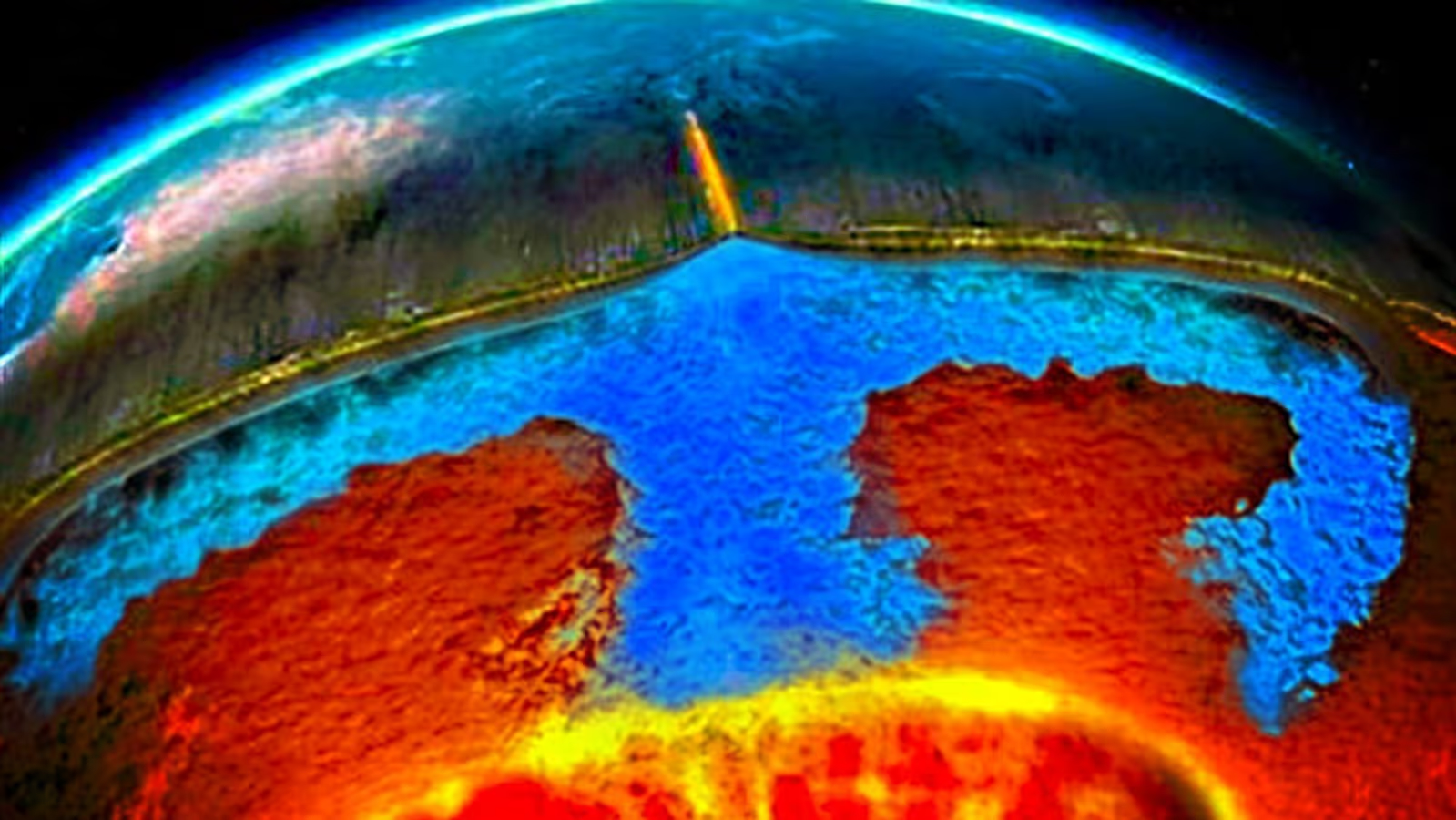
In a revelation that seems ripped from the pages of nineteenth-century science fiction, an international consortium of geophysicists and mineralogists announced today a discovery so profound it fundamentally rewrites the story of our planet and hints at unseen forces shaping worlds across the cosmos. Researchers have confirmed the existence of a vast reservoir of water, equivalent to more than all the oceans on Earth’s surface combined, trapped within a mineral structure in the transition zone between Earth’s upper and lower mantle, approximately 410 to 660 kilometers beneath our feet. This confirmation, the culmination of a decade of indirect evidence and theoretical models, comes not from a literal subterranean voyage as imagined by Jules Verne in Journey to the Center of the Earth, but from a brilliant synthesis of cutting-edge seismic analysis, quantum mechanical modeling, and high-pressure laboratory experiments that have finally pierced the deep mysteries of our planet’s interior. The finding not only validates long-held theories about the origin of Earth’s surface water but also introduces a radical new paradigm for planetary formation, the potential for deep-Earth life, and the very geophysical engines that drive our world.
The breakthrough centers on a mysterious layer known as the “transition zone,” a region of immense pressure and heat that has long baffled seismologists. For years, seismic waves from large earthquakes would slow down dramatically when passing through this zone, suggesting the presence of a material less rigid and dense than the surrounding rock. The key to deciphering this signal was the identification of a specific high-pressure form of the mineral olivine, called ringwoodite, which acts like a geological sponge. Under the crushing pressures of the mantle, the crystalline structure of ringwoodite can trap water molecules in the form of hydroxyl ions, effectively locking oceanic quantities of water into solid rock. Dr. Aliyah Chen, the lead seismologist on the project at the Advanced Geodynamic Observatory in Zurich, explained the moment of clarity: “We were able to create a three-dimensional viscosity map of the mantle by analyzing thousands of seismic shear wave profiles from the last thirty years. The anomalies in the transition zone weren’t just pockets; they formed a near-continuous, global reservoir. When we modeled the physics, only the presence of water-saturated ringwoodite on a massive scale could explain the data. We are not looking at lakes or seas, but at a hydrous silicate layer holding water in a molecular form, integrated into the very fabric of the rock.”
The scale of this discovery is staggering. Estimates based on the seismic attenuation and electrical conductivity data suggest this deep reservoir holds at least three times the volume of all the planet’s surface oceans. This water is not sloshing freely; it is bound within the crystal lattice of ringwoodite and other high-pressure minerals like wadsleyite, released only when geological processes force the rock across pressure thresholds. This discovery provides the definitive answer to one of Earth science’s oldest questions: where did our surface water come from? The dominant “late veneer” theory, which suggested water was delivered by comets and asteroids after Earth’s formation, now gives significant ground to the “primordial ocean” hypothesis. It appears most of Earth’s water was here from the beginning, sequestered during the planet’s violent accretion, and has been continuously cycled between the surface and this immense internal reservoir over billions of years through the process of plate tectonics. Dr. Kenji Tanaka, a mineral physicist at the Japanese Kaiko Deep Earth Simulator, whose team successfully synthesized wet ringwoodite at mantle conditions, stated, “We have found the missing piece of the hydrological cycle—a deep Earth component. Subducting tectonic plates, carrying hydrated oceanic crust, are the delivery trucks taking surface water down. At the depth of the transition zone, that water is forced into the ringwoodite structure. Conversely, upwellings from the lower mantle can dehydrate this rock, releasing water that facilitates melting and feeds volcanic plumes. The planet is breathing water on a million-year timescale.”
The implications of this discovery ripple outwards, challenging our understanding far beyond geology. First, it redefines the potential for abyssal biospheres. Microbiologists are now radically revising estimates for the total biomass of Earth. The presence of this water, combined with heat from the core and minerals from the rock, provides all the necessary ingredients for chemosynthetic life. The deep, hot biosphere, previously thought to be limited to crustal aquifers and hydrothermal vents, may extend hundreds of kilometers deeper, hosted within microscopic fractures and pore spaces in the hydrated mantle rock. “The boundary for life is no longer depth or darkness, but temperature and stability,” noted Dr. Elena Petrova, an astrobiologist consulted on the findings. “This expands the habitable volume of our own planet by an order of magnitude and forces us to reconsider what ‘habitable’ means on other worlds.”
Furthermore, this discovery has monumental consequences for planetary science and the search for life elsewhere in the universe. It suggests that water-rich planets may be a common outcome of planetary formation, with vast internal stores that can buffer surface oceans against stellar evolution and atmospheric loss. A rocky planet need not occupy the narrow “Goldilocks Zone” of its star to possess the ingredients for life; it may harbor them deep within, waiting for tectonic or volcanic activity to bring them to a nascent surface. “We must abandon the ‘pale blue dot’ paradigm for a ‘deep blue marble’ one,” asserted Dr. Marcus Thorne of the Institute for Exoplanetary Studies. “When we analyze the mass and density of exoplanets, we must now heavily factor in the potential for these hydrous mantle layers. A super-Earth that appears desiccated from atmospheric spectroscopy could, in fact, be a water world—its oceans simply hidden in its mantle, making it potentially more geologically active and longer-lived as a habitat.”
Perhaps the most profound philosophical shift prompted by this discovery touches on the very dynamics of our planet. The presence of such vast quantities of water in the mantle acts as a potent flux, drastically lowering the melting point of rocks and influencing the viscosity of the asthenosphere. This means water is not a passive passenger on Earth’s tectonic plates; it is a primary driver. “Water is the lubricant of plate tectonics,” Dr. Chen emphasized. “This reservoir explains the unique persistence and vigor of Earth’s tectonic activity compared to seemingly dormant worlds like Venus or Mars. It regulates volcanism, stabilizes the magnetic field generation by influencing core-mantle boundary dynamics, and ultimately governs the carbon-silicate cycle that has maintained Earth’s climate in a life-friendly equilibrium for eons. We have discovered the planet’s ultimate life-support system.”
In the end, the ghost of Jules Verne looms large over this scientific triumph. Where he imagined fantastical caves and prehistoric seas lit by electrically charged gas, modern science has uncovered a reality equally wondrous: a planet within our planet, a hidden ocean integral to our very existence. This is more than a discovery about water; it is a discovery about Earth’s soul—a wet, dynamic, and deeply connected engine whose inner workings we are only beginning to comprehend. As we peer into the deep heavens at other worlds, we now do so with the humbling knowledge that the most profound secrets, and perhaps the very essence of what makes a world alive, may lie not on the surface, but locked in the stony, water-rich heart within. The universe, it seems, may be far wetter, and far more ingeniously designed for the emergence and sustenance of life, than we ever dared to dream.