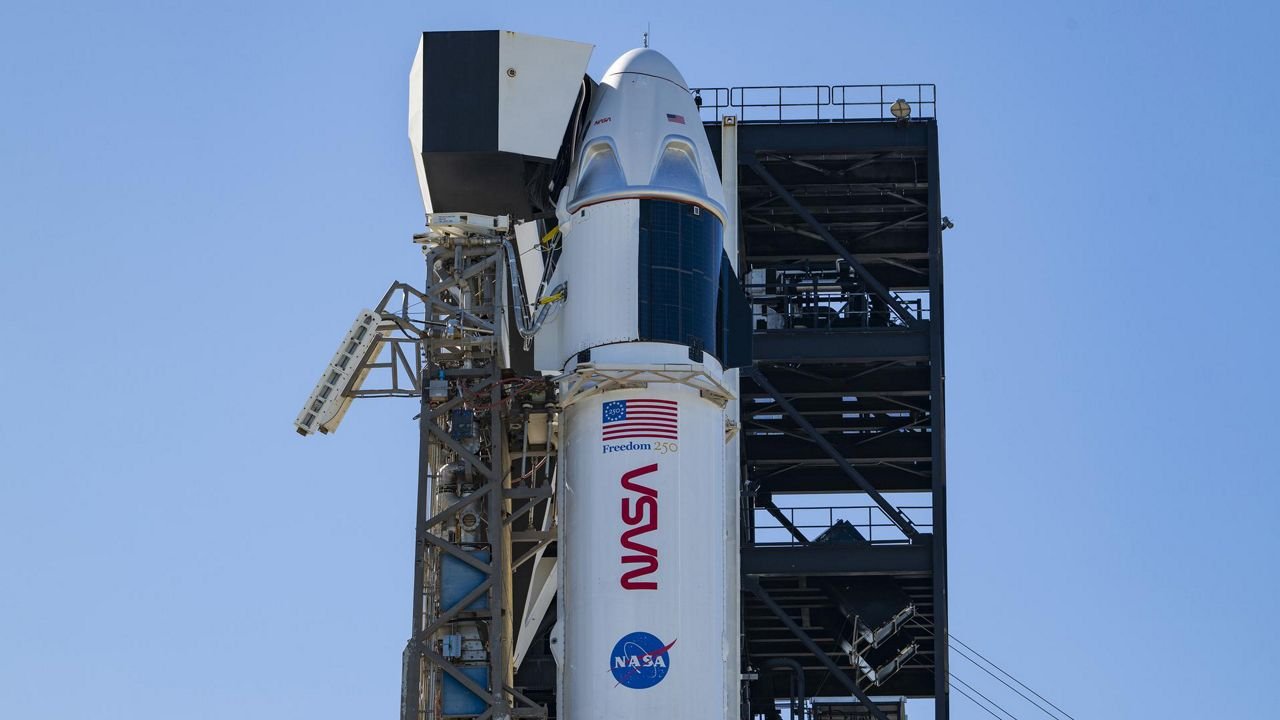
SpaceX is “go” to launch NASA’s Crew-13 astronaut mission to the International Space Station on Oct. 1, following the completion of the agency’s Flight Readiness Review and a series of prelaunch checks at NASA’s Kennedy Space Center in Florida. The mission, which will send four astronauts to the orbiting laboratory for a long-duration stay, marks another milestone in the long-running Commercial Crew Program partnership between NASA and SpaceX. Launch is scheduled for Oct. 1 aboard a SpaceX Falcon 9 rocket and Crew Dragon spacecraft, with liftoff expected from Launch Complex 39A at Kennedy Space Center. NASA and SpaceX teams confirmed that the rocket, spacecraft, ground systems, and recovery assets are all ready for the mission, and the crew has completed its final training and quarantine period ahead of flight.
The Crew-13 mission will carry NASA astronauts and international partner crew members to the ISS, where they will spend approximately six months conducting scientific research, technology demonstrations, and maintenance activities. While NASA has not yet released every crew assignment detail in this summary, the mission follows the established model of mixed NASA and international partner crews, reflecting the station’s role as a global research outpost. The astronauts will join the Expedition crew already aboard the station, temporarily increasing the station’s population and allowing for a smooth handover of responsibilities before the outgoing Crew-12 astronauts return to Earth. The docking is expected roughly one day after launch, with the Crew Dragon spacecraft autonomously approaching the station and latching onto a forward port of the Harmony module. Once aboard, the Crew-13 astronauts will be welcomed by the current station residents and will begin a period of orientation and safety briefings before transitioning into full-time research and operations.
SpaceX’s Falcon 9 rocket will power the Crew Dragon into low Earth orbit, and the booster will attempt a landing on a droneship stationed in the Atlantic Ocean, continuing SpaceX’s practice of reusing flight-proven hardware. The Crew Dragon capsule assigned to the mission is also a veteran vehicle, having previously flown crewed and cargo missions, which NASA and SpaceX say demonstrates the reliability and maturity of the commercial crew system. Weather conditions are being closely monitored, and range safety teams will assess factors such as precipitation, cloud cover, and sea states in the booster recovery zone. If weather or technical issues force a delay, backup launch opportunities are available in the days immediately following Oct. 1, and NASA will provide updates as the launch window approaches.
The Crew-13 mission is significant for several reasons. First, it continues the regular cadence of crewed flights to the ISS that has been maintained since SpaceX began flying astronauts in 2020. Second, it reinforces NASA’s strategy of relying on commercial partners for routine crew transportation while the agency focuses on deep-space exploration through the Artemis program. Third, it highlights the international character of the ISS program, with partner agencies contributing crew members and research. Fourth, it provides another opportunity to study the effects of long-duration spaceflight on the human body, including bone density loss, muscle atrophy, fluid shifts, and radiation exposure—research that is essential for future missions to the Moon and Mars. Fifth, it supports a broad suite of microgravity experiments in biology, physics, materials science, and Earth observation, many of which have direct benefits for people on Earth.
Ahead of launch, the astronauts will follow a carefully scripted timeline. They will don their SpaceX-designed pressure suits, ride to the launch pad in Tesla vehicles, and ascend the fixed service structure to the Crew Dragon access arm. After ingressing the capsule, they will conduct communication checks and wait for the launch team to complete final polls. The Falcon 9’s nine Merlin engines will ignite at T-0, generating more than 1.7 million pounds of thrust and lifting the vehicle off the pad. The rocket will pitch downrange, pass through maximum aerodynamic pressure, and then the first stage will separate and begin its descent. The second stage will continue burning to place Crew Dragon into its initial orbit, and the capsule will separate from the second stage shortly afterward. Crew Dragon will then deploy its solar arrays and begin a series of automated phasing burns to catch up with the space station.
For NASA, the Flight Readiness Review is a critical gate before any crewed launch. During the review, managers from NASA, SpaceX, and international partners examine technical risks, schedule margins, hardware performance, and contingency plans. A “go” decision means that all parties agree the mission can proceed safely. The agency also conducts a Launch Readiness Review closer to flight, which focuses on final launch site preparations, range coordination, and weather. SpaceX, meanwhile, conducts its own internal reviews and static fire tests. The static fire test—during which the Falcon 9’s engines are briefly ignited while the rocket remains held down on the pad—is a key milestone that confirms the vehicle and ground systems are functioning properly. Recovery teams and rescue forces are also stationed along the flight path in the unlikely event of an emergency, and Crew Dragon’