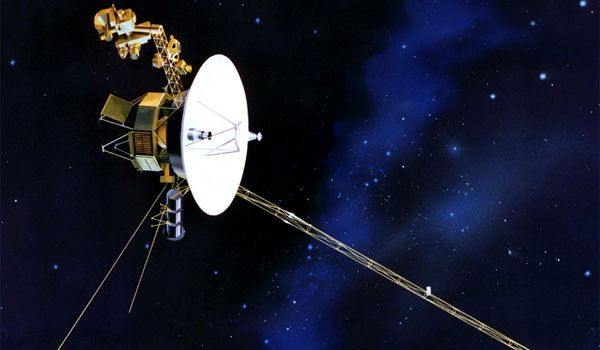
Forty-eight years ago, a pair of spacecraft left Earth on what was intended to be a five-year mission to explore the outer planets. They have long since surpassed that goal, becoming humanity’s farthest-flung outposts. Yet, as they drift through the void of interstellar space, they are only beginning to grasp the true scale of the cosmos. This November, Voyager 1 will reach a symbolic and profound milestone: it will become the first human-made object to travel a distance of one light-day from Earth. On November 18, 2026, at approximately 2:16 AM Pacific Time, the spacecraft will be roughly 25.9 billion kilometers (over 15 billion miles) from home, the distance that light, the universe’s speed limit, can cover in a single 24-hour day. This monumental achievement underscores a humbling reality—after nearly half a century of travel at over 61,000 kilometers per hour, Voyager 1 has barely left the cosmic doorstep.
This staggering distance brings with it a tangible, daily challenge: the immense communication delay. A radio signal, traveling at the speed of light, now takes nearly a full day to reach the probe, and any response from Voyager 1 takes another day to return to Earth. This means that for every command sent by engineers at NASA’s Jet Propulsion Laboratory, a wait of approximately 48 hours is required for a simple “good morning” and its reply. This two-day conversation window is a direct, visceral consequence of operating a machine at such an extreme frontier and highlights the patience and precision required to manage a spacecraft from so far away.
To keep this elderly explorer talking as long as possible, NASA engineers have been performing a delicate, high-stakes balancing act with its dwindling power supply. The spacecraft is powered by the decaying heat of plutonium-238, and its electrical power drops by about four watts each year. This has forced the mission team to make the difficult decision to systematically shut down science instruments. In April 2026, they commanded the shutdown of the Low-Energy Charged Particles (LECP) instrument, which had been operating almost continuously since the 1970s. This leaves Voyager 1 with just two active science instruments: a magnetometer and a plasma wave system—designed to measure the magnetic fields and charged particles of the interstellar medium. The shutdown was hastened by an unexpected power drop during a routine maneuver earlier in the year, prompting a proactive decision to conserve energy and avoid a more dangerous system fault. This “save” is expected to provide about a year of breathing room for the mission team as they plan a more ambitious, power-saving “Big Bang” reset for both Voyagers.
Even as it continues its scientific observations, sending back invaluable data at a meager 160 bits per second, Voyager 1 is also a cosmic time capsule. Tucked aboard is the Golden Record, a gold-plated phonograph disc curated by a team led by the late Carl Sagan. It carries a message for any intelligent life that might find it in the distant future, containing images, sounds of Earth, and greetings in over 50 languages. Voyager 1’s legacy is also imprinted on human consciousness through a single, poignant photograph. In 1990, at the request of Sagan, the spacecraft turned its cameras back toward its home planet for one last time. The resulting image, the famous “Pale Blue Dot,” showed Earth as a tiny, almost imperceptible speck suspended in a vast beam of sunlight, a powerful reminder of our smallness and fragility in the immensity of space.
Despite its incredible journey, its power source is finite. NASA estimates that the spacecraft will likely run out of power to operate any of its instruments by the early 2030s, at which point Voyager 1 will fall silent, becoming a ghost ship adrift in the galaxy. But its mission is far from over. It will continue its silent voyage, carrying the Golden Record. In about 300 years, it will reach the inner edge of the Oort Cloud, a vast shell of icy objects at the very edge of our solar system. It will take another 30,000 years to pass through it and into true interstellar space. In about 40,000 years, it will pass within 1.7 light-years of the star Gliese 445. Reaching the milestone of one light-day is a testament to human ambition and engineering, yet it also reveals a cosmic truth: in the grand scale of the universe, we are only just beginning to learn how to leave home.