June 18, 2026
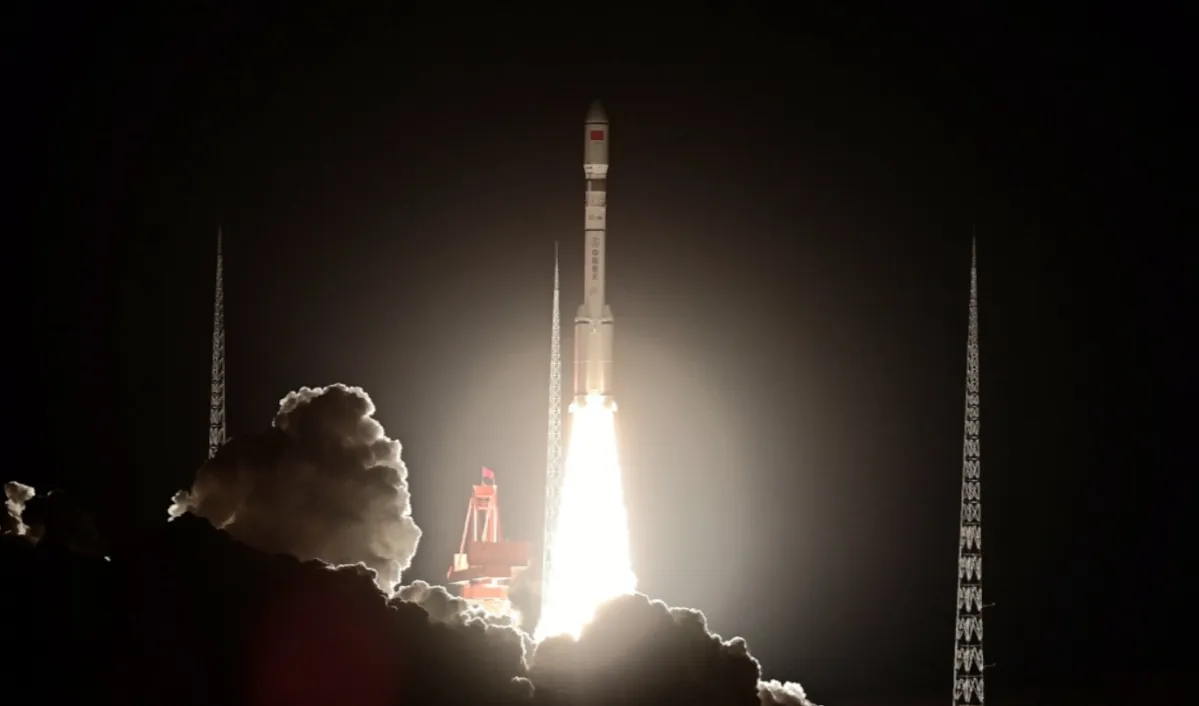
China completed a remarkable sequence of four orbital launches in just three days, demonstrating an accelerated launch pace that underscores the nation’s growing ambitions in space. The spree began with the successful June 9 launch of a Zhuque-2E Y6 carrier rocket from the Dongfeng commercial space innovation pilot zone, which placed two new satellites, the Spacesail DTC 01 and China Mobile 02, into their designated orbits.
This mission, the eighth for the Zhuque-2 series, was confirmed a success by its developer, the private Chinese company LandSpace. However, this rapid cadence was brought to an abrupt and mysterious halt following the liftoff of a Kuaizhou-11 solid rocket from the Jiuquan Satellite Launch Center in the Gobi Desert on the morning of June 17. The launch, which occurred at approximately 11:40 p.m. U.S. Eastern time on June 16 (03:40 UTC, June 17), was followed by an unusual and extended silence from both the launch vehicle’s manufacturer, ExPace, and Chinese state media. For more than eight hours after liftoff, no official word on the mission’s status was provided, a development that industry observers interpret as a strong indicator of a potential failure or a serious anomaly with the rocket or its payloads.
This conspicuous silence surrounding the Kuaizhou-11 mission stands in stark contrast to the immediate declarations of success that typically accompany Chinese launches. The Long March 12 rocket, for instance, launched just hours prior from the Hainan Commercial Space Launch Site, and the China Aerospace Science and Technology Corporation (CASC) promptly confirmed its success, stating the payloads were the 22nd group of satellite internet low-Earth orbit satellites for the national Guowang broadband constellation. This launch added to a growing fleet, bringing the total number of Guowang satellites in orbit to 177 as part of a planned 13,000-satellite network. The Kuaizhou-11, a larger version of Expace’s Kuaizhou-1A, has a history that makes this silence particularly concerning; its first launch in July 2020 ended in failure, though it had seen three successful missions since, including a rideshare in March 2026.
The ambiguity of the Kuaizhou-11’s fate on June 17 is compounded by conflicting reports from various sources. Some indications suggest the rocket may have failed late into its flight, potentially achieving only a shallow, sub-orbital trajectory. Other sources speculate that the launch vehicle might have reached its intended orbit, but at least one of its satellite passengers subsequently experienced a major malfunction. This uncertainty is further fueled by ExPace’s operational culture; unlike Western launch providers who often announce success or failure relatively quickly, Chinese commercial space entities have a preference for confirming mission success only after all customer payloads have been verified as healthy and communicative.
This cautious, payload-centric approach to public announcements can create significant delays, leaving the public and industry analysts in a state of suspense. The company’s history also provides a notable precedent for this opacity: a previous launch failure of its smaller Kuaizhou-1A went unacknowledged for an extended period, with the subsequent return-to-flight mission focusing instead on generic system upgrades rather than addressing the past failure directly. As one researcher familiar with the Chinese launch industry observed, “The extended silence is often more telling than an official statement. It suggests an internal investigation is already underway, and the priority is to secure the customer’s data and insurance claims, not to satisfy public curiosity.” This perspective highlights the calculated approach to risk and public relations that sometimes characterizes such events.
Despite the potential setback, the overall impact on China’s ambitious launch schedule for the year is expected to be minimal. The country is understood to be aiming to surpass the 100-launch mark for a calendar year for the first time in 2026, and this sequence of launches brought its total attempts for the year to 43. This includes a June 9 Zhuque-2E launch, the upper stage of which experienced a breakup in orbit the same day, a separate incident that U.S. Space Forces confirmed. The Kuaizhou-11, produced by Expace, plays a supplementary role in China’s overall launch capabilities, so a failure, while a blow to the company’s commercial reputation, would not critically derail the nation’s strategic launch plans for state-owned and large commercial constellations.
Nevertheless, the incident casts a shadow over what has otherwise been a period of high activity and technical achievement. Upcoming missions, including a Long March 7A rocket from Wenchang on June 23 and a Long March 8A from the Hainan commercial space launch center on June 27, are expected to proceed as planned. *A senior research scientist at a European space agency, commenting on the event, stated: “The rapid cadence we are witnessing is a testament to China’s industrial capacity. However, high-frequency launches also expose technical weaknesses that might have been masked at a slower pace. The silence following Kuaizhou-11 is a reminder that scaling up space operations is fraught with challenges.”*
In conclusion, the week of June 18, 2026, has been a defining one for China’s space program, marked by the extremes of both operational success and perplexing ambiguity. The successful deployment of satellites for the Guowang constellation and the rapid sequence of four launches from different sites exemplify China’s push towards becoming a dominant force in space, developing both its national infrastructure and commercial capabilities. Yet, the deafening silence from ExPace regarding the Kuaizhou-11’s fate serves as a potent counter-narrative. The failure to provide a timely update highlights the inherent risks of spaceflight and the less transparent aspects of the country’s burgeoning space industry. As the world awaits official word, the incident reinforces the reality that for all its ambition and progress, the path to the stars is still paved with potential pitfalls.