
June 24, 2026
In a discovery that has sent ripples through the planetary science community, researchers have detected a mysterious and as-yet-unidentified substance on the surfaces of two of the solar system’s most intriguing worlds: Saturn’s moon Titan and the dwarf planet Pluto . The finding, which leverages the unparalleled power of the James Webb Space Telescope (JWST), has unveiled a shared chemical fingerprint that defies current explanation, potentially unlocking new secrets about the complex organic chemistry that shapes these distant bodies. At first glance, Titan and Pluto appear to be worlds apart.
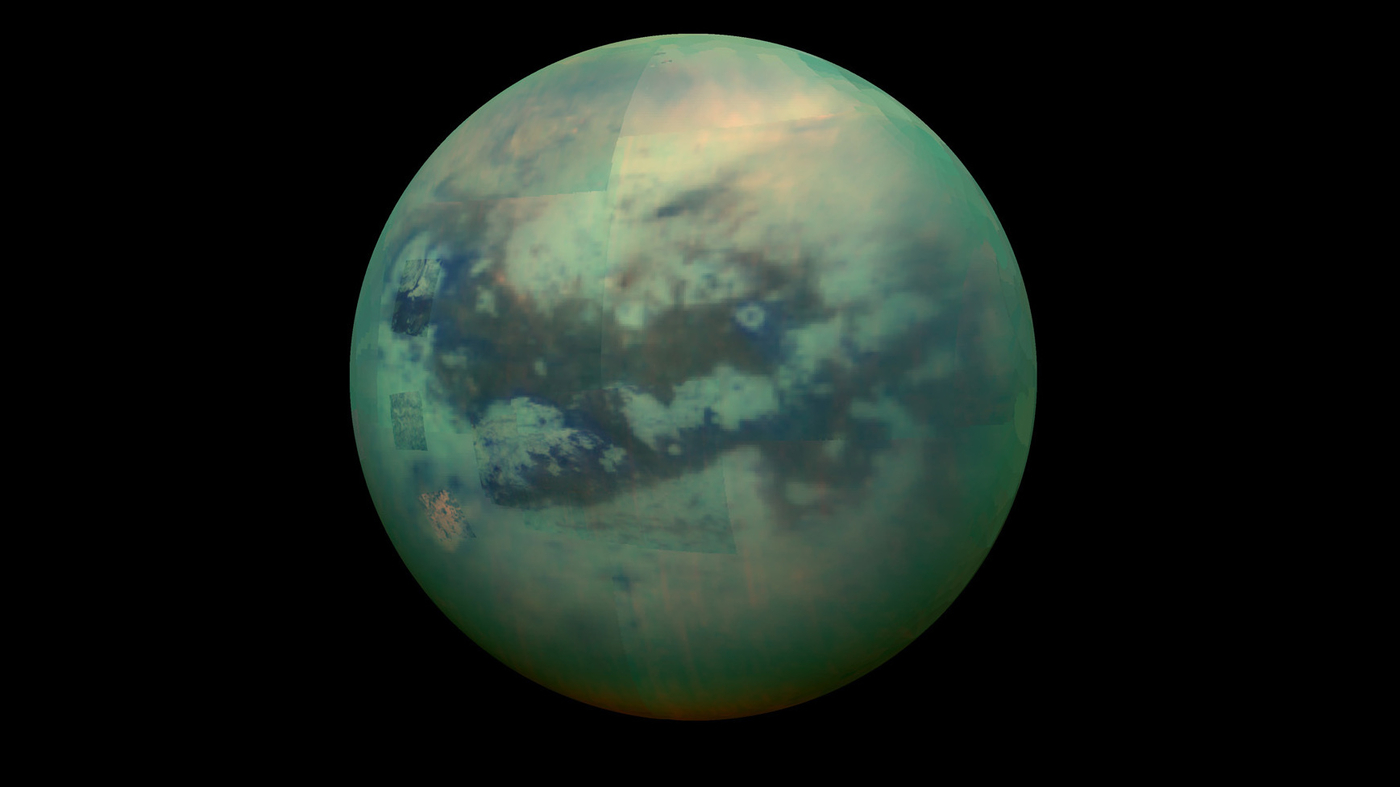
Titan is a large moon with a thick, hazy atmosphere, stable lakes of liquid methane, and a dynamic hydrological cycle, while Pluto is a smaller, frozen world at the edge of the solar system, far colder and with an atmosphere approximately 15,000 times less dense . However, both possess atmospheres predominantly composed of nitrogen and methane, a critical similarity that may hold the key to this enigma .
The discovery was made by a team led by Dr. Bruno Bézard of the Paris Observatory, who analyzed spectroscopic data from the JWST . By studying the specific wavelengths of light absorbed or reflected by distant objects, spectroscopy allows scientists to determine their chemical composition. In the JWST data, the researchers identified a narrow but distinct absorption feature at a wavelength of 5.11 micrometers on Titan, which was also present, albeit broader, on Pluto .
This suggests that a compound, or a family of closely related compounds, exists on both celestial bodies, absorbing light in a way never before cataloged. Dr. Bézard and his colleagues were unable to match this spectral signature to any known compound in extensive libraries of astronomical observations and laboratory spectra . “We looked at many simple ices that could be present due to the condensation of all the hydrocarbons and nitrates… and they don’t match,” stated Dr. Bézard, highlighting the perplexing nature of the find . “We have a few candidates, but it will not be a simple compound… Whatever it is, it will be a surprise” .
The prevailing hypothesis is that the unknown substance is the result of a shared chemical pathway on both worlds. Photochemical reactions in their nitrogen-methane atmospheres, driven by solar radiation, are known to produce complex organic haze particles called tholins . These particles gradually “snow down” and accumulate on the surface, where they could undergo further transformations . “Both atmospheres are mostly nitrogen and methane, so you have, in both, this chemistry in which haze particles are produced and they can snow down and accumulate on the surface,” Dr. Bézard explained, describing the probable formation mechanism . The fact that this feature appears on two such different bodies, one with a dense atmosphere (Titan) and one with a tenuous one (Pluto), is a powerful indicator that the substance is likely a surface compound, a product of atmospheric chemistry that has settled and accumulated over time .
While the exact identity of the molecule remains elusive, researchers have some leads. Candidate compounds include benzene, acetylene, and a family of molecules known as allenes, which could, under the specific physical conditions of each world, produce the observed spectral signatures . The broader absorption feature on Pluto compared to Titan suggests that the substance may exist in a different physical state or be mixed with other materials on the surface of the dwarf planet . To unravel this mystery, the research team is pursuing a multi-pronged strategy. They are analyzing additional JWST data to map the spatial distribution of the compound on Titan’s surface, correlating its presence with geological features like the vast dune fields . “It may be important,” Dr. Bézard noted. “Maybe it will help us to see if it correlates with some geomorphological feature at the surface, like with the vast dune fields” .
Simultaneously, laboratory experiments are being conducted to test whether the candidate molecules, when mixed or altered in Titan- or Pluto-like conditions, can reproduce the mysterious spectral fingerprint . Ultimately, the scientific community is looking forward to a definitive answer from the NASA Dragonfly mission, a nuclear-powered rotorcraft slated to launch in 2028 and land on Titan’s surface in 2034. While Dragonfly may not carry an infrared spectrometer to directly match the JWST data, its instruments will identify surface compounds, and researchers will work to connect those findings to this enigmatic spectral feature . This discovery is more than just a puzzle; it is a profound clue about the fundamental chemistry of our solar system. The presence of this compound on two disparate worlds with similar atmospheric chemistry suggests that prebiotic organic chemistry may be a common and widespread process in the universe . Understanding this substance could provide a unique window into the chemical evolution of not only these distant worlds but also the early Earth, where similar photochemical processes may have played a crucial role in the origin of life .