July 7, 2026
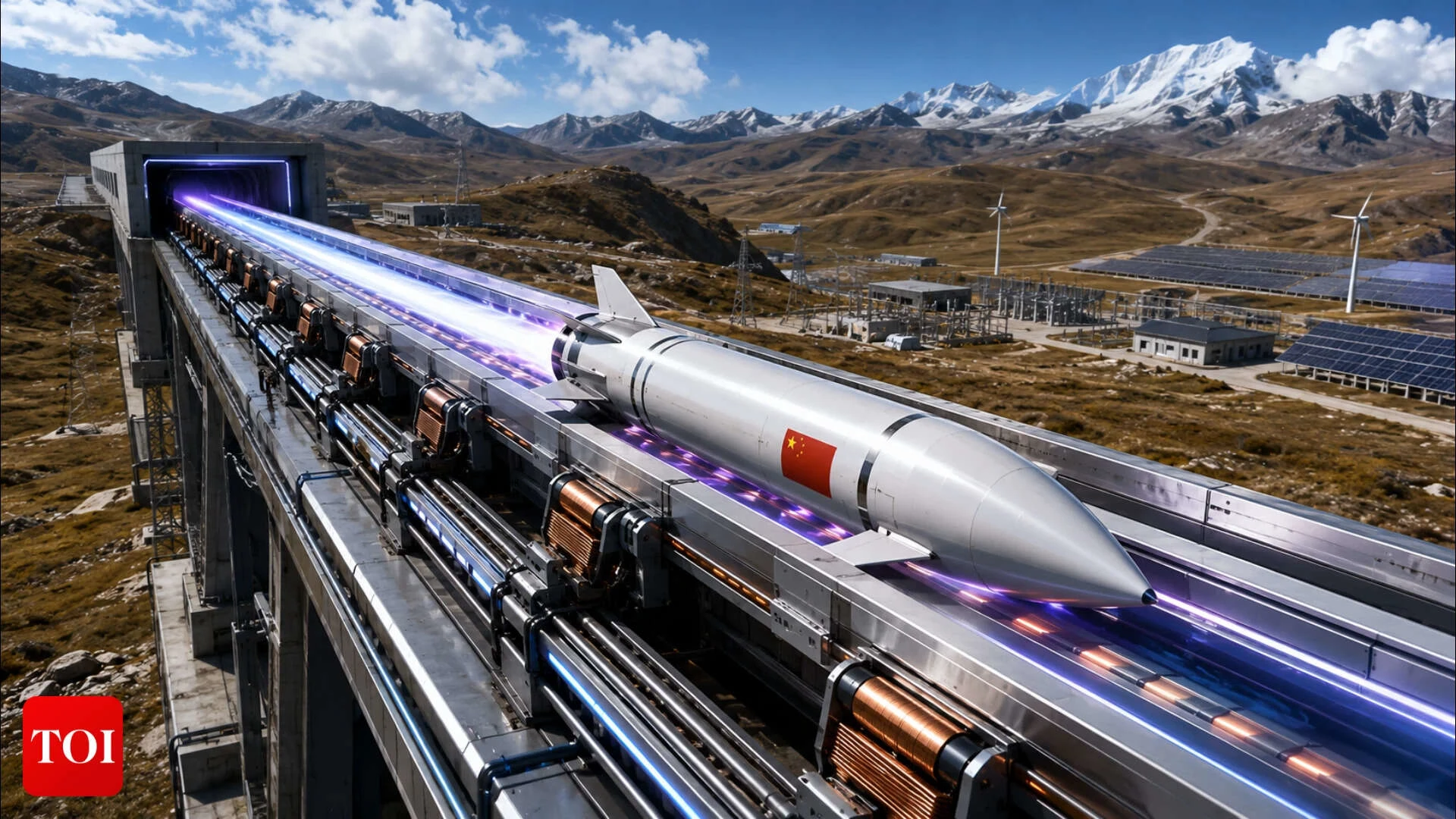
The narrative surrounding China’s space ambitions may be undergoing a dramatic shift, with the emergence of a next-generation kinetic launch system that could theoretically challenge the economic and logistical dominance of traditional chemical rockets. While the precise operational status of this “supersonic space catapult” on this date remains speculative, the concept, often tied to the principles of a mass driver or electromagnetic launch track, suggests a revolutionary method for propelling payloads into low Earth orbit (LEO).
The core technology typically relies on a long, evacuated tube and magnetic levitation to accelerate a payload-carrying capsule to hypersonic speeds—potentially exceeding Mach 5—before it exits the atmosphere, essentially treating a section of the Earth’s surface as a giant first-stage booster. This “catapult” would theoretically be capable of launching multiple payloads per day at a fraction of the cost of conventional rockets, primarily by replacing expensive, one-time-use chemical fuel with electricity as the primary energy source for the initial boost.
The primary advantage that makes this technology a contender to make traditional rockets obsolete is the radical reduction in cost per kilogram to orbit, which could fall from thousands of dollars to potentially hundreds[citation:2]. Traditional rockets, such as the Long March series or SpaceX’s Falcon 9, expend a significant portion of their mass and fuel simply escaping Earth’s gravity, with much of the fuel consumed in the first few minutes of flight. A launch system based on ground-based electrical power removes the need for massive fuel tanks and complex turbopumps, allowing for a much smaller, simpler, and reusable second-stage rocket to complete the orbital insertion. Furthermore, the absence of a fiery, fuel-rich liftoff reduces the environmental footprint and the stringent safety exclusion zones required for traditional launches, meaning the catapult could theoretically be built in high-altitude or remote regions to maximize velocity gains from the Earth’s rotation.
However, the path to making chemical rockets obsolete is fraught with colossal engineering hurdles that temper this optimism. The extreme acceleration forces generated by a supersonic electromagnetic launcher—often calculated to be in the hundreds or thousands of Gs—pose a massive risk to sensitive satellite electronics and structural integrity, effectively limiting its use to robust cargo, fuel, or resilient raw materials rather than delicate human astronauts or complex telescopes. Additionally, the aerodynamic heating experienced by a projectile traveling at hypersonic speeds within the dense lower atmosphere is intense, necessitating advanced thermal protection systems that add weight and complexity, potentially eroding the cost advantage. For this “space catapult” to truly render rockets obsolete on July 7, 2026, it would require a breakthrough in superconductor technology, a massive and reliable energy grid, and a tube extending tens of kilometers in length—infrastructure that is currently economically and geographically challenging to construct.
In the context of the global space race, China’s pursuit of such a system highlights a strategic focus on alternative access-to-space technologies. Even if the catapult does not completely replace traditional rockets on this date, it could still serve a complementary role, handling the high-volume, low-sensitivity payloads while rockets continue to handle the high-value, heavy, and human-rated missions. The implication for military and commercial applications is profound, as a working catapult would allow for a rapid, responsive launch capability—replenishing satellite constellations in a matter of hours rather than weeks.
Despite the promise, experts generally agree that chemical rockets will remain indispensable for deep-space missions, such as those headed to the Moon or Mars, where the velocity requirements far exceed the energy-efficient constraints of a ground-based accelerator, and where in-space propulsion is still necessary. Thus, while the “space catapult” represents a fascinating and potentially disruptive technological leap, its role on the 2026 timeline is likely to be that of a specialized adjunct to space logistics, rather than a comprehensive and immediate replacement for the chemical rockets that have defined the space age.