July 4, 2026
The details emerged regarding China’s latest defense innovation: a highly mobile, truck-mounted Electromagnetic Aircraft Launch System (EMALS) engineered for completely runway-free drone deployments. The technology, showcased in a video demonstration released by the Beijing Institute of Technology’s (BIT) School of Mechanical Engineering, represents a transformative shift toward highly dispersed, agile, and resilient unmanned aerial vehicle (UAV) warfare. By entirely eliminating the historical necessity for traditional, permanent, and highly vulnerable paved airfields, this innovative mobile system drastically enhances both the operational survivability and the tactical flexibility of fixed-wing military drones in heavily contested battle spaces.
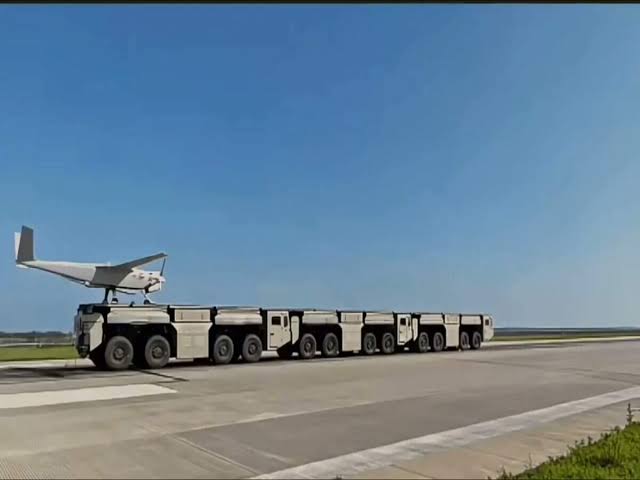
The physical architecture of the newly revealed launcher utilizes a unique modular design comprised of three eight-wheeled heavy flatbed trucks. When traveling in transit, these vehicles are designed to blend seamlessly into ordinary civilian logistics networks, appearing to casual observers and satellite surveillance as standard commercial freight transport trucks. However, upon arriving at a designated operational area—which can be any relatively flat clearing, highway, or dirt field—the three heavy trucks pull into a precise, interconnected linear formation and lock together end-to-end using specialized heavy mechanical connectors. This rapid synchronization physically, structurally, and electronically fuses the separate flatbeds to form a continuous, robust electromagnetic launch rail measuring roughly sixty meters in length.
At its core, this ground-based mobile launcher adapts the exact same linear induction motor technology utilized aboard the People’s Liberation Army Navy’s (PLAN) Type 003 Fujian aircraft carrier. Instead of relying on conventional, high-maintenance launch mechanisms like volatile chemical rocket boosters, pneumatic compressed air systems, or slow-recharging hydraulics, the system utilizes powerful linear electric motors to generate a moving magnetic field. A fixed-wing drone is secured to a specialized launching shuttle that sits directly on the rail. When the firing sequence is activated, a massive electrical wave ripples down the track’s independent magnetic coils, sequentially driving the shuttle and the attached drone forward with rapid, ultra-smooth acceleration that safely reaches maximum velocity in a matter of seconds.
Managing such an instantaneous and immense electrical surge requires a sophisticated on-board power distribution network that operates completely independent of external grids. Each of the heavy trucks is equipped with an advanced Medium Voltage Direct Current (MVDC) supercapacitor system integrated directly into its undercarriage. These supercapacitors pull power continuously from onboard diesel generators to gradually accumulate a incredibly dense electrical charge. When the final firing command is given, this stored energy is dumped into the modular track in a fraction of a second. Highly advanced coordination software treats the separate, fragmented truck beds as a single continuous track, precisely timing the high-energy magnetic pulses to bridge the physical gaps between the vehicle platforms flawlessly as the shuttle glides over them.
Performance data indicates that the truck-mounted EMALS is fully capable of accelerating aircraft weighing up to 2.2 metric tons (approximately 4,400 pounds) to terminal takeoff speeds of up to 50 meters per second within a very brief window. While this weight capacity is too low to launch heavy, manned fighter jets, it perfectly hits the sweet spot for modern Medium-Altitude Long-Endurance (MALE) unmanned aerial vehicles. Drones equivalent to China’s GJ-1 or Wing Loong I series, as well as emerging jet-powered collaborative combat aircraft (CCA) and “loyal wingman” platforms, can be deployed effortlessly. Once the accelerated drone reaches the end of the 60-meter rail, it cleanly separates from the launching shuttle and transitions seamlessly to self-sustained powered flight using its own internal propulsion engine.
The demonstration video also highlighted highly advanced mobility and alignment features designed for rapid battlefield adaptation, including an integrated all-wheel steering system. Despite being a chained, three-truck formation locked end-to-end, the entire connected platform boasts an incredibly tight turning radius, enabling it to navigate sharp turns, restricted rural roads, or dense forest pathways with ease. More importantly, this steering flexibility allows operators to dynamically rotate the entire sixty-meter launch rail on the spot to perfectly align with prevailing headwinds before a launch. Positioning a fixed-wing aircraft directly into a headwind drastically maximizes lift-off efficiency, minimizes the ground speed required for takeoff, and significantly elevates operational safety margins during high-speed ejections.
The overriding strategic motivation driving the development of this technology is the absolute negation of fixed runway dependencies during peer-to-peer conflicts. In modern warfare, permanent military airbases, long paved runways, and heavily defended airports are highly prioritized targets that are virtually guaranteed to be severely cratered or entirely neutralized on day one by long-range precision-guided ballistic missiles, cruise missiles, and loitering munitions. Because permanent runways are permanently visible to adversarial satellite reconnaissance, they have become severe tactical liabilities. This mobile EMALS effectively creates a pop-up, runway-free airbase that can roll out of a hidden forest or mountain tunnel, deploy a squadron of heavy surveillance or attack drones, unclamp, and immediately scatter before an adversary can coordinate a kinetic counterstrike.
Furthermore, this mobile EMALS is not an isolated experimental prototype, but rather a core pillar of a broader, massive military modernization initiative known as the Containerized Weapon Module Suite. Led by the Beijing Institute of Technology, this ambitious defense project involves a sprawling coalition of more than seventy distinct Chinese research institutions. The overarching objective of the program is to standardize diverse, hard-hitting military capabilities into identical dimensions that match global commercial shipping containers. Beyond the electromagnetic drone catapult, the comprehensive suite includes at least ten additional modular variants encompassing containerized anti-ship missiles, land-attack cruise missiles, air defense systems, electronic warfare jamming pods, radar detection networks, close-in weapon systems, and automated command-and-control hubs.
The standardized container design opens up a highly disruptive maritime application, allowing China to rapidly and secretly convert its massive commercial shipping fleet into auxiliary military assets. Because the EMALS catapult is fully self-contained on the truck frames and requires absolutely zero structural modification to a ship’s hull, these modules can simply be driven or craned onto the flat decks of standard commercial container ships or roll-on/roll-off (Ro-Ro) civilian ferries. This exact operational concept was recently observed when the segmented EMALS and associated weapon modules were loaded onto the civilian cargo ship Zhong Da 79. This capability enables China to turn any generic merchant vessel into a localized, auxiliary drone carrier during regional maritime contingencies.
The unprecedented scale of this project points to a highly coordinated doctrine of low-cost, high-density swarm warfare backed by immense deep military industrial capacity. The Beijing Institute of Technology has reportedly established an aggressive initial production target of up to 2,000 containerized weapon sets annually, with plans to export these modular systems to Belt and Road Initiative (BRI) partners and Global South nations. While international defense analysts note that these containerized systems cannot fully substitute for the complex radar, anti-submarine warfare, and damage-control capabilities of dedicated naval destroyers, they provide an unparalleled, low-cost asymmetric method to project massive firepower, dense swarm attacks, and persistent reconnaissance across contested domains worldwide.