July 4, 2026
The dream of harvesting solar power in space and beaming it down to Earth—a concept long confined to the realms of science fiction—is on the cusp of becoming a stunning reality. The monumental technological breakthroughs and ambitious projects from around the world signal that Space-Based Solar Power (SBSP) is not just a theoretical possibility but an impending revolution in how we generate energy. This year marks a pivotal moment, with key experiments and plans moving forward at an unprecedented pace, promising an inexhaustible source of clean energy for humanity.
In a groundbreaking development, Japan is poised to achieve a world-first with its OHISAMA demonstration satellite. Scheduled for launch in fiscal year 2026 aboard Space One Co.’s Kairos 5 rocket, this mission aims to be the first in history to successfully deliver solar power from orbit to a receiving site on Earth and convert it into usable electricity. The OHISAMA satellite, equipped with an integrated power-generation and transmission panel, will generate a modest 720 watts of power and will beam microwaves from a 450-kilometer orbit down to a 64-meter parabolic antenna at the Japan Aerospace Exploration Agency’s Usuda Deep Space Center.
The ultimate goal of this experiment is to use the received energy to light an LED, demonstrating a complete end-to-end power transmission system. This follows Japan’s successful wireless power transmission test from an aircraft in 2024, proving that the nation is a leader in this critical technology. A successful test would likely be a precursor to additional orbital trials, with the ultimate goal of commercialization by the 2040s, potentially providing 1 gigawatt of power—enough to cover more than 10 percent of Tokyo’s annual electricity consumption—from a single space-based unit.
Concurrently, China is making spectacular strides with its “Zhuri” or “Sun Chasing” project, spearheaded by a team from Xidian University led by academician Duan Baoyan. Recent milestones include breaking multiple key technologies for space solar power stations and microwave wireless power transmission, achieving kilowatt-level power output over distances of 100 meters and successfully demonstrating a “one-to-many” wireless power transmission system for moving targets on the ground. This system, which achieved a wireless power transmission efficiency of 20.8% from direct current to direct current, is a crucial step toward building a full-scale space power plant.
It validates the core principle of converting solar energy to microwaves in space and beaming them to a receiving antenna, or “rectenna,” on Earth. With work already underway in Chongqing to build an experimental space power plant, China intends to send a small-to-medium-sized station into the stratosphere between 2021 and 2025, and a megawatt-level station by 2030, aiming to become the first country to build a space-based solar plant with practical value. The Chinese Academy of Engineering has highlighted that this technology could address energy shortages on Earth while also supplying uninterrupted power for space missions, including directly charging drones and spacecraft.
The competitive landscape extends beyond Asia, with Europe and the private sector also making substantial inroads. A February 2026 UK government report, conducted by Frazer-Nash Consultancy and Imperial College London, has proposed an innovative and practical approach to SBSP. It suggests integrating the ground-receiving stations, or rectennas, directly into existing offshore wind farms, thereby utilizing their established grid connections to deliver clean, continuous power without the need for new, costly infrastructure.
This study calculates that by 2040, the cost of SBSP could be competitive with other commercial renewable energy sources, with launch costs potentially dropping to as low as £550 per kilogram to orbit. This is driven by the advent of reusable rockets from companies like SpaceX, which is making the concept economically viable. The report envisions that a single space-based platform could generate up to 2 gigawatts of reliable, around-the-clock power, effectively operating like a large nuclear reactor but without the associated waste or safety concerns.
Meanwhile, American startups are creating novel business models to accelerate the deployment of space-based power. Verde Technologies, a perovskite solar panel startup, is pivoting its focus from terrestrial rooftops to space. Their lightweight, flexible, and radiation-tolerant perovskite panels offer a power-to-mass ratio that is roughly 50 times better than silicon and are up to 1000 times more radiation-tolerant, and they anticipate hundreds of gigawatts of demand for space solar power in the coming years from orbital data centers and megaconstellations. Furthermore, the company Overview Energy has struck an agreement with Meta to beam a gigawatt of power to its AI data centers starting in 2030. Their unique method uses near-infrared lasers to transmit power to existing solar panels on the ground, effectively allowing them to generate electricity at night and providing a 24/7 power supply for energy-intensive operations. This competitive drive, coupled with initiatives from the US military and other nations like India, underscores that the race to unlock the power of space solar is accelerating across the globe.
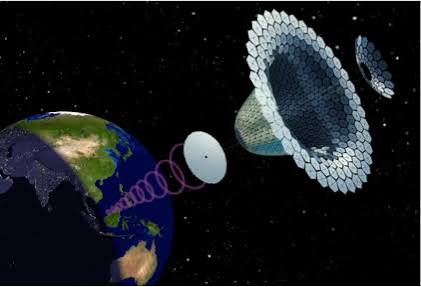
The technology behind SBSP is as elegant as it is ambitious. The core principle involves placing massive solar collectors in geostationary orbit, approximately 36,000 kilometers above Earth, where the sun shines continuously without atmospheric interference or the day-night cycle. In space, the solar energy density can reach around 1,360 watts per square meter, compared to just 200-300 watts per square meter on Earth’s surface. This energy is collected by the station and converted into high-frequency microwaves or lasers. These energy beams are then transmitted wirelessly through the atmosphere to receiving stations on the ground, called rectennas, which can be several kilometers in diameter.
The rectennas capture these microwaves and convert them back into direct current (DC) electricity, which is subsequently fed into the power grid for use. Unlike terrestrial solar and wind power, which are intermittent, space-based power can provide a stable, baseload source of clean energy that is largely unaffected by weather or time of day. This reliability, combined with the potential to deliver up to 13 times more energy per year than an identical installation on Earth, is what makes SBSP a truly transformative solution for the world’s growing energy crisis and climate change goals.