
July 12, 2026
The global space industry witnessed a paradigm shift as China successfully landed a reusable rocket booster, joining the ranks of Elon Musk’s SpaceX and Jeff Bezos’ Blue Origin. This milestone was achieved during the maiden launch of the Long March-10B carrier rocket by the state-owned China Aerospace Science and Technology Corporation (CASC) from the Hainan International Commercial Aerospace Launch Center . The mission saw the 63.6-meter-tall, liquid-fueled rocket lift off at 12:15 PM local time and successfully deploy a satellite into its designated orbit.
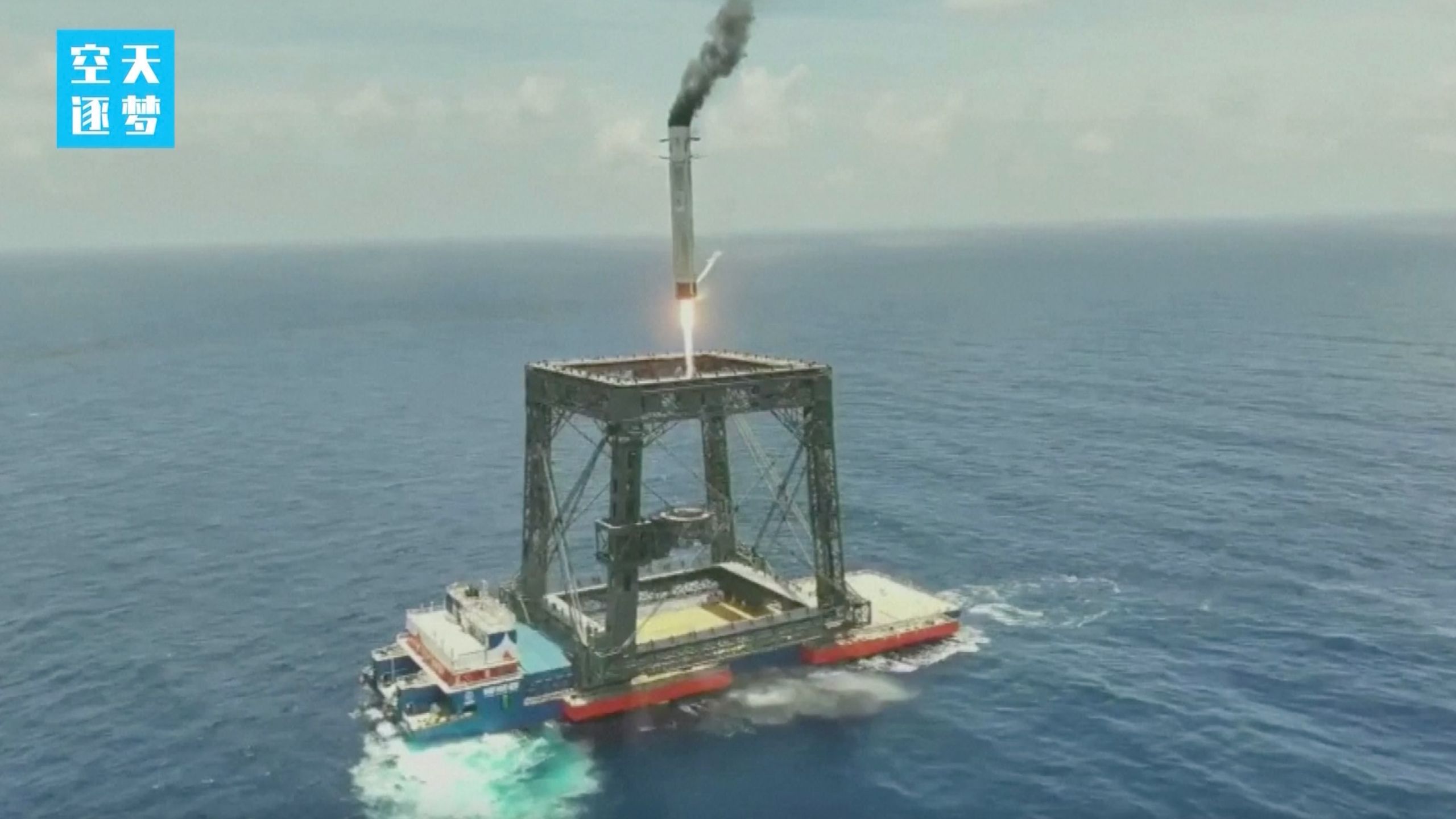
Approximately six minutes after separating from the rocket’s upper stage, the first-stage booster performed a controlled vertical return to Earth and was successfully recovered on a floating sea platform . This event is monumental as it marks the world’s third successful recovery of an orbital-class rocket booster, breaking the decade-long duopoly held by American aerospace firms. Over 600 such landings have been achieved by SpaceX, which pioneered the technology in December 2015, while Blue Origin achieved its first success with the New Glenn rocket in November 2025 . China’s breakthrough, coming after two failed attempts by other domestic rockets last December, signifies a major leap for the country’s space program and its ambition to compete in the lucrative commercial launch market .
What distinguishes China’s accomplishment is not just the success, but the innovative method by which it was achieved. Unlike the American approach where rockets deploy landing legs to touch down on ground pads or drone ships, the Long March-10B employed a world-first “net-based recovery” system . In this novel approach, the descending booster, equipped with specialized “landing hooks,” was caught by a high-tension wire net suspended on a retrieval ship named Linghangzhe . After the initial capture, auxiliary cables stabilized the booster before a clamping platform locked it into place, fully securing the 760-metric-ton rocket .
Chen Muye, a structural designer for the rocket, noted that this method removes the need for complex landing legs, thereby reducing the rocket’s structural weight and boosting its payload capacity . The successful verification of this system marks the first controlled recovery of a rocket’s first stage for China and represents a significant breakthrough in its reusable rocket technology . This innovation is a strategic move to drastically lower launch costs, a key factor that has made SpaceX the dominant global launch provider .
The Long March-10B is a powerful rocket in its own right. In its reusable configuration, it is capable of carrying a payload of up to 16 metric tons to low-Earth orbit (LEO), drawing frequent comparisons to SpaceX’s workhorse Falcon 9 . However, the technical gap with the current market leader remains significant; the Falcon 9 can lift approximately 22,800 kilograms to LEO, while Starship, designed for over 100 tonnes, represents the next frontier . Even so, industry analysts view this as a critical step for China’s commercial aspirations, particularly for building its own massive satellite internet constellations, akin to SpaceX’s Starlink .
Wang Wei, a project manager for the Long March 10 series, stated that the rocket will “fill the domestic gap in reusable launch vehicle technology” and “drastically reduce commercial launch costs”, enhancing China’s global competitiveness . The success was immediately felt economically, with shares of Chinese space companies surging . Following this historic achievement, CASC has indicated plans to reuse the recovered booster before the end of the year, promising a new, more competitive era in the global space race .