17 July 2026
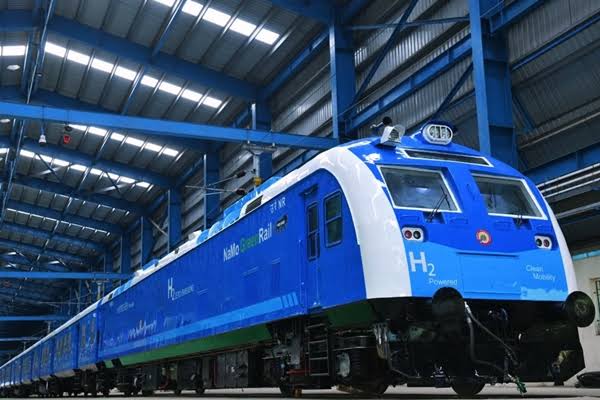
Today India reaches a momentous milestone in the history of global sustainable transport as Prime Minister Narendra Modi officially flags off India’s first hydrogen fuel cell trainset. This historic debut, operating on the 89-km Jind–Sonipat section of the Northern Railway in Haryana, propels Indian Railways into an elite global club of nations—alongside Germany, Japan, China, and the United States—actively implementing hydrogen propulsion systems. Representing the pinnacle of indigenous engineering under the Atmanirbhar Bharat initiative, this pilot project translates the core objectives of the National Green Hydrogen Mission into tangible rolling stock. Far exceeding a mere technology showcase, the launch establishes a completely self-sustaining, zero-emission hydrogen rail ecosystem that handles everything from localized production and high-pressure dispensing to multi-layered passenger safety protocols.
The architectural backbone of this new-era train relies on Proton Exchange Membrane Fuel Cell (PEMFC) technology. Unlike traditional diesel locomotives that burn fossil fuels or conventional electric trains that draw power from external overhead lines, this hydrogen trainset acts as a fully self-contained, rolling power plant. Inside the fuel cells, compressed hydrogen gas stored in specialized roof-mounted cylinders combines electrochemically with oxygen drawn directly from the surrounding atmosphere. The resulting chemical reaction generates electricity to drive the train’s traction motors while producing absolutely zero carbon emissions, smoke, or particulate matter. The only direct byproducts of this highly efficient process are completely harmless water vapour and heat, signaling a massive victory for environmental preservation.
Engineering excellence is highly evident in the train’s configuration and power metrics. The broad-gauge trainset is a 10-coach formulation consisting of two Hydrogen Driving Power Cars (DPCs) and eight passenger trailer coaches. Strategically positioned at each end of the train, the two DPCs feature a combined total power output of 2,400 kW (1,200 kW or 1,600 horsepower per DPC), giving it the necessary muscle to easily propel a packed train up to its maximum operational speed of 75 km/h, following successful high-speed trials that capped out at 120 km/h. To optimize power delivery during fluctuating operational demands—such as sharp accelerations or steep gradients—each DPC seamlessly integrates its fuel cells with advanced lithium iron phosphate (LFP) hybrid batteries, which store surplus energy and buffer power distribution. This design also breaks international precedents; while most global hydrogen deployments are restricted to short regional runs with tiny 2-to-4-coach configurations, India’s massive 10-coach setup boasts a massive passenger capacity of approximately 2,600 people, proving that clean energy can scale to meet heavy public transit demands.
The successful deployment of the train was made possible through rigid collaborative institutional governance. The comprehensive technical blueprints and design approvals were strictly formulated by the Research, Design & Standards Organisation (RDSO). The intricate system integration was flawlessly executed by M/s Medha Servo Drives, while the famous Integral Coach Factory (ICF) designed the train’s sleek, modern exterior aesthetics. Prior to the launch, the train underwent grueling multi-stage safety inspections and oscillation tests by the Commissioner of Railway Safety (CCRS). Furthermore, because handling volatile gases requires top-tier clearance, the infrastructure secured formal statutory licensing from the Petroleum and Explosives Safety Organisation (PESO) for the safe containment and refuelling of Compressed Hydrogen Gas (CHG).
To reliably sustain daily operations, Indian Railways has built the country’s largest dedicated railway hydrogen storage and refuelling facility at Jind, Haryana. This state-of-the-art facility is engineered around a localized green fuel framework that utilizes solar or wind energy to execute water electrolysis, effectively splitting water molecules into pure hydrogen and oxygen gas. The facility produces an impressive 430 kg of green hydrogen per day and maintains an on-site indigenous storage capacity of nearly 3,000 kg. To guarantee rapid turnaround times, a sophisticated hydrogen compression system compresses the gas up to 500 bar for storage before feeding it to the trainset at 350 bar through two independent dispensers, enabling both power cars to refuel simultaneously. The inclusion of a robust standby compressor ensures that refuelling remains entirely uninterrupted even during routine maintenance schedules.
Given that hydrogen is an invisible, odorless, and highly flammable gas, the engineering teams adopted the internationally acclaimed “defence in depth” design principle, weaving multiple independent safety nets together. The train and the refuelling plant are packed with ultra-sensitive hydrogen leak detectors, heat sensors, flame sensors, and smoke detectors that continuously cross-examine the system to identify risks within seconds. This is reinforced by a non-stop automated ventilation system that keeps air cycling through the coaches at all times. In the minor event of an isolated leak, the rushing air dilutes and carries the hydrogen harmlessly into the open atmosphere rather than letting it pocket inside the structure. If parameters cross safety thresholds, an automatic shut-off system instantly cuts off the main hydrogen supply at the source. Additionally, the Loco Pilot’s cabin features an isolated emergency override mode, allowing the pilot to safely move the vehicle away from danger zones while viewing real-time system health data on an integrated diagnostic screen.
Ultimately, this maiden run between Jind and Sonipat serves as India’s foundational testbed for green rail tech. During this crucial initial pilot phase, the refuelling infrastructure will operate under strict 24×7 monitoring by certified technicians who will also accompany the train to gather real-world data on maintenance cycles and component wear. The institutional knowledge gained on this route is already slated to power the retrofitting of India’s historic narrow-gauge heritage lines, such as the iconic Kalka–Shimla route. By successfully transitioning from the legacy of coal, steam, and diesel into the carbon-neutral promise of hydrogen fuel cells, Indian Railways has solidified its path toward a completely green future.