
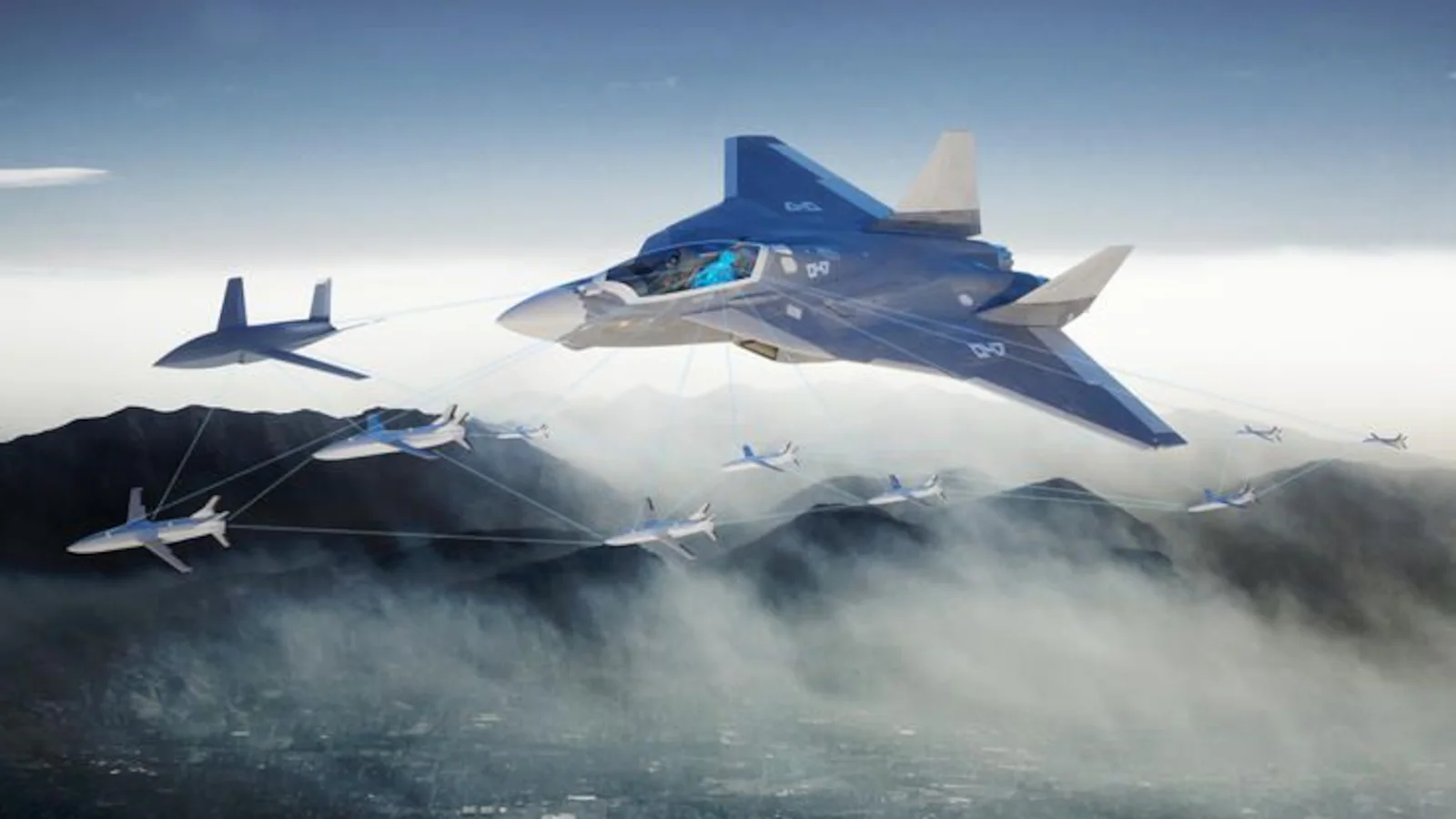
In a definitive move to future-proof its air combat capabilities, India has formally initiated concerted efforts to join the French-led Future Combat Air System (FCAS), entering the global race for sixth-generation fighter jet technologies. The decision was officially revealed by the Ministry of Defence in its Action Taken Reply submitted to the Parliamentary Standing Committee on Defence, which tabled its 25th report in the Lok Sabha. Marking a strategic pivot in New Delhi’s long-term aerospace roadmap, the ministry confirmed that it has moved beyond passive evaluation to actively pursue co-development and co-manufacturing rights within the French sixth-generation initiative. This development positions India as a potential co-architect of next-generation combat aviation rather than merely a recipient of off-the-shelf foreign equipment.
The decision comes against the backdrop of an intense global competition between two primary Western sixth-generation initiatives: the European FCAS and the UK-Italy-Japan Global Combat Air Programme (GCAP). While the Indian Air Force had previously examined both consortia to determine the best technological fit, New Delhi ultimately opted to focus its diplomatic and military procurement efforts on the French program. The parliamentary panel had previously cautioned the government against lagging behind in the rapid technological leap toward sixth-generation warfare, emphasizing that the long development cycles of modern combat aircraft require early equity investments, tech-sharing frameworks, and industrial workshare allocations well before platforms enter operational service.
The timing of India’s formal push aligns with significant structural realignments within the FCAS project itself. Originally launched as a trilateral venture among France, Germany, and Spain to replace Rafale and Eurofighter fleets by around 2040, the project faced years of bitter friction between primary contractors Dassault Aviation and Airbus Defence and Space over program leadership, flight-control software, and intellectual property ownership. These escalating disagreements culminated in the restructuring of the joint crewed fighter element, leaving France open to pursuing the Next Generation Fighter (NGF) under Dassault with new international partners. For Paris, bringing India aboard offers a financially robust, technologically ambitious partner with a vast defense market, shared requirements for long-range strike capabilities, aircraft carrier compatibility, and a non-aligned philosophy of strategic autonomy.
Unlike conventional fifth-generation platforms centered strictly around stealth and sensor fusion, sixth-generation air combat is defined as a multi-domain “system of systems.” At its core, the FCAS architecture integrates a highly survivable crewed fighter jet operating as an airborne command center alongside autonomous unmanned combat aerial vehicles (UCAVs) and swarming “remote carriers.” These platforms are interlinked via an ultra-secure, AI-driven “Combat Cloud” digital network that continuously synthesizes battlespace data, conducts electronic warfare, and executes precision strikes across air, land, sea, space, and cyber domains in real time. By participating in FCAS, India aims to acquire key foundational capabilities in artificial intelligence algorithms, direct energy weapons, advanced stealth coatings, and networked swarm control.
A major catalyst driving India’s sense of urgency is the rapid expansion and technological maturation of the Chinese People’s Liberation Army Air Force (PLAAF). China has accelerated the deployment of its fifth-generation J-20 and J-35 stealth fighters while concurrently testing prototype sixth-generation airframes, unmanned loyal wingmen platforms, and long-range hypersonic missiles along the Indo-Pacific theater. To maintain a credible deterrence capability along its northern borders, the Indian Air Force recognizes that upgrading existing fourth-generation assets like the Su-30MKI will be insufficient on its own. Joining a top-tier sixth-generation initiative provides a direct technological hedge against evolving regional threats and ensures India does not face an asymmetric capability gap in future air warfare.
Crucially, defense officials have emphasized that joining the France-led FCAS will complement, rather than replace, India’s flagship indigenous Advanced Medium Combat Aircraft (AMCA) project. Developed under the Aeronautical Development Agency (ADA) and Defence Research and Development Organisation (DRDO), the AMCA remains India’s premier fifth-generation stealth fighter effort, targeting its first flight around 2029. While AMCA Mk1 and Mk2 focus on building domestic design, manufacturing, and systems-integration expertise, co-joining FCAS allows Indian engineers to gain direct insight into leapfrog technologies—such as sixth-generation propulsion, advanced avionics architecture, and autonomous teaming—which can later be retrofitted into upgraded variants of indigenous fighters.
The move further consolidates an exceptionally deep India-France strategic defense relationship that has expanded across multiple aviation domains. Beyond the operational success of the IAF’s 36 Rafale jets and the ongoing acquisition of 26 Rafale-Marine fighters for the Indian Navy, New Delhi and Paris are currently negotiating a major procurement of 114 Multi-Role Fighter Aircraft (MRFA) with extensive Make-in-India manufacturing provisions. Simultaneously, French engine giant Safran is collaborating with DRDO’s Gas Turbine Research Establishment (GTRE) to joint-develop a powerful 120-kilonewton (kN) high-thrust jet engine. This engine co-development program directly bridges India’s domestic needs for the AMCA Mk2 with the high-power, high-thermal demands of sixth-generation propulsion systems like FCAS.
Despite the strategic promise, the Parliamentary Standing Committee on Defence has requested that the Ministry of Defence submit a comprehensive roadmap, status report, and tentative timeline. Lawmakers have signaled the need for prudence, mindful of past international joint ventures like the joint Su-57/FGFA program with Russia, from which India withdrew in 2018 due to persistent disputes over technology transfer, workshare, and cost transparency. The parliamentary committee reiterated that securing unfettered access to critical source codes, domestic maintenance sovereignty, and substantial industrial participation for Indian defense firms must be hardcoded into any final agreement with France.
Looking ahead, India’s entry into the sixth-generation combat arena represents a pivotal transition from legacy defense procurement to high-technology co-creation. As formal negotiations between New Delhi and Paris progress, defining the exact distribution of technical work packages, funding commitments, and intellectual property rights will determine the speed and success of the partnership. If successfully executed, India’s involvement in FCAS will not only transform the tactical capabilities of the Indian Air Force over the coming decades but also catalyze the growth of the domestic private aerospace ecosystem, solidifying the nation’s position as a major player in next-generation global defense technology.