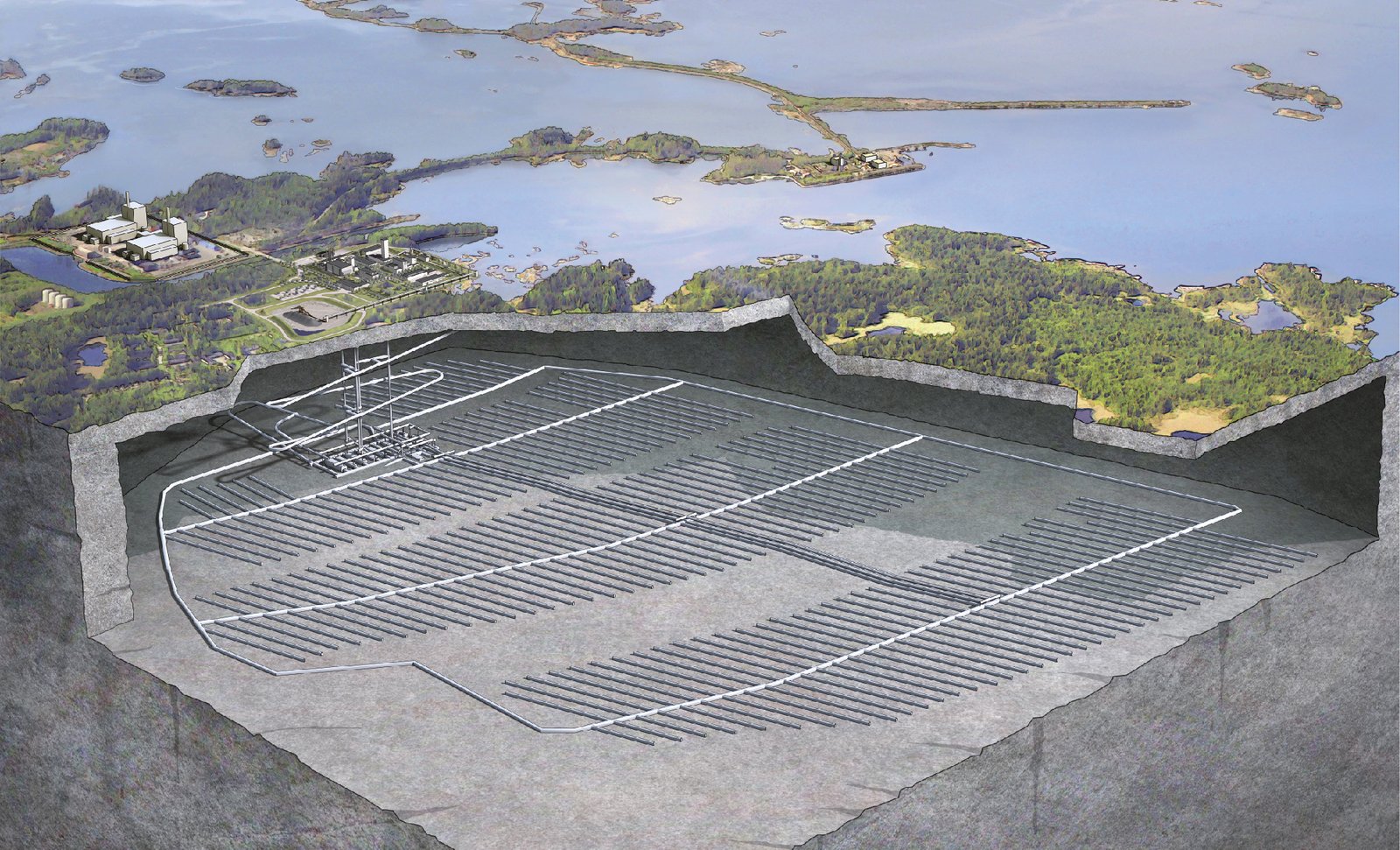
In a landmark step for nuclear waste management, Sweden has officially begun construction of a permanent deep geologic repository for spent nuclear fuel, a project designed to safely isolate highly radioactive waste for the next 100,000 years . This initiative, led by the Swedish Nuclear Fuel and Waste Management Company (SKB), marks one of the world’s first attempts to create a final resting place for high-level nuclear waste, tackling a profound challenge that has accompanied nuclear energy since its inception . The repository is being built at Forsmark, on Sweden’s east coast, about 140 kilometers north of Stockholm, and its construction signifies a monumental achievement in engineering, geology, and long-term societal planning .
The Swedish government granted the final license for the repository and an associated encapsulation plant in January 2022, with an environmental permit following in October 2024 . After decades of research and development, surface work began in early 2025, including forest clearance and the construction of support facilities, with full-scale rock excavation slated to commence shortly after . The repository is being built in stable, 1.9 billion-year-old granite bedrock, located 500 meters underground, a site chosen for its geological stability and favorable groundwater conditions following an extensive site selection process that concluded in 2009 . When fully developed around the 2080s, the underground complex will consist of approximately 60 kilometers of tunnels and have the capacity to hold 12,000 tonnes of spent nuclear fuel in about 6,000 canisters .
The core of Sweden’s solution is a sophisticated, multi-layered defense known as the KBS-3 method, which utilizes three protective barriers to ensure long-term containment . First, the highly radioactive spent fuel from nuclear reactors is to be enclosed in corrosion-resistant copper canisters, which are 5 meters long and designed to last for millennia . Second, these copper capsules will be surrounded by a buffer of bentonite clay, a material that swells when wet, creating a watertight seal and protecting the canisters from any minor movements in the bedrock . Finally, the surrounding bedrock itself, which has been geologically stable for billions of years, provides the ultimate natural barrier . The spent fuel will first be encapsulated at a dedicated plant being built in Oskarshamn, then transported by the specially built vessel M/S Sigrid to Forsmark for permanent disposal . The project is paid for by the nuclear industry through a fee on electricity generation, with the remaining cost of the program estimated at around $11 billion, and the total investment in current projects expected to reach SEK 21 billion .
However, even as construction commences, the project is not without its challenges. A Swedish non-governmental organization, MKG, has raised concerns about the long-term integrity of the copper canisters, citing research that suggests they could corrode and leak radioactive elements into groundwater, and has appealed for further safety checks . Despite these concerns, the meticulous regulatory review process, which included assessments by the Swedish Radiation Safety Authority (SSM) and the Land and Environment Court, has determined that the safety case is sufficiently robust to proceed . The regulatory framework is based on the “stepwise” licensing model, where safety is continually reviewed and approved at each stage; an approved safety analysis report from SSM is anticipated to be settled in 2026, and the first waste is expected to be deposited in the late 2030s . The repository’s final closure is planned for around 2080, after which the tunnels will be backfilled and sealed .
Beyond the technical and engineering feats, Sweden is also breaking ground in the domain of “nuclear semiotics”—the challenge of communicating the dangers of the repository to future generations who may not speak our languages or understand our symbols . Researchers from Linköping University have developed a “Key Information File” (KIF), a 42-page document designed to preserve the memory of the repository for 100,000 years . This document, which will be updated every ten years, tasks future civilizations with maintaining the warning and is being preserved in multiple formats, including being printed on ceramic tablets for storage in an Austrian salt mine as part of the “Memory of Mankind” project . The repository is not just a storage facility; it is the culmination of a national policy and an industrial effort that ensures Sweden’s nuclear power legacy is managed responsibly for the benefit of its present and far-future citizens, providing a model for the world on how to solve one of energy’s most intractable problems .