
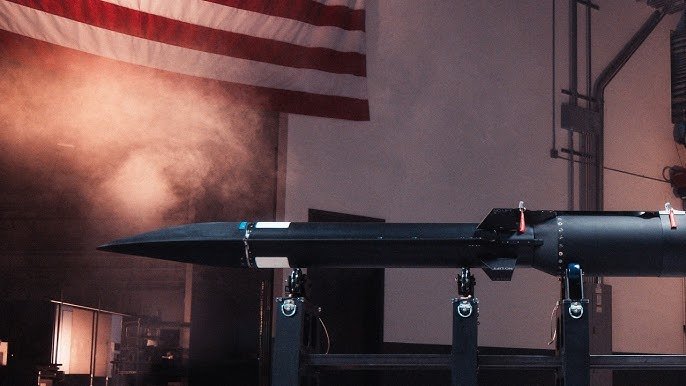
The US Navy is accelerating its hypersonic warfare capabilities with a paradigm-shifting weapon, the “Blackbeard” missile, which is being hailed as a faster, cheaper, and deadlier gamechanger that could redefine the economics of modern combat. Developed by the California-based defense startup Castelion—a company founded by former SpaceX employees in 2022—Blackbeard represents a radical departure from traditional, exorbitantly expensive strategic weapons . The core philosophy behind the program is “affordable mass,” aiming to transform hypersonic missiles from scarce, high-value assets into regular, high-volume battlefield ordnance that can be used without the crippling cost constraints of current systems . This strategic shift is being backed by significant financial commitment; in just a year, the Navy and other defense agencies have awarded Castelion contracts and orders totaling nearly $280 million, including a recent $90 million firm-fixed-price order to push the system to Early Operational Capability and a $105 million contract for integration onto the F/A-18E/F Super Hornet, with additional funds for pre-production prototypes .
The Blackbeard missile’s design and performance specifications are tailored to this new doctrine of cost-effective mass production. It is a booster-glide hypersonic weapon, using a rocket motor to propel an unpowered glide vehicle to speeds exceeding Mach 5 (over 3,800 mph) . This provides it with the speed to penetrate advanced air defense systems and the maneuverability to engage time-sensitive or moving targets, making it lethal against high-value assets like armored vehicle clusters, missile batteries, and naval vessels . With a reported range of approximately 500 nautical miles (about 800 kilometers), it is designed to fill the crucial operational gap between traditional artillery and long-range strategic hypersonic systems, providing commanders with a powerful, responsive option for contested environments . Its integration is highly versatile, as it is engineered for multi-platform use, with the Navy focusing on air-launch capability from the F/A-18E/F Super Hornet, while the Army is pursuing integration with the M142 HIMARS and M270 rocket launcher systems, often fitting seamlessly into existing launch pods without major modifications to the platforms .
What truly makes Blackbeard a “gamechanger” is its unprecedented affordability, achieved through Castelion’s commercial, SpaceX-style approach of rapid iteration, frequent testing, and design for manufacture. The program is leveraging commercial-grade materials and efficient production techniques to achieve a unit cost drastically lower than any comparable U.S. weapon, with estimates ranging from under $500,000 per missile, compared to over $40 million for a single “Dark Eagle” hypersonic weapon or millions for the Precision Strike Missile (PrSM) . This cost revolution allows the U.S. to field them in large numbers, as evidenced by a 2026 Navy order for 50 pre-production prototypes and a Department of Defense framework agreement to purchase at least 500 missiles annually, with a five-year plan to potentially acquire over 12,000 of these weapons . To support this ambitious scale, Castelion has established a 1,000-acre manufacturing facility in New Mexico, intended to be the nation’s largest hypersonic weapon production plant, capable of producing thousands of missiles per year . The weapon’s design is optimized for production, culminating in its final design being unveiled in August 2026, showcasing a clear path from development to deployment with a target of fielding the missile by 2027 or 2028 .
While the potential of Blackbeard is immense, it is not without challenges. Critics question the true extent of its maneuverability at hypersonic speeds, suggesting that its simpler booster-glide design may not match the advanced evasive capabilities of more complex, power-driven hypersonic cruise missiles or the sophisticated glide vehicles fielded by near-peer competitors like China’s DF-17 . The program is also a direct response to America’s perceived lag in the hypersonic arms race, representing a strategic push by the Pentagon to secure a massive numerical advantage by making the weapon a “consumable,” rather than just a precision tool . Nonetheless, the U.S. military is betting heavily on this strategy, with the 2027 fiscal year budget carving out nearly $500 million for these systems, underscoring the Pentagon’s confidence that Blackbeard will be a cornerstone of its future multi-domain operations . The “Blackbeard” missile is thus more than just a new weapon; it is the vanguard of a new military-industrial logic, aiming to overwhelm adversaries with sheer, affordable, and deadly quantity .