
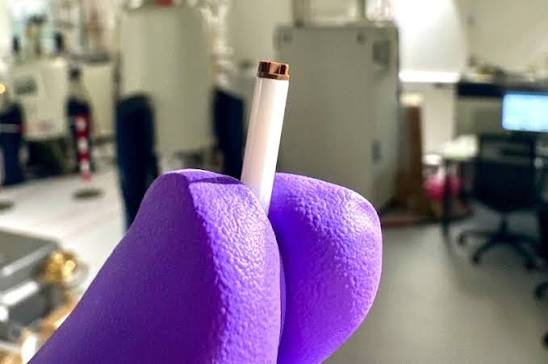
Scientists at the University of Birmingham have developed a groundbreaking “smart” gel that can switch between solid-like and liquid-like states when exposed to different external triggers, potentially revolutionising targeted drug delivery and ushering in a new era of responsive materials. The research, published in the Journal of the American Chemical Society, details the creation of the first multi-responsive gel built from “foldamers” — synthetic molecules that fold into defined shapes and can be assembled, disassembled, and reassembled on demand.
The new material behaves as a solid-like gel under normal conditions but transforms into a flowing, liquid-like state when exposed to ultraviolet (UV) light. Heating the material restores the gel structure, allowing the network to reform. Additionally, acid provides a separate mechanism for breaking down the molecular network, disrupting the connections between the foldamers and the palladium ions that hold the structure together. This ability to programme multiple independent responses into a single material represents a significant advance in materials science.
How the Smart Gel Works at the Molecular Level
At the heart of this innovation is a sophisticated molecular architecture. Helical foldamer molecules are joined by palladium ions, which act as four-way molecular connectors. Together, these components form an extended network that traps liquid within its structure, giving the material its characteristic gel-like properties. When UV light reaches the material, light-sensitive units within the foldamers change shape. Although this transformation occurs at the scale of individual molecules, its effects are amplified across the entire network until the gel loses its solid-like structure and begins to flow.
Dr Sarah Pike, who led the gel-design work at Birmingham’s School of Chemistry, explained: “A very small change in molecular shape translates into a visible change in the whole material — demonstrating how carefully designed molecular components can give us control over the behaviour of a bulk gel”. The research brought together expertise in designing new gels, supramolecular chemistry led by Dr Chiara Arno, and atomic-level structure characterisation led by Dr Dominik Kubicki.
Acid acts through a different mechanism than UV light, disrupting the connections between the foldamers and the palladium ions rather than changing molecular shape. This provides researchers with two chemically distinct routes to disassemble the material, offering greater flexibility for potential applications.
Hydrogel Conversion and Biomedical Potential
The researchers also successfully converted the material from an organic solvent-based gel into a water-containing hydrogel without disrupting its underlying molecular structure. This development is particularly significant for biomedical applications, as hydrogels are widely used in biotechnology and medicine because they can hold large amounts of water while maintaining structural integrity.
Dr Chiara Arno commented: “Supramolecular materials are assembled using reversible interactions rather than permanent chemical bonds. That gives us an opportunity to create materials that are robust under normal conditions but can be reorganised or dismantled when we apply the right signal”. She added that this represents a significant advance in building materials that behave more like biological systems by responding intelligently to their surroundings — for example, releasing drugs only when exposed to a specific trigger, such as changes in acidity within diseased tissue.
Advanced Imaging Reveals Atomic-Level Structure
To understand precisely how the gel is assembled, the research team employed dynamic nuclear polarisation-enhanced solid-state nuclear magnetic resonance spectroscopy (DNP NMR) to examine the material at an atomic level. This advanced technique dramatically accelerated the analysis: an experiment estimated to require approximately seven years using conventional NMR was completed in just 12 hours with DNP enhancement.
Dr Dominik Kubicki, who led the structural characterisation, explained: “Seeing a material change is only half the story. If we want to design better responsive gels, we need to know precisely how their molecular building blocks are connected. DNP NMR gave us that atomic-level picture in a material that is otherwise exceptionally difficult to study — allowing us to solve a major challenge in gel science”. The measurements revealed how palladium atoms connect the foldamer molecules to form the gel’s molecular backbone, providing crucial insights for future material design.
Future Applications and Research Significance
While the research remains at a fundamental stage, the ability to programme more than one response into the same material could ultimately inform the design of smart sensors, switchable catalysts, and materials that capture and release selected molecules on demand. Potential future applications include targeted drug delivery, controlled release of therapeutic molecules, biomedical materials, smart sensing systems, and catalysis and chemical manufacturing.
The research sits at the intersection of several globally important research areas including advanced materials, pharmaceutical sciences, and drug delivery. The work was supported by UKRI, the Engineering and Physical Sciences Research Council, the Biotechnology and Biological Sciences Research Council, the Royal Society, the Royal Society of Chemistry, the Leverhulme Trust, and European research programmes, with specialist low-temperature DNP NMR infrastructure accessed at the University of Gothenburg. This breakthrough highlights a growing direction in materials science: designing substances whose properties can be controlled through carefully selected molecular interactions, potentially leading to the next generation of intelligent materials.