
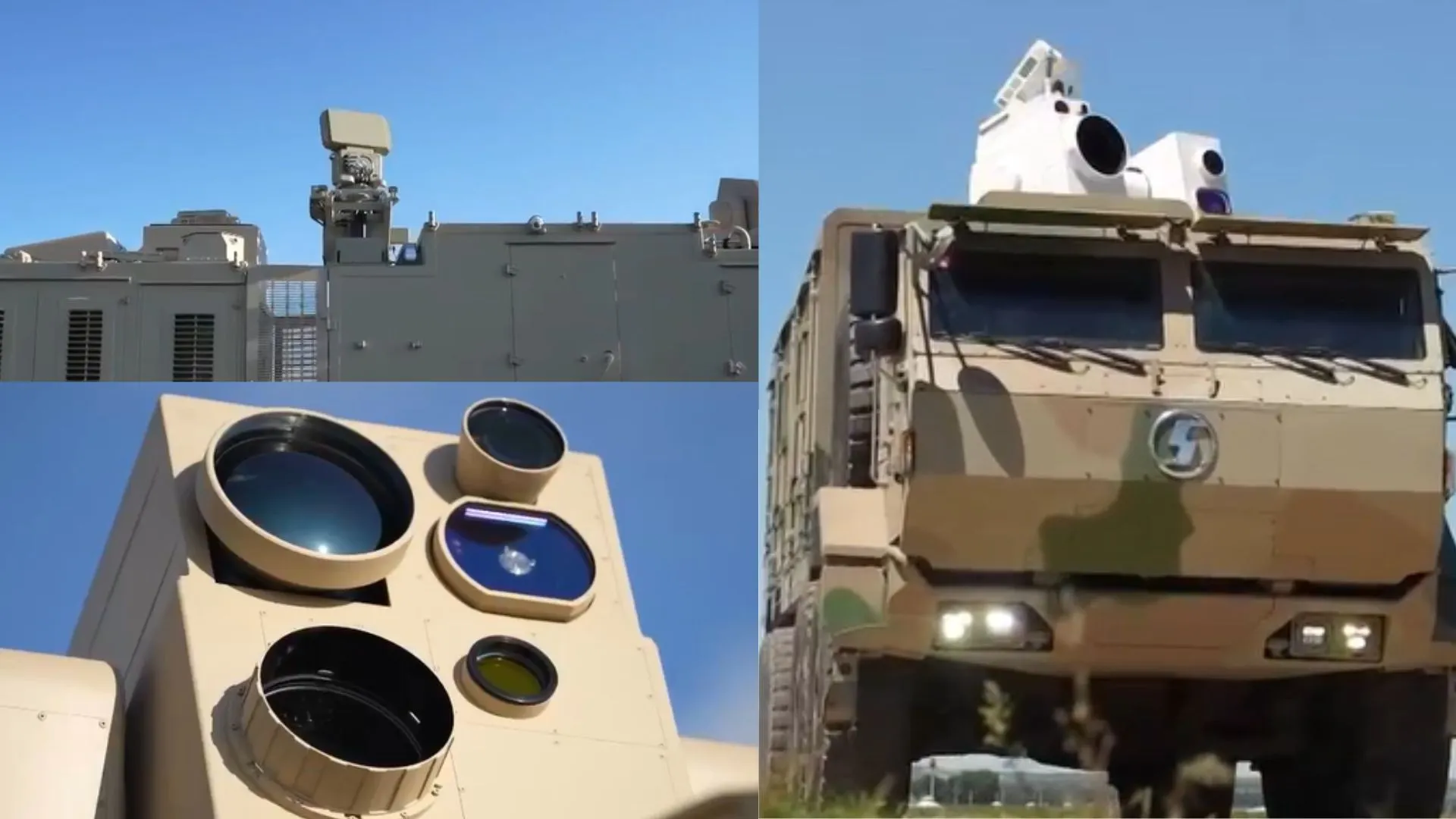
China’s new anti-drone laser weapon, a truck-mounted system officially designated the “Guangjian-21A,” represents a significant leap in directed-energy defense, offering a cost-effective, rapid-response solution to the proliferating threat of low-altitude drones in modern warfare. Unviled in official media reports and footage in March 2026, the system is part of the “Light Arrow” (Guangjian) series and marks the transition of laser weapons from experimental technology to deployable battlefield tools .
The Guangjian-21A is specifically designed to counter the “low, slow, and small” drones that have become ubiquitous in contemporary conflicts. These drones typically fly at altitudes between 50 and 80 meters, placing them in a detection blind spot for conventional radar systems, and often execute covert penetration missions that are difficult to intercept with traditional air defense measures . The system addresses this gap with a “shoot-on-the-move” capability, allowing it to maintain sustained firepower while remaining mobile to avoid being targeted by enemy countermeasures . At its core, the Guangjian-21A employs hard-kill laser technology, generating a high-density energy beam over several kilometers that can penetrate a drone’s outer shell and destroy its internal circuits or propulsion system within seconds .
The Guangjian-21A operates as part of a coordinated “soft and hard kill” system alongside its companion platform, the Guangjian-11E. While the 21A delivers physical destruction through laser ablation, the 11E functions as a multi-mode terminal jamming system that uses pulsed laser energy to instantaneously “blind” a drone’s optical sensors, severing its reconnaissance and data transmission capabilities without necessarily destroying the airframe . This complementary approach allows the paired systems to engage targets at different ranges and threat levels, covering each other’s operational gaps. Both platforms are equipped with phased-array radar and infrared detection systems, and can interconnect via wired and wireless links to share targeting data in real time, creating what developers describe as a “detect-to-destroy”闭环 (closed loop) when integrated with broader radar and electro-optical networks .
The strategic significance of these systems lies in their economic and operational advantages over traditional air defense methods. A primary driver behind global laser weapon development is the prohibitively high cost of intercepting cheap drones with expensive missiles—a dynamic that has been starkly demonstrated in recent conflicts where adversaries deploy swarms of low-cost unmanned systems . Laser weapons offer a near-infinite “magazine” and a cost-per-shot that is a fraction of traditional munitions, enabling sustained defense against saturation attacks. A related Chinese system, the commercially oriented NI-L3K developed by Hunan-based Novasky Technology, illustrates this cost asymmetry: its 3-kilowatt laser can destroy a drone for roughly $10 in electricity, compared to tens of thousands of dollars for a short-range air defense missile . The Guangjian-21A, as a military-grade system, likely delivers substantially higher power and range for frontline units protecting critical assets.
For modern warfare, the proliferation of mobile laser air defense represents a potential shift in the cost-exchange calculus that has favored offense in the drone era. Small drones have empowered even non-state actors with precision strike capabilities, and traditional defensive measures—from electronic jamming (defeated by fiber-optic-guided drones) to gun-based systems (limited by ammunition and reaction time)—have struggled to keep pace . Laser weapons offer speed-of-light engagement, precision, and deep magazines, making them uniquely suited to the terminal defense layer against drone swarms and loitering munitions. However, they are not without limitations: adverse weather such as rain, fog, dust, or smoke can severely degrade beam propagation, and power and thermal management constraints impose practical limits on sustained firing rates . The current generation of vehicle-mounted systems also faces trade-offs between power output, weight, and mobility.
China’s unveiling of the Guangjian series signals its intent to lead in this emerging domain, with experts positioning the country’s laser-based counter-drone technologies at the global forefront . The systems have already been deployed for security purposes during major events in Beijing, demonstrating operational maturity beyond laboratory testing . The Guangjian-21A thus embodies a broader trend in military affairs: the integration of directed-energy weapons into layered air defense architectures, where lasers complement—rather than replace—missiles and guns, providing a cost-effective answer to the proliferation of unmanned threats that increasingly define the modern battlefield.