
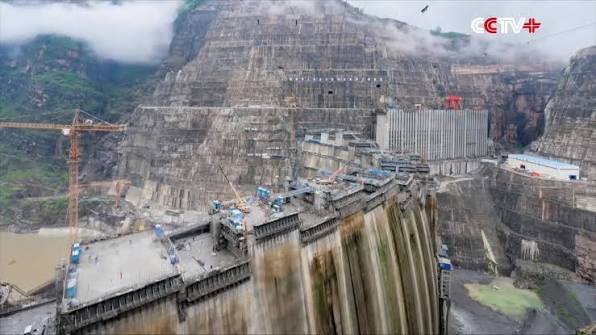
High in the mountainous terrain of Sichuan Province, China is making rapid progress on an extraordinary engineering marvel that is set to become the world’s tallest dam. The Shuangjiangkou Hydropower Station, situated in a narrow canyon along the upper reaches of the Dadu River, is designed to reach an astounding height of 315 metres (1,033 feet). Upon its full completion, this massive structure will surpass the current record holder, China’s 305-metre Jinping-I Dam, by 10 metres, establishing a new pinnacle for civil engineering and water infrastructure. Developed by state-owned energy giants at a cost of roughly 36 billion yuan ($4.9 billion), the mega-project represents China’s ambitious drive toward renewable energy expansion, flood mitigation, and technological leadership in mega-construction.
Building a record-breaking structure at an elevation of roughly 2,200 metres above sea level presents severe environmental and logistical challenges. The gorge experiences harsh alpine weather, with winter temperatures frequently plummeting to -20°C (-4°F). These extreme sub-zero conditions create a major bottleneck for the construction of the dam’s impervious clay core—the central watertight barrier essential for structural integrity. To achieve maximum density and stability, the clay material must be placed, layered, and compacted under carefully controlled temperatures. When the ground freezes, the soil hardens, making it nearly impossible to compress properly. Historically, such cold weather would force engineers to halt core construction for more than half the year, drastically extending project timelines.
To overcome this freezing environmental barrier, project engineers devised an ingenious, low-carbon solution: utilizing pure sunlight. Workers installed an array of 27 automated heliostats—large, sun-tracking mirrors—positioned along the slopes of the mountain valley. Guided by modern tracking technology, these 27 specialized mirrors follow the sun’s path across the sky, reflecting and concentrating solar thermal rays directly onto the clay core work surface below. By focusing intense solar radiation onto the targeted zone, the system raises the ground temperature by approximately 3°C. While a three-degree increase might seem modest, it is crucial in preventing soil frost, effectively granting engineers about three additional working hours per suitable winter day. This creative solar heating technique extends the annual construction window, keeping the site active through months that would otherwise be completely frozen.
Beyond its innovative solar-heating arrangement, the Shuangjiangkou project stands as a masterpiece of modern civil engineering. It is constructed as an ultra-high rockfill embankment dam with a clay core, requiring an astonishing 45 million cubic metres of rock and soil fill material. To handle the high altitude, steep terrain, and complex seismic zones, construction management incorporated 5G-enabled autonomous machinery, robotic compaction rollers, and AI surveillance drones. These automated systems collect real-time data on soil compaction, moisture, and structural alignment, maintaining strict quality standards across every layer of the dam.
The scale of power generation and water storage capacity at Shuangjiangkou is equally immense. The facility features four main Francis turbine-generator units rated at 500 megawatts each, giving the power plant a total installed capacity of 2,000 megawatts. Once fully operational, the station is projected to generate roughly 7.7 to 8.3 billion kilowatt-hours of clean electricity annually, supplying enough green energy to power over 3 million households. Additionally, its massive reservoir is engineered to store approximately 2.9 to 3.1 billion cubic metres of water. This immense storage volume acts as a vital regulatory buffer along the Dadu River basin, serving to mitigate downstream flooding during monsoon seasons, store emergency water reserves, and regulate flow to downstream hydroelectric stations.
The development of the mega-project has advanced through critical operational milestones. The reservoir began its initial water impoundment phase, marking the start of active water storage. Shortly thereafter, the facility achieved another major milestone as the first 500 MW generating unit was successfully connected to the power grid. The remaining generating units are scheduled to be commissioned in phases, with full commercial operation slated for completion. This simultaneous operational strategy allows engineers to produce clean grid power from completed infrastructure while continuing elevation work on the remaining height of the dam.
While celebrated as a triumph of Chinese engineering and green energy infrastructure, the Shuangjiangkou project has also sparked environmental discussions. Environmental researchers and conservation groups have pointed out potential impacts on the ecological balance of the Dadu River basin. Massive reservoirs can modify river flow dynamics, alter localized water temperatures, and disrupt sediment migration, which affects aquatic biodiversity downstream. In response, project managers implemented monitoring networks and environmental mitigation measures to minimize ecological disruption along the river.
Ultimately, the Shuangjiangkou Hydropower Station showcases how modern technological adaptation can overcome extreme physical environments. By pairing heavy earth-moving engineering with an unconventional array of 27 sun-tracking mirrors, China has successfully bypassed winter construction delays high in the mountains. The 315-metre structure not only pushes the boundary of dam construction heights but also serves as a critical asset in China’s long-term energy transition and flood management strategy.