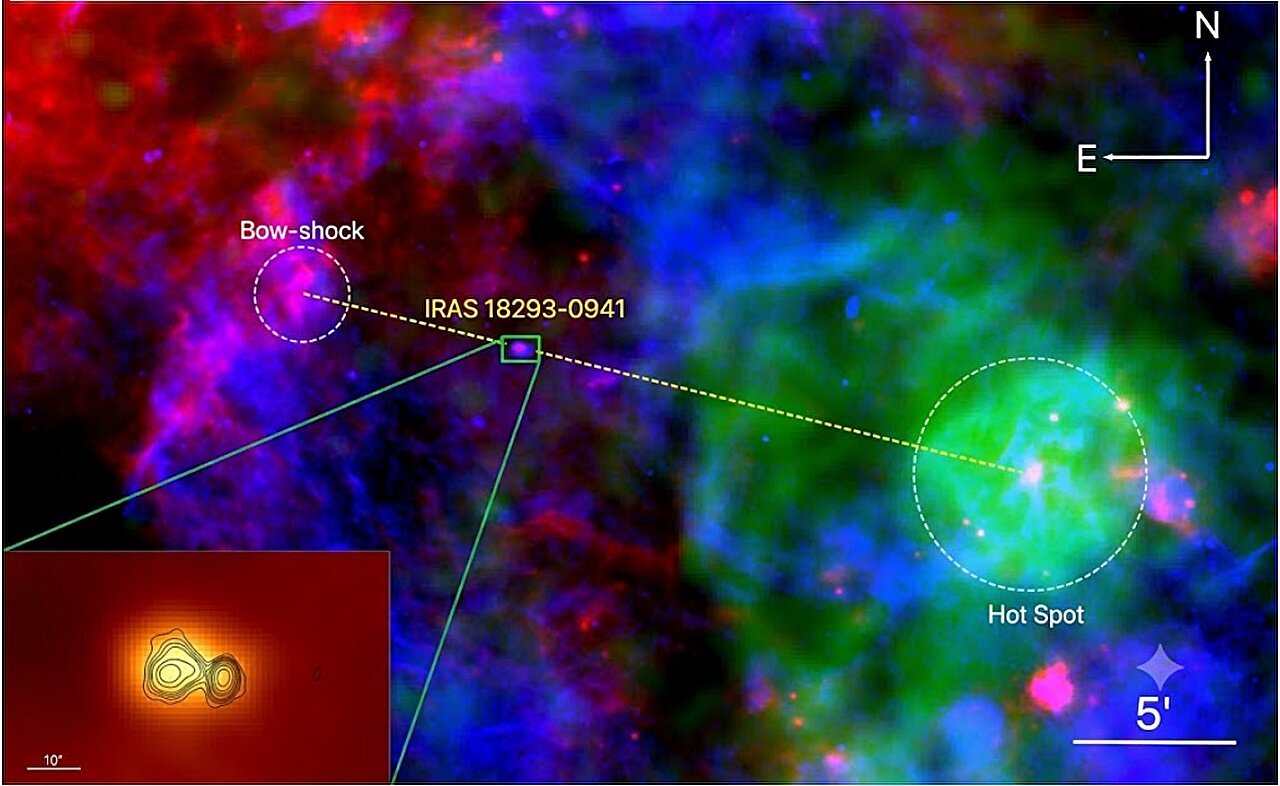
Astronomers have identified the first known “microblazar” in the Milky Way, a rare stellar-mass black hole system that is firing a jet of high-speed plasma almost directly at Earth. The discovery provides a unique nearby laboratory for studying the physics of particle acceleration and jet formation, which are otherwise only observable in distant galaxies. The system, designated IRAS 18293−0941, is located approximately 12,000 light-years away and was found after decades of being overlooked due to obscuring dust .
The discovery, led by researcher Josep Martí of the University of Jaén in Spain, centers on a black hole that is feeding on material stripped from a massive companion star. The two objects are locked in a tight orbit, completing a cycle every 11.4 Earth days. As material from the star falls toward the black hole, it forms an accretion disk. Some of this matter is channeled toward the black hole’s poles and then blasted outward as twin jets traveling at near light-speed. The system is classified as a “microquasar” because it is a scaled-down version of a quasar, which is powered by a supermassive black hole. In this case, the central engine is a stellar-mass black hole, likely only a few to a few hundred times the mass of the Sun, rather than the millions or billions of solar masses found in quasars .
What makes this system particularly notable is the orientation of its jets. Because one of the jets is pointed almost directly toward Earth, astronomers classify the object as a “microblazar.” This alignment explains why the system appeared as a bright, flickering source in earlier observations. The team first detected the system due to the flickering of its companion star’s light, which revealed the presence of the unseen black hole. Follow-up observations using the European VLBI Network (EVN) confirmed that the radio emission originated from the stellar system itself, not from a background galaxy, solidifying the discovery .
The high-speed jet from this black hole is not only a spectacle but also a powerful cosmic particle accelerator. The jet carries approximately 500,000 times the energy radiated by the Sun. As this jet plows into the surrounding interstellar gas and dust, it creates a massive bubble about 100 light-years wide. At the edge of this bubble, a “hotspot” forms where the collision accelerates particles to extreme energies. This region is the source of high-energy gamma-rays, with each photon carrying ten times the energy of particles accelerated by the Large Hadron Collider (LHC) on Earth. As team member Pedro Luque-Escamilla explained, the system elegantly separates the “accelerator engine” from the “target,” with the jet doing the accelerating and the surrounding cloud providing the material that shines .
This discovery is scientifically valuable because microquasars in our own galaxy allow astronomers to study the physics of black hole jets on human-observable timescales. In supermassive black holes, variations can take years or centuries, but in stellar-mass systems like IRAS 18293−0941, similar processes occur on timescales of hours or days. The proximity of this object, despite being hidden behind thick interstellar dust, offers a unique opportunity to understand how feeding black holes transfer energy to their surroundings and how they accelerate particles to such extreme energies . The research has been accepted for publication in the journal Astronomy & Astrophysics .