
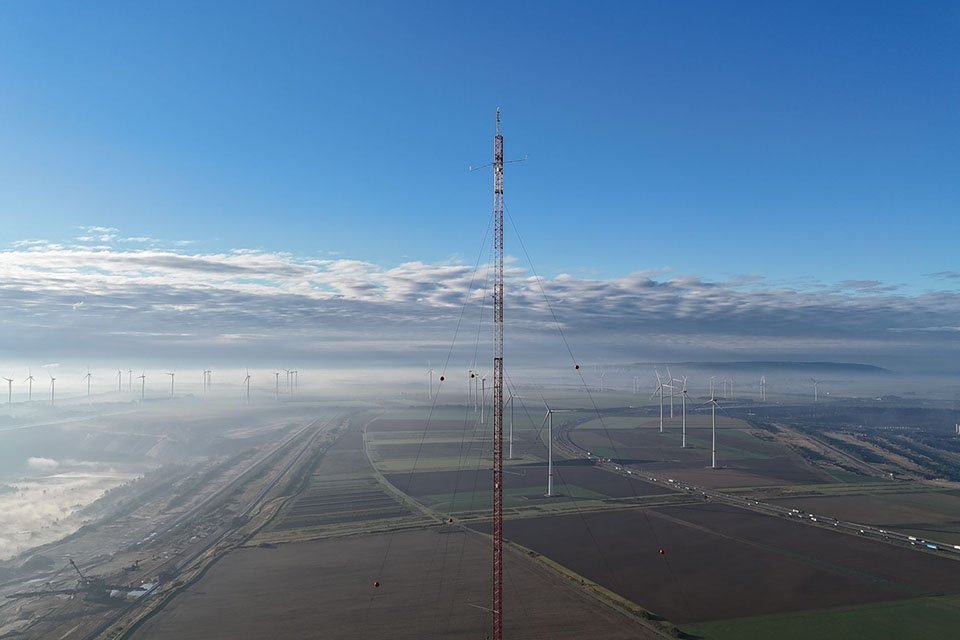
China has completed and put into operation the world’s tallest wind measurement tower, standing 360 meters tall, at an experimental wind farm in Mulei County, Xinjiang Uygur Autonomous Region. The tower, which surpasses any existing wind measurement structure globally, represents a significant leap forward in China’s capabilities for high-altitude wind observation and wind power technology validation.
The question of why such extreme height is necessary cuts to the heart of a fundamental shift in wind energy engineering. Modern wind turbines are becoming dramatically larger, with blades now exceeding 100 meters in length and hub heights climbing past 150 meters. To design these massive machines efficiently, engineers need precise data about wind conditions at the altitudes where the blades will actually operate. Wind speed, direction, shear, and turbulence intensity vary significantly with height, and relying on extrapolated data from lower measurement points introduces substantial uncertainty. A 360-meter tower allows for direct, gradient-based observation across the entire vertical span that a modern turbine rotor sweeps, providing the empirical foundation necessary for accurate aerodynamic modeling and structural load calculations.
The tower’s construction is closely tied to China’s broader renewable energy strategy. Located in Mulei County—which sits at the core of Xinjiang’s ten major wind zones and five major solar zones—the site was designated under the national 14th Five-Year Plan as part of a “desert, gobi, and wasteland” large-scale wind and photovoltaic base. The region has already established itself as a renewable energy hub, with Mulei becoming Xinjiang’s first county-level base to exceed 10 million kilowatts in both wind and solar capacity in 2025. The tower thus serves not merely as a standalone scientific instrument but as a critical validation platform within a broader industrial ecosystem.
Beyond supporting turbine design, the tower carries dual core value for China’s wind sector. First, it provides standardized validation conditions for cutting-edge measurement equipment operating at high altitudes, which is expected to drive quality upgrades across the domestic wind measurement equipment industry. Second, it enables full-gradient synchronous collection of high-altitude wind data, offering essential support for basic research into atmospheric boundary layer dynamics. When this observational data is fused with actual turbine operational data, it creates a feedback loop that directly informs the design of large-blade turbines and strengthens China’s ability to lead in setting international wind power technical standards.
Coinciding with the tower’s completion, the National Wind Power Standardization Technical Committee designated the site as a “Wind Power Standard Technical Validation Base”. This formal recognition underscores the facility’s role as a permanent infrastructure for testing new theories, models, and equipment against real-world conditions. The operator has already signed agreements with 11 wind measurement manufacturers and 6 universities, establishing a collaborative framework that integrates government, industry, academia, and research institutions. This open, shared research platform is designed to accelerate innovation across the entire wind power value chain—from resource assessment methodology to turbine component certification.
The strategic timing reflects China’s intensifying pursuit of its “dual carbon” goals: peaking carbon emissions before 2030 and achieving carbon neutrality before 2060. Wind power is a cornerstone of this transition, and improving the efficiency and reliability of turbines through better high-altitude data directly reduces the cost of renewable electricity. As of early 2025, Xinjiang alone had transmitted over 304 billion kilowatt-hours of renewable electricity to other regions, accounting for roughly 30 percent of its total outbound power supply. Enhancing the performance of wind assets in this base and others nationwide has measurable implications for the national grid’s carbon intensity.
In essence, the 360-meter tower answers a straightforward engineering dilemma: you cannot accurately design a machine that operates at 200 meters by measuring wind only at 100 meters. The tower’s height is dictated not by ambition but by the physical reality of modern turbine geometry. By building the world’s tallest wind measurement structure, China is securing the empirical data needed to transition its wind industry from scale-driven expansion to innovation-driven leadership, ensuring that the next generation of turbines is designed on the basis of direct observation rather than extrapolation.