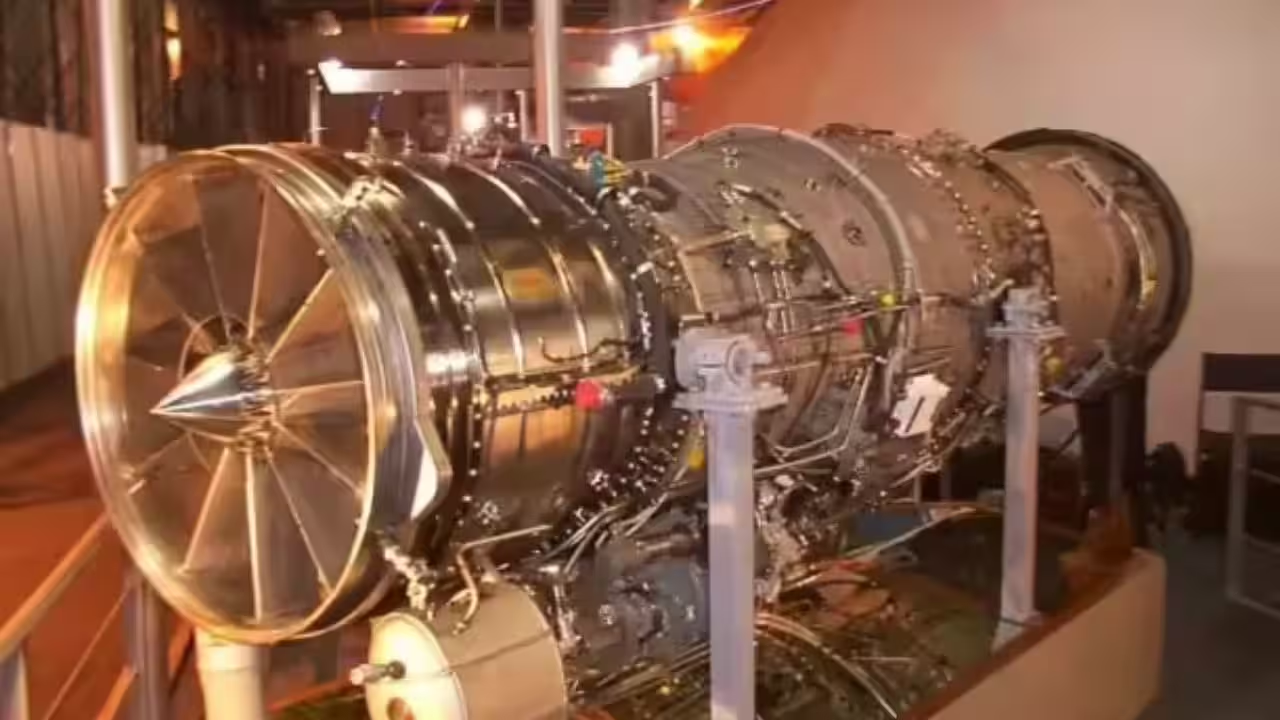
India’s Defence Research and Development Organisation (DRDO) has achieved a significant milestone with its indigenous Kaveri engine successfully completing critical trials in Russia, marking a major step forward for the country’s ambitious Ghatak stealth unmanned combat aerial vehicle (UCAV) programme. The trials, conducted in collaboration with a Russian testing facility, focused on validating the engine’s performance under conditions simulating the operational requirements of the stealth drone. This development is being seen as a breakthrough for India’s quest for self-reliance in critical aero-engine technology, a domain where the country has historically depended on foreign suppliers.
The Kaveri engine, originally conceived in the 1980s as a powerplant for the Tejas Light Combat Aircraft (LCA), faced years of technical challenges, particularly regarding thrust output and weight. The original Kaveri could not meet the Tejas’s requirements, leading DRDO to pursue the Kaveri Derivative Engine (KDE) and later the “Kaveri Dry” variant for unmanned platforms. The Ghatak UCAV, designed to be a stealthy, autonomous combat drone capable of penetrating contested airspace, requires a non-afterburning (dry) turbofan engine that balances thrust, fuel efficiency, and a low infrared signature. The Russian trials reportedly validated the Kaveri Dry engine’s altitude performance, endurance, and stability, which are essential for the Ghatak’s long-range stealth missions.
The Ghatak programme, formerly known as the Autonomous Unmanned Research Aircraft (AURA), aims to develop a flying-wing stealth drone capable of carrying precision-guided munitions, intelligence, surveillance, and reconnaissance (ISR) payloads. It is designed to operate in heavily defended airspace, neutralising enemy air defences and conducting deep-strike missions. The success of the Kaveri engine trials in Russia is therefore not just a propulsion milestone but a strategic enabler for the entire Ghatak ecosystem. Without a reliable, indigenous dry engine, India would have been forced to seek foreign powerplants, compromising the stealth characteristics and operational independence of the platform.
The trials in Russia were conducted at a high-altitude test facility, likely the Central Institute of Aviation Motors (CIAM) in Moscow, which has previously collaborated with DRDO on the Kaveri programme. The Russian facility offers simulated altitude conditions up to 15,000 metres, allowing engineers to assess engine behaviour in thin air, extreme cold, and varying speeds. According to sources, the Kaveri Dry engine demonstrated reliable restart capability, stable combustion, and thrust output within the desired parameters for the Ghatak’s expected mission profile. The engine’s dry thrust is estimated to be in the range of 48–52 kN, sufficient to power a subsonic stealth drone with a maximum take-off weight of around 15–20 tonnes.
One of the most important aspects of this development is the validation of the engine’s digital control system and indigenous materials. The Kaveri engine incorporates single-crystal turbine blades, nickel-based superalloys, and a full-authority digital engine control (FADEC) system developed by DRDO’s Gas Turbine Research Establishment (GTRE). These technologies are critical for achieving the high thrust-to-weight ratio and thermal efficiency needed for stealth operations. The Russian trials confirmed that the engine’s indigenous components can withstand the rigours of high-altitude, long-duration flight, reducing dependence on foreign critical technologies.
The success also has implications for India’s broader aerospace ambitions, including the Advanced Medium Combat Aircraft (AMCA) programme. While the AMCA will use a more powerful engine (currently planned as a joint venture with a foreign partner), the Kaveri programme’s spin-offs—such as the Kaveri Core—could serve as the basis for future indigenous engines. DRDO has already announced plans to develop a 110 kN engine for the AMCA based on the Kaveri core, and the Russian trials provide valuable data for that effort. Furthermore, the Ghatak UCAV is expected to be powered by two Kaveri Dry engines, giving it redundancy and sufficient thrust for carrier operations if a naval variant is pursued.
However, challenges remain. The Kaveri programme has historically suffered from delays, cost overruns, and technical shortfalls. The Russian trials, while successful, are only a step in the certification process. The engine must still undergo flight testing on a flying test bed (FTB), likely a modified IL-76 aircraft, before being integrated into the Ghatak prototype. DRDO plans to conduct these FTB trials in Russia or India within the next two years. Additionally, the Ghatak programme itself requires the development of stealth materials, autonomous flight control algorithms, internal weapons bays, and sensor fusion technologies, all of which are complex and time-consuming.
The geopolitical dimension is also noteworthy. The trials in Russia come amid Western sanctions on Russia and India’s delicate balancing act between its traditional Russian defence ties and its growing partnership with the United States and Europe. The fact that Russia allowed high-altitude testing of a sensitive military engine underscores the enduring trust in the India-Russia defence relationship. At the same time, India is pursuing co-development of engines with France (Safran) and the UK (Rolls-Royce) for other platforms, indicating a diversified approach.
In terms of timeline, DRDO hopes to fly the Ghatak demonstrator by 2027–2028, with production clearance possibly by the early 2030s. The Kaveri Dry engine’s successful Russian trials have reduced technical risk and boosted confidence within DRDO and the Indian Air Force. The Ghatak, once operational, will give India a credible stealth UCAV capability, joining a select club of nations—the US, China, Russia, and Europe—that are developing or fielding such systems. It will also complement the HAL CATS Warrior and other unmanned systems being developed for manned-unmanned teaming.