The pioneering study, published in the International Journal of Hydrogen Energy by researchers from ECU’s School of Engineering, offers critical insights into how geological processes can be harnessed to extract clean fuel straight from the ground. Traditional hydrogen production relies heavily on fossil-fuel-driven steam methane reforming (gray hydrogen) or energy-intensive water electrolysis (green hydrogen). In contrast, naturally generated hydrogen—often referred to as “white hydrogen” or “gold hydrogen”—is produced spontaneously underground through hydrothermal chemical reactions without human energy inputs. By identifying the precise chemical and geological conditions that stimulate this natural production, scientists hope to unlock subsurface reservoirs of naturally generated gas or even artificially stimulate depleted underground iron deposits to continuously manufacture clean fuel.
To understand how hydrogen forms naturally in deep crustal environments, the ECU research team simulated subsurface mantle conditions by submerging magnetite samples in pressurized water heated to 200 degrees Celsius for 60 days. Under these intense hydrothermal conditions, a geochemical oxidation process known as serpentinization occurs, where water molecules interact with iron-rich minerals, stripping oxygen atoms from the iron and releasing pure hydrogen gas as a byproduct. While researchers previously knew that iron minerals could trigger this reaction, the breakthrough experiment demonstrated that the physical architecture and surface area of the mineral dictate the volume of hydrogen released far more than the raw quantity of the mineral itself.
The dramatic difference in yield between powdered mineral forms and solid rock slabs highlights the critical role played by rock permeability and geological fractures. Because magnetite powder possesses an exponentially higher contact surface area and greater porosity, water penetrates the mineral far more effectively, sparking accelerated hydrothermal reactions. Conversely, solid rock slabs restrict fluid movement, causing reaction rates to stall as outer layers oxidize and prevent water from reaching internal magnetite pockets. This crucial insight proves that identifying promising white hydrogen reservoirs requires locating not just magnetite-dense formations, but highly fractured, permeable rock zones where water can flow freely.
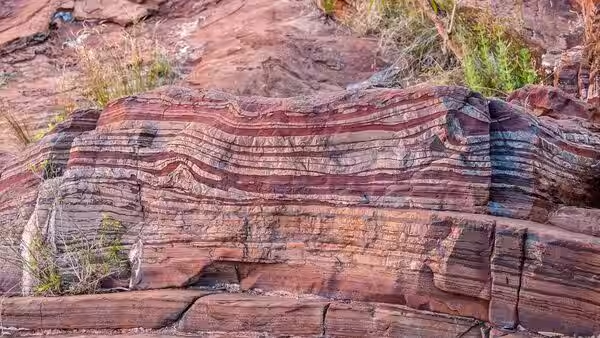
Western Australia provides an exceptional geographic setting for this renewable energy breakthrough because the region hosts some of the largest banded iron formations (BIFs) on Earth, containing billions of tons of ancient magnetite deposits. For decades, these vast reserves have made Australia a global powerhouse in iron ore mining, but this research suggests the very same geology could support an entirely new clean energy industry. If engineers can inject water into naturally fractured, deep-seated magnetite beds, they could potentially trigger controlled underground hydrogen generation, transforming static iron deposits into dynamic, self-replenishing clean energy generators.
The implications for global decarbonization and industrial energy transitions are profound. Hydrogen burns without emitting carbon dioxide, producing only water vapor, making it an essential fuel for decarbonizing heavy industries like steelmaking, shipping, aviation, and long-haul trucking. However, green hydrogen produced via renewable-powered electrolysis remains expensive to manufacture and transport. If subterranean natural hydrogen extraction proves commercially viable, it could lower production costs drastically compared to manufactured green hydrogen, providing a cheap, carbon-free energy source at a global scale.
Moving forward, researchers and energy companies are focusing on translation from laboratory simulations to real-world field exploration. The next phase of research involves mapping underground rock fractures and water flow systems across the Pilbara to locate high-potential natural hydrogen reservoirs. Scientists are also evaluating engineering methods—such as controlled hydraulic fracturing or targeted water injection—to optimize subsurface fluid pathways without disrupting surface ecosystems. By combining geochemical knowledge with modern reservoir engineering, Australia’s ancient red rocks could evolve from a world-leading source of raw iron into the epicenter of the global natural hydrogen revolution.