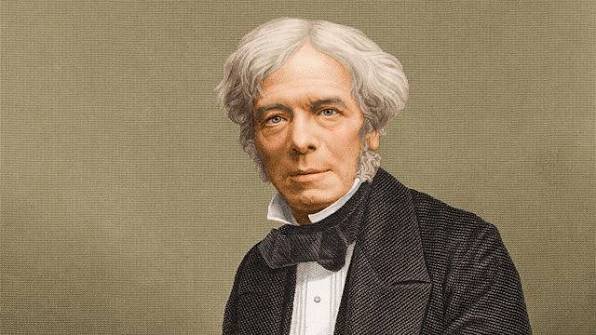
Michael Faraday was born on September 22, 1791, in Newington Butts, London, into a humble working-class family. His father, a blacksmith, suffered from chronic ill health, which left the family in severe financial hardship. Because of these impoverished circumstances, Faraday received only a rudimentary formal education consisting of basic reading, writing, and arithmetic. At the age of fourteen, Faraday was bound as an apprentice to a local London bookbinder and stationer, George Riebau. Over the course of his seven-year apprenticeship, Faraday developed an insatiable passion for learning. He spent his spare hours reading many of the books he was bound to bind, developing a profound fascination with natural philosophy, particularly chemistry and electricity.
A pivotal turning point in Faraday’s life occurred in 1812, when a client of the bookshop gifted him tickets to attend a series of chemistry lectures delivered by the eminent scientist Sir Humphry Davy at the Royal Institution. Mesmerized by Davy’s demonstrations, Faraday meticulously recorded detailed notes, bound them into a 300-page book, and sent them to Davy alongside a petition requesting employment in his laboratory. Although Davy initially lacked a vacancy, a laboratory accident shortly thereafter temporarily blinded Davy, prompting him to hire Faraday as his assistant. In 1813, Faraday was officially appointed Chemical Assistant at the Royal Institution, embarking on an extraordinary scientific journey that would span over five decades despite his lack of formal university training.
Throughout his mid-to-late career, Faraday served as the Director of the Laboratory at the Royal Institution and established the famous Christmas Lectures, designed to bring science to young audiences. Despite gaining worldwide renown, Faraday remained remarkably humble throughout his life. He consistently declined a knighthood, turned down the presidency of the Royal Society on two occasions, and refused to participate in the development of chemical weapons for the Crimean War on moral grounds. In his later years, Faraday suffered from severe memory loss, forcing him to gradually retire from active scientific research. He passed away peacefully at his home near Hampton Court on August 25, 1867, leaving behind one of the most transformative legacies in the history of science.
His Pioneering Contributions to Physics
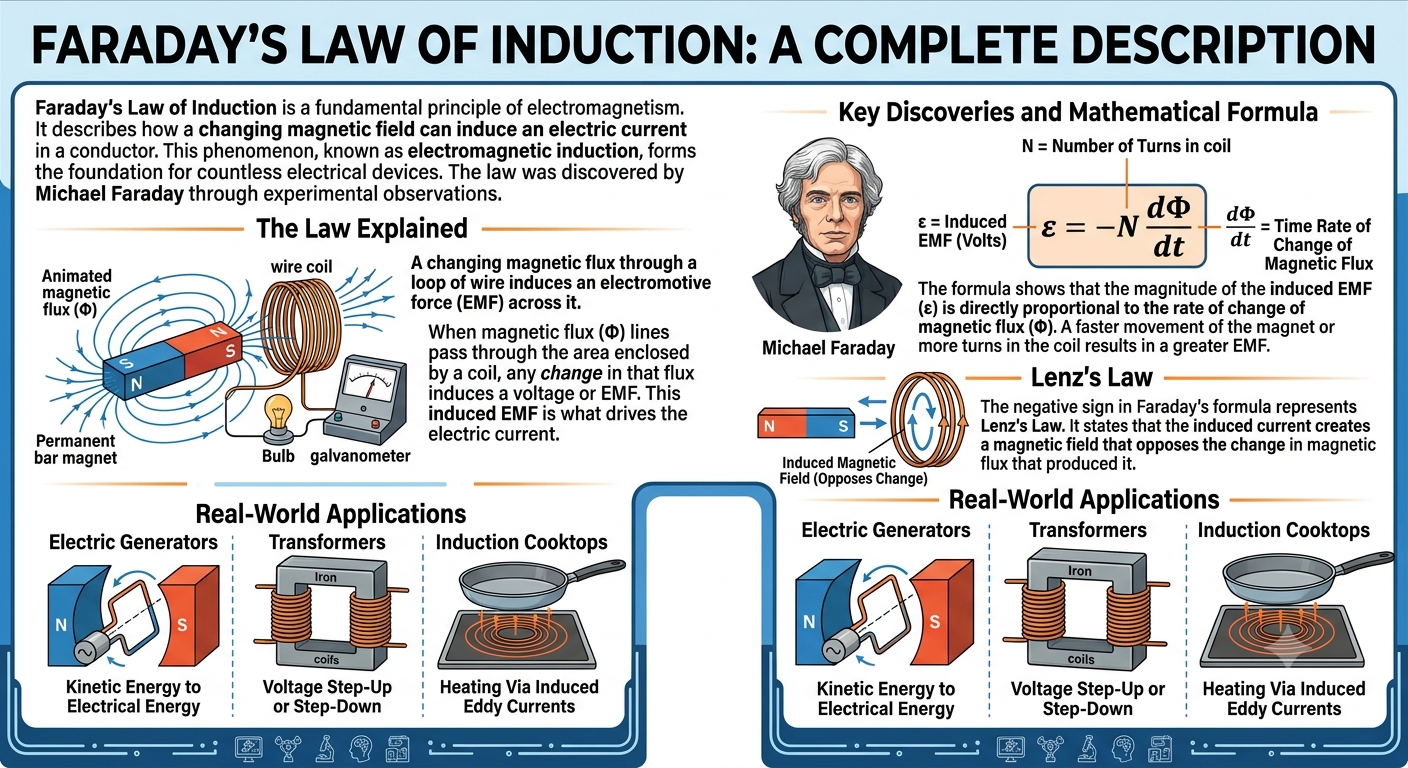
Michael Faraday’s contributions revolutionized the fundamental understanding of physical principles, transforming physics from a collection of isolated observations into a coherent field theory. His most celebrated breakthrough came in 1831 with the discovery of Electromagnetic Induction. Building upon Hans Christian Ørsted’s discovery that an electric current creates a magnetic field, Faraday reasoned that a magnetic field should likewise be capable of producing an electric current. Through a series of brilliant experiments involving moving bar magnets through wire coils and varying currents in adjacent circuits, Faraday demonstrated that a changing magnetic flux induces an electromotive force (EMF) in a conductor. Expressed mathematically as follows,
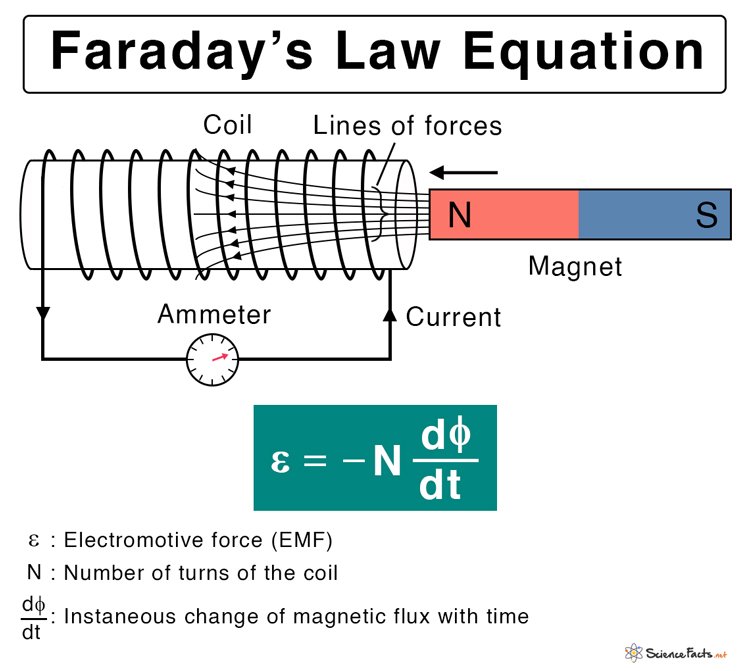
Faraday’s Law of Induction established that electricity and magnetism were inextricably linked, providing the theoretical blueprint for modern electric generators, transformers, and electric motors.
Faraday’s work in electromagnetism went far beyond induction; he was also instrumental in formulating the underlying physical concepts that unified field theories. Prior to Faraday, physical forces were predominantly conceptualized as direct action at a distance, akin to Newtonian gravity. Faraday challenged this paradigm by introducing the revolutionary concept of lines of force (or magnetic and electric fields), proposing that space itself is filled with invisible lines of tension through which magnetic and electrical interactions propagate. This mental framework directly laid the conceptual foundation for James Clerk Maxwell, who later formalized Faraday’s intuitive field lines into the famous Maxwell’s Equations, officially predicting electromagnetic radiation and light as an electromagnetic wave.
In addition to induction and fields, Faraday made ground-breaking contributions to electrostatics and dielectric physics. In 1836, he invented the Faraday Cage, demonstrating that electrical charges reside entirely on the exterior of a charged conductor and do not penetrate its interior. This discovery proved that an enclosure made of conductive material shields everything inside it from external static electric fields, a principle widely utilized today in surge protectors, microwave ovens, and aircraft safety. Furthermore, Faraday introduced fundamental terms that remain central to physics and chemistry today, including anode, cathode, electrode, ion, and dielectric constant, standardizing the vocabulary of electrical science.
Faraday also bridged the gap between optics and electromagnetism through his discovery of the Faraday Effect in 1845. He demonstrated that when plane-polarized light passes through a heavy glass material placed within a strong magnetic field, the plane of polarization of the light rotates. This was the very first experimental proof that light and magnetism are fundamentally connected, offering crucial evidence toward the electromagnetic theory of light. Shortly thereafter, Faraday discovered diamagnetism, revealing that all matter exhibits a response to magnetic fields, with certain materials being weakly repelled by both poles of a magnet.
Beyond physics, Faraday made landmark achievements in chemistry and electrochemistry. In 1825, he isolated and identified benzene, one of the most important organic compounds in modern chemical industries. He also formulated Faraday’s Laws of Electrolysis, establishing a direct quantitative relationship between the quantity of electricity passed through an electrolyte solution and the mass of chemical substance liberated at the electrodes. This work demonstrated for the first time that electricity was linked to atomic structure, anticipating the discovery of the electron by half a century. Through his relentless experimental rigor, intuitive insight, and physical vision, Michael Faraday laid the bedrock of modern electromagnetic technology and theoretical physics.