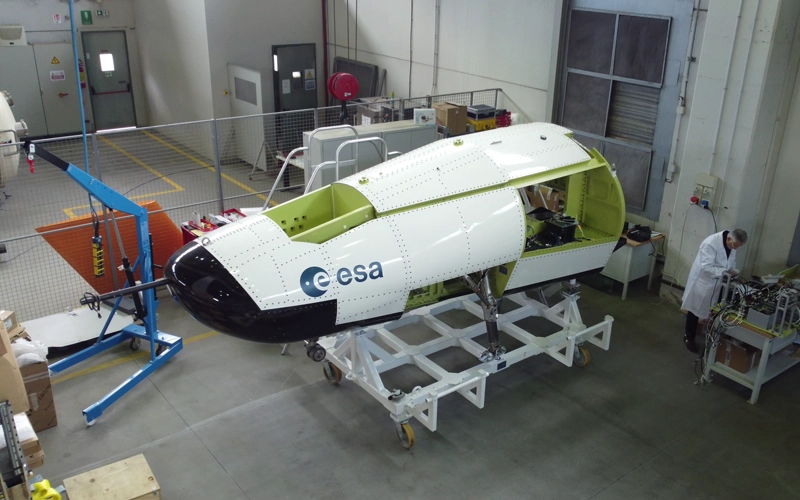
The European Space Agency (ESA) recently addressed a major setback in its reusable space transportation efforts following a critical drop-test failure. During a high-altitude atmospheric test conducted over the military test range in Sardinia, Italy, a full-scale test model of the Space Rider reusable spacecraft crashed into the ground and was destroyed after its main landing system failed. Despite the complete loss of the drop-test article, senior officials at the agency have downplayed the long-term impact of the mishap. Speaking at an official media briefing on October 22, 2026, Géraldine Naja, ESA’s Director of Space Transportation, framed the incident as a routine engineering obstacle inherent to complex aerospace development. She reassured the public and industry partners that the failure is not expected to derail the overall timeline or cause significant delays to the program’s debut orbital launch targeted for the late 2020s.
The flight test, which took place on October 6, 2026, was designed to evaluate the critical final phases of the spacecraft’s return sequence—specifically its autonomous guidance, descent, and landing procedures. Under the test plan, a helicopter carried the full-scale mock-up to an altitude of 3 kilometers (approximately 10,000 feet) before releasing it into freefall. Initially, the primary descent sequence initiated as expected, with the small drogue parachute deploying successfully to stabilize the craft and reduce its fall velocity. However, the failure occurred when the main steerable parafoil detached during deployment. Deprived of its primary mechanism for controlled aerodynamic braking and steering, the heavy prototype fell rapidly without sufficient decelerating force and shattered upon impact with the ground.
ESA quickly mobilized recovery operations to retrieve the shattered hardware from the Sardinian range to preserve evidence for analysis. An independent investigation board has been established to pinpoint the root cause of the structural or mechanical separation. At this stage, investigators have not determined whether the detachment resulted from a structural failure of the attachment points, an operational software anomaly, a mechanical latch malfunction, or an issue within the parachute canopy packing and deployment rigging. agency officials emphasized that preliminary findings do not point to a systemic design flaw in the spacecraft structure itself, but rather an issue specific to the detachment mechanism under load during deployment.
In downplaying the severity of the crash, ESA management highlighted the distinction between a representative drop-test article and actual orbital flight hardware. The destroyed model was an uncrewed atmospheric vehicle specifically manufactured to test the high-stress low-altitude descent phase. No orbital flight hardware, scientific payloads, or flight engines were involved or damaged in the mishap. ESA officials reiterated that the primary purpose of conducting full-scale physical drop tests—rather than relying solely on computer simulations—is to expose potential hardware vulnerabilities and fail safe in a controlled test environment before committing expensive, multi-million-euro operational assets to spaceflight.
The October drop test had already experienced prior logistical delays, having been postponed from an initial attempt in May 2026 when a ground-sensor anomaly caused engineers to abort the drop before the vehicle was released from the carrying helicopter. Following that early abort, testing was paused due to seasonal military range availability constraints between June and September. Despite these operational hurdles and the recent crash, ESA stressed that other major structural and thermal qualification milestones for the program remain entirely on track. For instance, earlier in the year, the high-temperature heat shield materials for Space Rider successfully passed extensive plasma wind tunnel tests at temperatures exceeding 1,600 degrees Celsius (2,900 degrees Fahrenheit), proving the heat shield can withstand the extreme thermal environment of orbital reentry.
The Space Rider program represents a cornerstone of Europe’s strategic ambition to establish independent, reusable space transportation and in-orbit manufacturing capabilities. Designed as an uncrewed, robotic laboratory, the unpressurized spaceplane is built to be launched atop a Vega-C rocket from Kourou, French Guiana. Once in low-Earth orbit, it is designed to operate as an automated platform for microgravity research, technology demonstrations, materials processing, and Earth observation for missions lasting upwards of two months. Upon completion of its orbital objectives, the spacecraft will perform a deorbit burn, navigate through atmospheric reentry protected by its thermal shields, and use its steerable parafoil to achieve a precise, soft touchdown on land—allowing the vehicle and its payload to be refurbished and reused for up to six subsequent flights.
While the destruction of the full-scale atmospheric model poses an undeniable engineering challenge, ESA maintains that such mishaps are part of the learning curve in developing reusable space systems. Industry leaders point to similar historical setbacks faced by commercial space operators during early parachute and landing recovery tests, which ultimately led to safer flight systems. The investigation board will continue analyzing the recovered debris and flight data logs over the coming months to identify the exact cause of the main parafoil separation. Once corrective actions and design modifications are implemented, ESA plans to resume atmospheric drop testing with a replacement model to fully qualify the landing sequence ahead of Space Rider’s targeted inaugural orbital mission later this decade.