
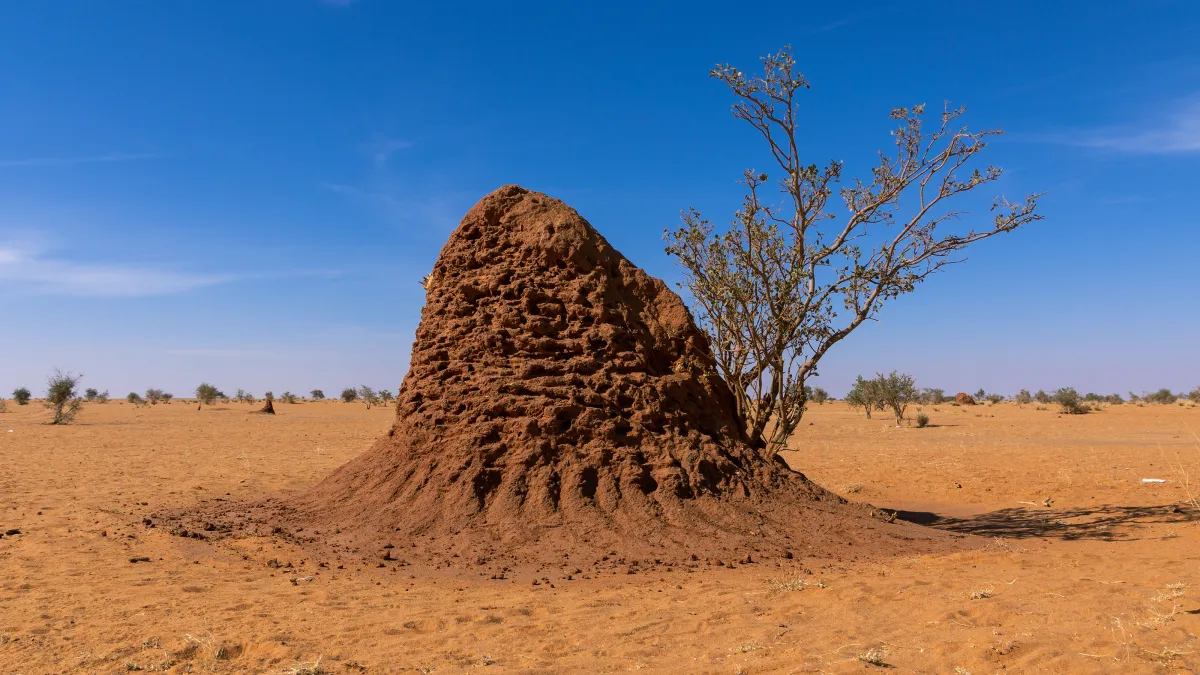
Across the vast expanses of peninsular and semi-arid India, where harsh summers bake the earth into cracked, impenetrable crusts, soil degradation remains an existential threat to agriculture and ecosystems alike. For generations, farmers and land managers have often viewed subterranean and mound-building insects with immediate suspicion, frequently categorizing them as destructive agricultural pests. However, modern ecological science is dramatically shifting this perspective, revealing that certain mound-building termites—most notably species belonging to the genus Odontotermes—act as vital ecosystem engineers. These insects do not merely inhabit the drylands; they actively heal them, constructing architectural marvels that serve as natural hydrological and biochemical restoration hubs beneath and above the surface.
To understand how these structures repair degraded terrain, scientists look beyond the visible tower and examine the termitosphere, a term describing the zone of influence that extends several meters outward from the mound wall itself. Within this expanded perimeter, the physical and chemical properties of the earth are profoundly altered. While the surrounding landscape suffers from severe compaction, erosion, and nutrient leaching, the soil influenced by termite activity demonstrates a remarkably enhanced structure and stability. The termites continuously excavate deep subterranean galleries, transporting fine-grained particles from lower horizons to the surface. This continuous burrowing creates a complex network of macropores that fundamentally transforms how the earth interacts with water, air, and organic life.
Water scarcity is the single greatest bottleneck for dryland agriculture in India, and it is precisely here that termite mounds perform their most critical hydrological function. During torrential monsoon downpours, hard, sun-baked earth typically repels water, leading to rapid surface runoff, severe soil erosion, and flash flooding. Mounds and their surrounding networks act as natural infiltration catalysts. The intricate system of vertical shafts and tunnels channels rainwater deep underground rather than letting it evaporate off the surface or wash away topsoil. Research indicates that the soil within and around these mounds possesses a significantly higher water-holding capacity and infiltration rate compared to adjacent barren ground. By trapping and storing moisture deep within the soil profile, these structures create localized oases of hydration that sustain surrounding flora long after the rains have ceased.
The architectural genius of the mound extends to its material composition, which is a meticulous mixture of soil particles, termite saliva, digested organic matter, and excreta. As the termites cement these components together, they create a durable matrix rich in clay and organic colloids. This biological cement alters the texture of sandy or heavily degraded soils, increasing their proportion of fine particles and boosting their overall cation exchange capacity. Consequently, essential plant nutrients such as calcium, magnesium, potassium, and available phosphorus accumulate in concentrations far exceeding those found in control soils. This localized nutrient hotspot provides a fertile foundation where pioneering vegetation can take root, initiating a natural cycle of ecological succession in otherwise barren terrain.
Beyond hydrology and chemistry, termite mounds are engines of soil aeration and structural aggradation. In dry Indian tracts, topsoil frequently develops a hard, crusty surface layer that suffocates plant roots and prevents seedlings from emerging. The relentless tunneling activity of termites physically breaks up this compaction, allowing oxygen to diffuse deep into the root zone and enabling plant roots to penetrate stubborn strata. As roots grow deeper through these loosened pathways, they leave behind organic residues when they die, further enriching the soil organic carbon pool. This biological feedback loop transforms dead, sterile earth into a living, breathing matrix capable of supporting complex microbial communities.
Microbial dynamics inside and around termite mounds reveal another layer of the hidden science. Studies consistently show that termite mound soil harbors a dramatically larger and more active microbial population, including specialized bacteria and fungi that produce a wide array of organic matter-degrading enzymes. These microbes accelerate the breakdown of sparse dryland leaf litter and organic debris, converting recalcitrant plant material into plant-available nutrients at an accelerated rate. The digestive tracts of termites act as biological bioreactors, pre-conditioning organic matter before it is deposited into the mound structure, thereby fast-tracking nutrient cycling in environments where decomposition would otherwise happen at a sluggish pace.
When ancient termite mounds eventually erode, weather away, or are deliberately leveled and integrated into agricultural plots by observant farmers, they do not lose their value. Instead, they act as slow-release fertility packets. The accumulated organic carbon, clay minerals, and concentrated nutrients are gradually distributed across the surrounding field during tillage or natural weathering, enriching impoverished plots over multiple growing seasons. Farmers who understand this dynamic recognize that spreading eroded termite mound soil across degraded patches of land can significantly boost crop yields without the immediate need for heavy synthetic chemical inputs, mimicking natural regenerative agriculture.
Of course, managing the relationship between termites and agriculture requires nuance and careful species identification. Not all termites are beneficial mound-builders, and some subterranean species can indeed pose serious threats to standing crops and wooden infrastructure. However, the dominant mound-building architects in semi-arid Indian landscapes provide an irreplaceable service that modern science is only beginning to fully appreciate. By functioning as natural pumps for water, sifters for nutrients, and architects of soil health, these insects offer profound lessons for combating desertification. Ultimately, termite mounds remind us that some of the most powerful tools for ecological restoration are already hard at work beneath our feet, quietly stitching broken landscapes back together grain by grain.