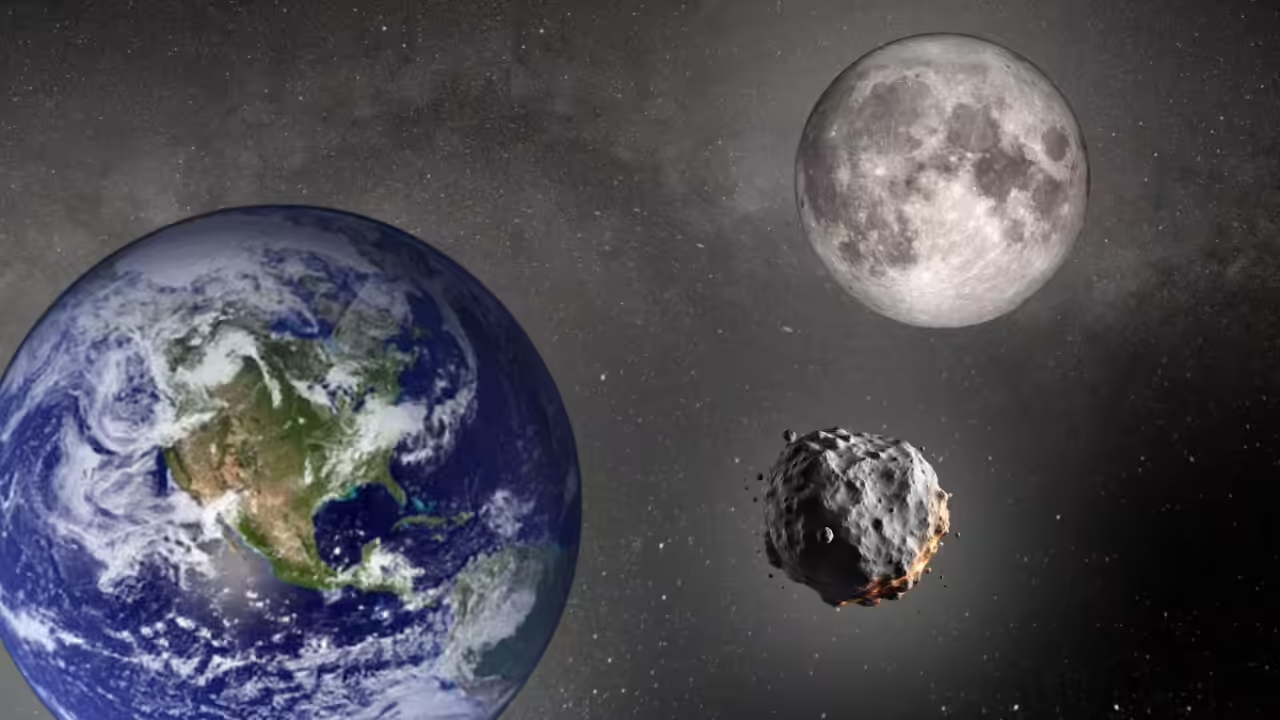
Earth has quietly acquired a fascinating temporary companion. Astronomers have confirmed that a tiny asteroid, officially designated as 2026 QQ8, has been captured by our planet’s gravitational field, effectively becoming a mini-moon. Unlike our permanent Moon, which has orbited Earth for billions of years, this newly discovered visitor is only staying for a fleeting cosmic visit. First entering Earth’s sphere of influence in late April 2026, the tiny space rock went unnoticed for months until it was finally spotted by noted Hungarian astronomer Krisztián Sárneczky on August 20, 2026. Following intensive tracking, the Minor Planet Center officially confirmed its natural origin, putting to rest initial debates over whether the object was a natural asteroid or simply a piece of discarded human-made space debris.
Measuring approximately one meter (about 3 feet) across—roughly the size of a washing machine—this diminutive asteroid poses zero threat to Earth. Even if its orbital mechanics were altered to send it plunging directly toward our planet, its microscopic dimensions mean it would instantly disintegrate into a harmless, fiery streak of light upon hitting the atmosphere. During its temporary residency, 2026 QQ8 maintains a safe distance, with its closest approach estimated at 0.0038 astronomical units (AU), which is roughly one and a half times the distance between Earth and our permanent Moon. Because it operates well beyond our immediate skies, it remains entirely invisible to the naked eye and can only be tracked using powerful professional telescopes.
The mechanics behind how 2026 QQ8 became our secondary moon involve a delicate balance of solar and terrestrial gravity. The asteroid crossed into Earth’s Hill sphere—the region surrounding a planet where its gravity exerts a stronger pull on orbiting bodies than the Sun does. Rather than locking into a clean, circular path like a manufactured satellite, the mini-moon follows a wide, looping, and kidney-shaped trajectory. Orbital modelers note that this erratic dance is characteristic of temporary captures. Having drifted close enough to be ensnared in April, the asteroid is expected to break free from Earth’s gravitational grasp by December 2026, after which it will resume an independent orbit around the Sun. Interestingly, archival trajectory data reveals that this is not the asteroid’s first brush with us; it passed reasonably close by in 1965 and is projected to make another similar close encounter around 2058.
Confirming that 2026 QQ8 was a natural rock rather than an old rocket booster or satellite fragment required rigorous international collaboration. Astronomers utilized advanced instruments, including the University of Hawaii’s 2.2-meter telescope and the Lowell Discovery Telescope, to analyze its spectral characteristics and motion. Discoveries like 2026 QQ8 add to a growing list of transient cosmic visitors—such as past mini-moons 2020 SO, 2020 CD3, and 2024 PT5—as well as long-term quasi-moons that travel alongside Earth. For scientists, these brief captures are a goldmine of opportunity, offering accessible natural laboratories to study near-Earth object dynamics, asteroid compositions, and the subtle gravitational interactions shaping our solar system before these tiny wanderers return to deep space.