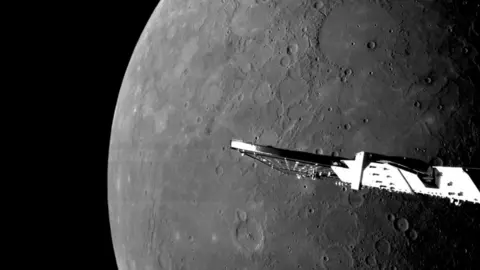
On November 21, 2026, the joint European Space Agency (ESA) and Japan Aerospace Exploration Agency (JAXA) mission BepiColombo achieved a historic milestone by entering orbit around Mercury, becoming captured by the innermost planet’s gravity more than eight years after launching from Earth on October 20, 2018. Named in honor of Italian mathematician and engineer Giuseppe “Bepi” Colombo, who helped make early Mercury exploration possible through orbital mechanics, the spacecraft has long stood as one of planetary science’s most demanding undertakings. Reaching Mercury is notoriously difficult because the planet sits deep within the Sun’s powerful gravitational well. Rather than speeding up as a spacecraft falls toward the Sun, a probe heading to Mercury must shed massive amounts of orbital energy so it does not whip past the planet at unmanageable speeds. BepiColombo’s capture marks the culmination of an arduous interplanetary cruise through the scorching inner Solar System and makes it only the second mission to enter orbit around Mercury, following NASA’s MESSENGER spacecraft, which orbited the planet from 2011 to 2015.
To slow down efficiently enough to be captured by Mercury, BepiColombo relied on a combination of solar electric propulsion and a complex series of nine gravity-assist flybys—one past Earth, two past Venus, and six past Mercury. Each planetary flyby gently bent the spacecraft’s path and shaved off excess orbital energy while preserving fuel. Along the way, the mission also had to overcome unexpected engineering hurdles. In April 2024, engineers detected unexpected electrical currents between the solar array and the power unit that reduced available thrust to roughly 90 percent of what was needed for the original arrival schedule. Rather than compromising the mission’s scientific goals, ESA’s flight dynamics team redesigned the trajectory, shifting orbital capture from December 2025 to November 21, 2026 while keeping baseline science intact. In June 2026, the electric thrusters completed their final thrust arc, and on September 3, 2026, the Mercury Transfer Module (MTM) separated from the spacecraft stack, handing arrival duties over to chemical propulsion as the craft approached Mercury.
When BepiColombo was captured into an initial elongated orbit on November 21, 2026, its two scientific orbiters—ESA’s Mercury Planetary Orbiter (MPO) and JAXA’s Mercury Magnetospheric Orbiter (Mio)—were still traveling together in a stacked configuration. This two-orbiter architecture is one of the mission’s defining strengths, giving researchers simultaneous measurements from complementary vantage points around the planet. Following orbital capture, the mission moves through a carefully choreographed arrival sequence: MPO and Mio are scheduled to separate between December 9 and 10, 2026, and the Mercury Magnetospheric Orbiter’s Sunshield and Interface Structure (MOSIF) is slated to separate from MPO around December 16, 2026. Each spacecraft will then maneuver into its designated operational orbit—with MPO targeting a lower orbit for detailed surface and interior study and Mio entering a wider polar orbit to sample the magnetic and plasma environment—before routine scientific operations begin in April 2027.
Once science observations begin, BepiColombo will focus on unraveling some of the deepest mysteries surrounding Mercury, the smallest planet in the Solar System and an extreme world shaped by intense solar radiation and proximity to the Sun. Despite its small size, Mercury possesses an unusually large iron-rich core, a weak intrinsic magnetic field, and a tenuous exosphere rather than a thick atmosphere. ESA’s MPO, carrying 11 science experiments, will examine Mercury’s surface composition, geology, impact craters, volcanic features, and internal structure to clarify how the planet formed and evolved. Early post-separation checks in September and October 2026 already showed promising instrument health, including first-light tests of the BELA laser altimeter, the MERTIS thermal and infrared spectrometer, and the SIMBIO-SYS imaging system.
Complementing MPO’s surface and interior focus, JAXA’s Mio, equipped with five instruments and designed to spin as it orbits, will investigate Mercury’s magnetic field, magnetosphere, and dynamic interaction with the solar wind. Because Mercury sits so close to the Sun, the solar wind slams into its magnetosphere with extraordinary force, creating a natural laboratory for studying star-planet plasma interactions that cannot be duplicated on Earth. Together, the two spacecraft will also probe permanently shadowed polar craters, where temperatures remain low enough to harbor water ice and other volatile materials despite scorching heat elsewhere on the planet.
Beyond answering questions specific to Mercury, BepiColombo’s arrival carries broader significance for comparative planetology and exoplanet science. Astronomers have discovered thousands of rocky exoplanets orbiting very close to their host stars, making a detailed understanding of how Mercury formed, lost or retained volatile elements, and generated its magnetic field essential for interpreting distant worlds. Surviving the brutal thermal swings and radiation environment of the inner Solar System for eight years to achieve gravitational capture at Mercury is a testament to international aerospace engineering across Europe and Japan. Now held in Mercury’s gravitational embrace, BepiColombo stands poised to deliver a transformative new chapter in our understanding of the innermost planet.