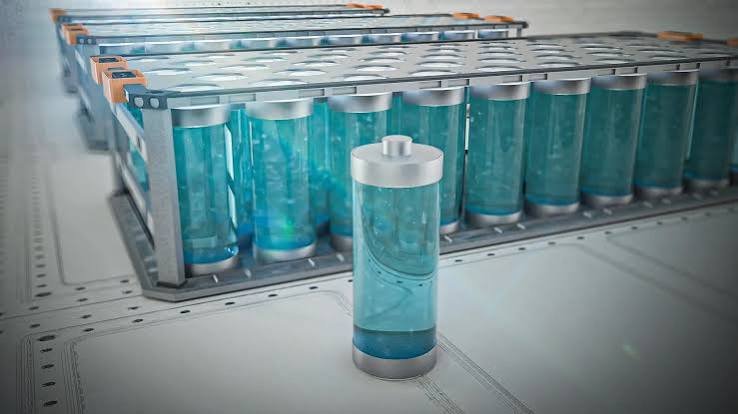
A research team led by scientists at University College London (UCL), published in Nature in November 2026 (with Dr. Ruwei Chen as first author and Professor Guanjie He as corresponding author, alongside collaborators including researchers from the University of Oxford), has introduced a new aqueous (water-based) battery chemistry that doubles the electron-transfer capacity of iodine from two electrons to four electrons, boosting energy-storage potential while avoiding the flammability risks and scarce-material supply pressures associated with conventional lithium-ion batteries.
Modern grid-scale energy storage and portable electronics rely heavily on lithium-ion batteries, which use organic liquid electrolytes that can pose fire hazards and depend on supply chains involving scarce elements such as cobalt, alongside mining-related environmental impacts. Water-based (aqueous) batteries have long appealed to researchers as a safer and more sustainable alternative because water is non-flammable and widely available, yet their relatively low energy density has restricted them largely to research settings. By increasing how much charge a given amount of active material can hold in water, the UCL-led breakthrough directly targets the core trade-off between safety and energy storage capacity.
At the center of the new battery design is iodine as the active energy-storing species. In traditional aqueous iodine batteries, each iodine reaction step transfers two electrons during charge and discharge cycles. The UCL-led team engineered a reaction pathway that enables iodine to participate in a four-electron transfer across reaction steps, effectively doubling the theoretical charge storage per iodine unit. Achieving that extra capacity involves generating and stabilizing hypervalent iodine cations, which are highly reactive species that tend to undergo unwanted side reactions in plain water.
Earlier attempts to suppress those undesirable side reactions relied on highly concentrated, halogen-containing electrolytes, which proved corrosive, expensive, and difficult to manufacture at scale. Instead of using aggressive, concentrated halide liquids, the UCL researchers developed a molecularly tailored aqueous electrolyte that shapes the local chemical environment around the iodine. Within this electrolyte, certain molecules block water from reaching the iodine to curb parasitic reactions, while other molecules bind to reactive iodine species to stabilize them and keep the redox reactions reversible as the cell charges and discharges. As Dr. Ruwei Chen noted in UCL’s announcement, making rechargeable iodine batteries practical requires not only stabilizing reactive intermediates but also understanding how those species interact with the water-based electrolyte—and how those interactions evolve—throughout repeated charging and discharging.
The team evaluated the chemistry across practical laboratory cell formats, including coin cells and pouch cells, and demonstrated strong cycling stability. In zinc-iodine batteries, the system retained nearly all of its storage capacity over thousands of charge-discharge cycles, showing that the four-electron reaction can remain reversible over extended use rather than rapidly degrading. Crucially, the researchers also indicated that the electrolyte strategy is not locked to a single anode pairing and can be adapted to aluminium-iodine batteries (including cells utilizing aluminium-zinc alloy anodes), pointing toward a broader design framework for safer aqueous energy storage.
Despite these promising laboratory results, the technology remains at the laboratory research stage rather than commercial deployment. As Professor Guanjie He and industry observers note, translating this chemistry into real-world grid storage or broader applications will require scaling up cell dimensions, testing under realistic operating conditions, suppressing iodine loss at high active-material loadings, and optimizing engineering parameters such as cell constraint pressure. Supported by a European Research Council (ERC) Starting Grant underwritten by UK Research and Innovation (UKRI), the study illustrates how fundamental electrolyte engineering can unlock higher energy density in water-based batteries without sacrificing safety.