April 14, 2026
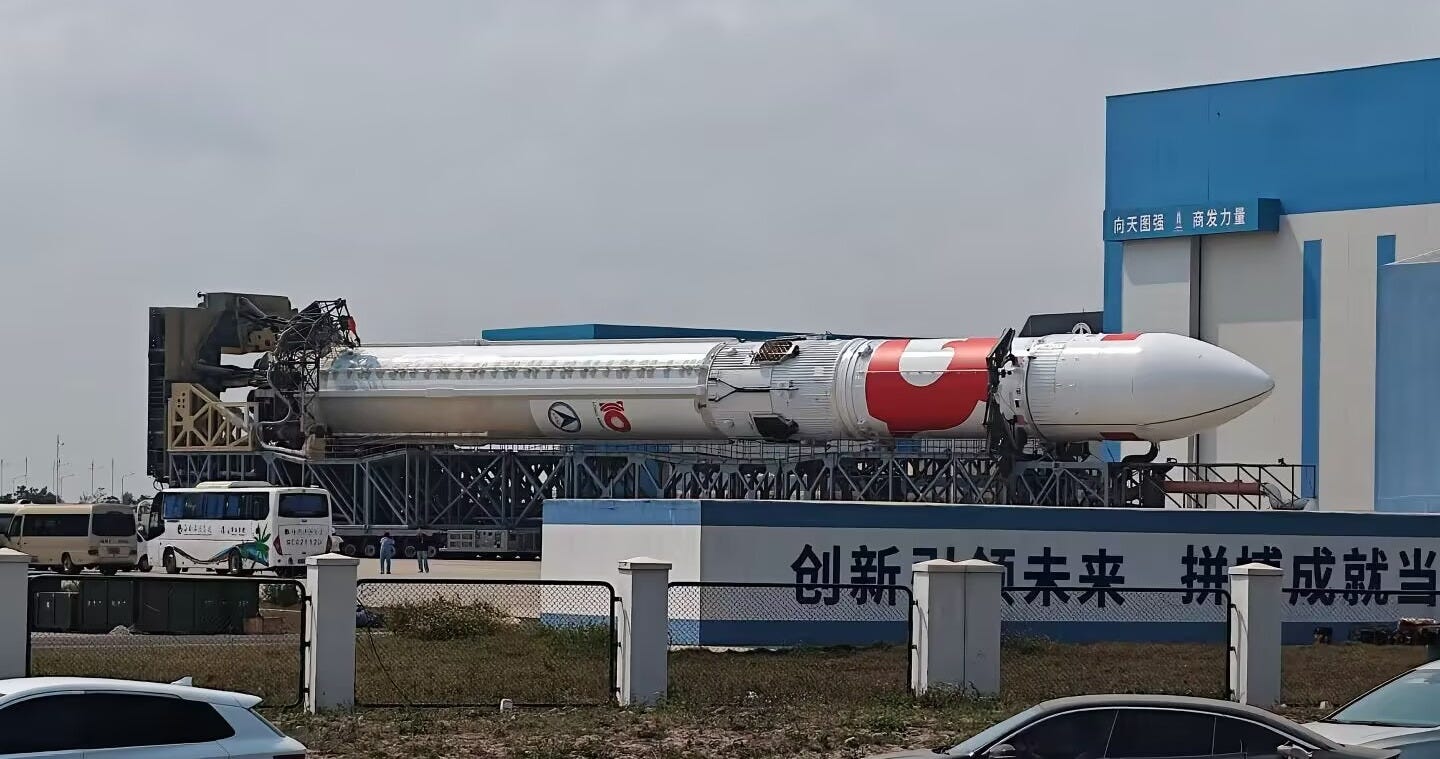
China appears to be on the verge of a historic milestone in spaceflight, with the first orbital launch of the reusable Long March 10B (Chang Zheng 10B) rocket potentially just weeks away following the successful completion of a critical fueling test over the weekend. Unofficial images and footage circulating on Chinese social media indicate that the 5.0-meter-diameter rocket underwent a comprehensive “wet dress rehearsal” at the Hainan Commercial Space Launch Site, adjacent to the national Wenchang spaceport on Hainan island. This complex operation, which involves rolling the rocket to the launch pad and fully loading it with propellant—in this case, kerosene and liquid oxygen—before safely draining the tanks, is the final major ground test before a launch campaign can begin.
While Chinese state media and the China Manned Space Agency (CMSA) have remained officially silent on the exact launch date, and airspace closure notices have yet to be published, industry experts agree that such a rehearsal typically places the launch window within the next two to four weeks. The Long March 10B is a cargo-optimized, single-stick variant of the larger Long March 10 rocket family, which is being developed by the China Academy of Launch Vehicle Technology (CALT) to facilitate China’s crewed lunar ambitions by 2030 as well as the construction of massive low Earth orbit megaconstellations. Unlike its crew-rated counterpart, the Long March 10A—designed to launch the “Mengzhou” (Dream Vessel) spacecraft—the 10B is tailored for logistics, specifically designed to carry heavy payloads of approximately 11,000 kilograms to a 900-kilometer-altitude orbit at a 50-degree inclination, a trajectory ideally suited for deploying the “Guowang” (National Network) megaconstellation.
The data gathered from this wet dress rehearsal builds directly on the momentum of a spectacular series of tests conducted earlier this year. On February 11, 2026, a single-stage test article of the Long March 10A successfully executed a low-altitude demonstration and verification flight from Wenchang, which included a maximum dynamic pressure (Max Q) abort test for the Mengzhou spacecraft. That mission was historically significant not only for the spacecraft’s escape system but because the first stage of the rocket went on to perform a controlled, powered descent using its YF-100K engines, culminating in a precise splashdown and successful maritime recovery near a waiting vessel. That recovery marked China’s first successful retrieval of a rocket booster from the sea, proving the viability of the net-catching recovery system that the 10B will attempt on a full orbital scale.
Zhu Pingping, head engineer at the China Aerospace Science and Technology Corporation (CASC), described the complexity of that February flight, stating: “To me, the challenges our rocket system faced in this test are unprecedented. The flight profile this time is the most complex we’ve ever attempted, and this marks the first time globally that so many test procedures have been combined into a single flight test.” Regarding the intense thermal and aerodynamic stresses experienced during the booster’s return, he added: “Although we call it low-altitude flight, the maximum dynamic pressure and maximum heat flux we experienced during the return were the highest in our country, the most challenging ever.”
The upcoming debut of the Long March 10B will represent a fundamental shift in China’s access to space. Historically, China has relied on expendable rockets, but the 10B is designed to be fully reusable, utilizing a unique recovery method that eschews the landing legs commonly used by vehicles like SpaceX’s Falcon 9 in favor of a ship-based net system. This approach allows the rocket to save mass on landing gear, potentially increasing payload capacity. Zhou Jianping, chief designer of China’s manned space program, highlighted the significance of the progress made in February, stating: “This was an extremely challenging flight test, both technically and methodologically. It also served as a strong validation of our testing approach and demonstrated China’s growing capabilities in space technology.”
The success of the 10B is also critical for the human-rated 10A; given their commonalities in the first stage design, a successful launch and recovery of the cargo variant will likely be required before the 10A is cleared to carry the Mengzhou spacecraft with astronauts. As of April 14, 2026, the rocket is in its final launch configuration at the Hainan Commercial Space Launch Site. While officials remain tight-lipped, the technical readiness is evident, and the space world is watching for the opening of a launch window that could see China become just the second nation to successfully recover an orbital-class rocket booster, solidifying its position in the new era of commercial and reusable space transportation.