July 20, 2026
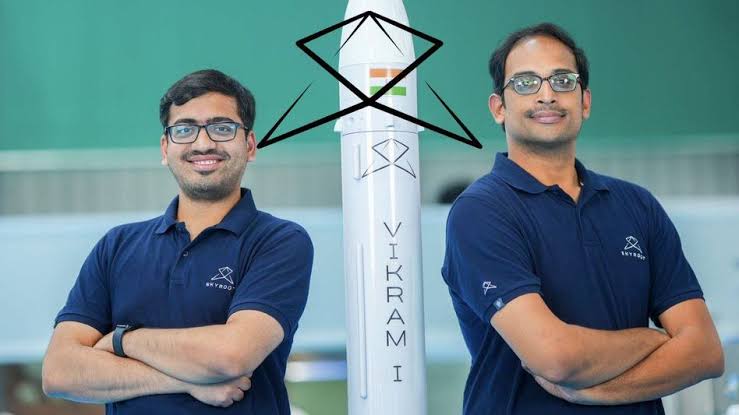
On July 18, 2026, India etched its name into the annals of space history, becoming only the third nation—after the United States and China—to possess a private orbital launch capability . This monumental achievement was realized by Skyroot Aerospace’s Vikram-1 rocket, which successfully completed its maiden flight, named Mission Aagaman, from the Satish Dhawan Space Centre at Sriharikota . While the event marked a giant leap for India’s burgeoning private space sector, it was also the culmination of a decade-long dream for two former Indian Space Research Organisation (ISRO) scientists: Pawan Kumar Chandana and Naga Bharath Daka. Their journey from government scientists to leaders of India’s first space-tech unicorn is a story of vision, resilience, and a deep-seated belief in the potential of India’s youth .
Chandana and Daka, both alumni of the prestigious Indian Institutes of Technology (IIT), began their careers within the hallowed halls of ISRO. Chandana, who earned his B.Tech and M.Tech from IIT Kharagpur, spent nearly six years at ISRO’s Vikram Sarabhai Space Centre, working on the prestigious GSLV Mk III, India’s heaviest launch vehicle, where his contributions earned him an internal innovation award . Daka, an IIT Madras alumnus with a master’s in Microelectronics and VLSI Design, contributed as an avionics engineer, designing critical modules for Indian launch vehicles . It was during their time at ISRO that they reportedly shared accommodation and a common dream: to make access to space as routine and affordable as commercial air travel . This vision propelled them to leave their secure government careers and found Skyroot Aerospace in Hyderabad in 2018, at a time when India’s private space sector lacked a clear policy, dedicated funding, and a ready talent pool .
The founders’ journey was perfectly synchronized with a transformative period in India’s space history. The government’s landmark decision in 2020 to open the space sector to private players provided the crucial regulatory framework and opportunity that Skyroot needed to flourish . They capitalized on this shift, achieving a series of firsts that built momentum toward the historic Vikram-1 launch. In 2020, they conducted India’s first static fire test of a privately built rocket engine, followed the next year by test-firing the country’s first privately built cryogenic engine . The real breakthrough came on November 18, 2022, when their Vikram-S rocket lifted off, becoming the first privately built rocket from India and South Asia to reach space, albeit on a suborbital trajectory . This mission, called Prarambh, was a critical proof of concept, demonstrating that a private Indian company could independently design, build, and launch a rocket from Indian soil .
Building on this success, the Vikram-1 mission was the ultimate test for Skyroot and its founders. Named after Dr. Vikram Sarabhai, the father of India’s space program, the seven-storey, multi-stage rocket was designed to carry satellites weighing up to 350 kilograms to low Earth orbit . Its architecture showcased India’s growing technological prowess, featuring an all-carbon composite structure and in-house developed propulsion systems, including 3D-printed engines . As the countdown began, it was momentarily paused due to a minor hiccup in the automatic launch sequence, but the issue was swiftly resolved and the rocket launched at 12:05 PM, a delay of about 35 minutes from its scheduled time . The rocket flawlessly injected its four technology demonstration payloads—which included a debris-clearing robotic arm and a satellite from a German hardware maker—into a 450 km orbit within 20 minutes, a feat that far exceeded the mission’s primary objective of simply clearing the launch tower .
The success of Mission Aagaman was met with celebration and accolades from across the nation, with Prime Minister Narendra Modi hailing it as “a defining moment in India’s space journey” . He personally called the Skyroot team, stating that their achievement had vindicated his government’s decision to open the sector to private players and that it proved the nation should “trust the youth” to do extraordinary work . For Chandana and Daka, the moment was the realization of a vision they had nurtured when the private space sector was just a nascent idea. “We have created a global milestone from India,” said an elated Chandana, adding, “I thought it wouldn’t be possible. A big shout out to the phenomenal team, whose average age is 28 years” . His co-founder, Daka, emphasized that the mission validated every key technology, including propulsion, avionics, and guidance systems, under real-world conditions, generating invaluable data for future commercial missions .
The successful launch has solidified Skyroot’s position as a pioneer in India’s space economy, which the government aims to grow from $8 billion to **$44 billion by 2032** . The company, which became India’s first space-tech unicorn in May 2026 after raising $60 million at a valuation of over USD 1.1 billion, is now at the forefront of this commercial revolution . The story of Pawan Chandana and Naga Bharath Daka is no longer just about two ex-ISRO scientists who built a company; it is a powerful narrative about the broader transformation of India’s space ecosystem. It signals that the country’s next giant leap may not only come from government laboratories but also from the entrepreneurial spirit of a new generation of engineers. As Chandana himself puts it, the mission was proof that “India has the talent, the technology and the industrial strength to build launch vehicles that meet the world’s standards” .