
April 14, 2026
The Indian Space Research Organisation (ISRO) has marked a historic leap in its quest for human spaceflight by successfully conducting the second Integrated Air Drop Test (IADT-02) for the Gaganyaan mission. Executed on April 10, 2026, at the Satish Dhawan Space Centre (SDSC) in Sriharikota, this mission serves as a critical validation of the parachute-based deceleration system—the “safety net” that will ensure Indian astronauts return safely to Earth. This test follows the first IADT conducted in August 2025 and brings India significantly closer to its first uncrewed mission, G1, which is expected to launch later this year.
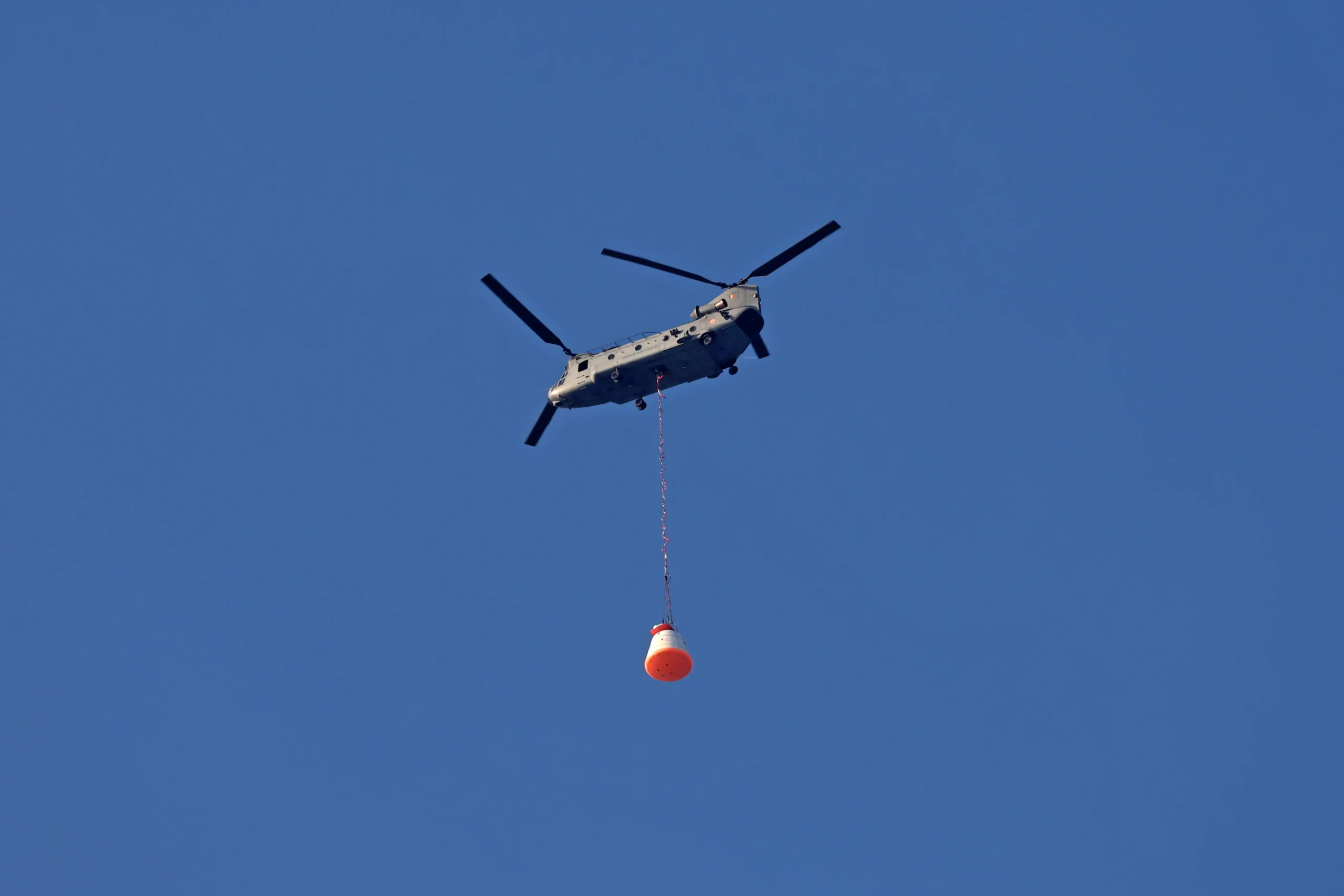
The high-stakes operation began when an Indian Air Force (IAF) Chinook helicopter lifted a 5.7-tonne simulated Crew Module to an altitude of approximately 3 kilometers. This specific weight was crucial, as it matches the actual mass of the crew module intended for the G1 uncrewed flight. Once the helicopter reached the designated drop zone over the Bay of Bengal, near the Sriharikota coast, the module was released into a free-fall. The primary objective was to test the complex sequence of ten parachutes of four different types, which must deploy in a precise, staggered order to reduce the module’s velocity from hundreds of kilometers per hour to a gentle splashdown speed.
Observers and scientists watched as the sequence unfolded flawlessly. The deployment included the Apex cover separation parachutes, followed by the drogue parachutes to stabilize the module, and finally the massive main parachutes that guided the 5.7-tonne structure to the water. The entire descent was monitored by ground stations and aerial platforms, confirming that the deceleration systems performed exactly as modeled. “This was important because we wanted to bring the module’s mass close to what would be used in the uncrewed missions. All parameters of the test were on expected lines, and we will now focus on other tests that need to be done,” stated VSSC Director A. Rajarajan, emphasizing the importance of mass accuracy in these trials.
Following the splashdown, the Indian Navy played a pivotal role in the recovery phase. Working in seamless coordination with ISRO, naval teams intercepted the module in the sea, demonstrating the robust recovery protocols required for a real-world mission. This inter-agency collaboration between ISRO, the IAF, the Indian Navy, and DRDO highlights the national scale of the Gaganyaan program. The successful retrieval of the module allows engineers to analyze the structural integrity of the capsule and the performance of the recovery hardware after impact.
The significance of the IADT-02 cannot be overstated. Unlike satellite launches, human spaceflight demands a “fail-safe” approach where every system has a redundant backup. The parachute system is one of the most complex mechanical components of the mission, as it must work perfectly every time to prevent a catastrophic landing. Union Minister Jitendra Singh lauded the achievement, stating, “Congratulations ISRO for the successful accomplishment of IADT-02 for Gaganyaan, India’s first human Space flight scheduled next year. This marks an important milestone towards the readiness for the Gaganyaan mission.” His statement reinforces the timeline that India is looking toward a 2027 crewed launch, with uncrewed trials serving as the immediate bridge.
Reflecting on the technical hurdles overcome during this test, ISRO Chairperson Dr. V. Narayanan noted that while the team is moving swiftly, safety remains the absolute priority. “Human space flight mission operations are very very critical, like any other important mission. There are a lot of challenges… we have to do the human rating of the launch vehicle. There are a lot of new developments, including crew escape system, environmental control safety system, and interfacing the human being along with the machine and software,” he explained. The IADT-02 is just one piece of this “gamut of activities” that includes upcoming pad abort tests and the final human-rating of the LVM3 launch vehicle.
Looking ahead, ISRO is preparing for the G1 mission, the first of three planned uncrewed flights. These missions will test the Human-Rated Launch Vehicle (HLVM3), the orbital module’s performance in space, and the full re-entry and recovery cycle. The success of the April 10 test provides the definitive data needed to finalize the parachute configurations for these upcoming flights. With the Crew Escape System and Deceleration Systems now showing high reliability, the path is being paved for Indian “Gaganauts” to make their journey into orbit.