
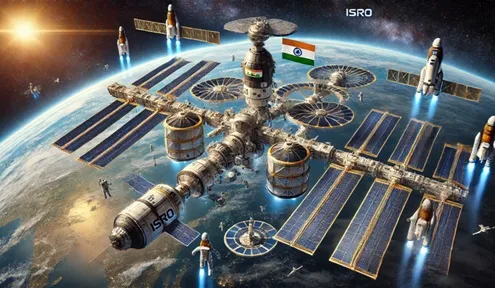
Based on the information provided to Parliament, the Indian Space Research Organisation (ISRO) has officially commenced the design phase for the subsystems of the proposed Bharatiya Antariksh Station (BAS), marking a pivotal shift from conceptualization to engineering reality. This update, which confirms that the nation’s premier space agency is actively working on the technological backbone of its indigenous space station, signals India’s intent to establish a sustained human presence in low Earth orbit.
The design phase encompasses critical life-support systems, environmental control mechanisms, and structural frameworks, representing a significant leap forward in the country’s technological capabilities. This development comes as a key milestone under the Gaganyaan program’s broader vision, which aims to not only demonstrate human spaceflight capability but also to create a long-term orbital platform for microgravity research and technology demonstration. The announcement underscores the government’s commitment to nurturing a robust space ecosystem, with the space station project being positioned as a cornerstone for future scientific and commercial activities in space.
The new information relayed to the lower house of Parliament suggests that while the overall architecture of the space station is still being finalized, the subsystem designs are being prioritized to ensure functionality and crew safety. These subsystems will likely include the regenerative life support systems necessary to recycle air and water, thermal control systems to manage the extreme temperatures of space, and power systems that will rely heavily on large solar arrays.
The design and development of docking mechanisms are also a critical component, as they will allow for the modular assembly of the station and facilitate crew and cargo transfers. This phase of the project is being undertaken with a clear focus on indigenous development, aiming to maximize the use of domestic manufacturing and technology. ISRO’s experience with the Gaganyaan crew module and the orbital module is expected to provide a foundational technology base, allowing for the adaptation and scaling up of existing systems for the more complex and long-duration requirements of a space station.
Regarding the timeline and operational framework, the government has indicated a phased approach to the station’s development, with the first module anticipated to be launched by 2028. The space station is envisioned to be a 20-tonne, five-module configuration, capable of hosting astronauts for extended missions of up to 15–20 days initially. This design phase is currently focused on ensuring that the subsystems are modular and interoperable, allowing for future upgrades and expansions as India’s space capabilities grow.
The subsystem designs are being subjected to rigorous testing and simulation to validate their performance under the harsh conditions of space, including radiation exposure and microgravity. This meticulous approach is designed to mitigate risks and ensure the reliability of the station, which will serve as a testbed for technologies essential for future interplanetary missions, including a potential crewed mission to the Moon.
The parliamentary response further emphasized the strategic and economic significance of the station, highlighting its role in fostering industry participation and creating high-value employment opportunities. The development of these subsystems is expected to be a major driver for technology transfer to the private sector, enhancing India’s footprint in the global space economy. The design work is being coordinated with various Indian academic institutions and industries, ensuring that the technological spin-offs benefit a wide range of sectors beyond space. As ISRO advances with the design of these critical subsystems, it not only consolidates India’s position as a major spacefaring nation but also lays the foundation for a sustainable human spaceflight program that promises to yield scientific dividends for decades to come.